
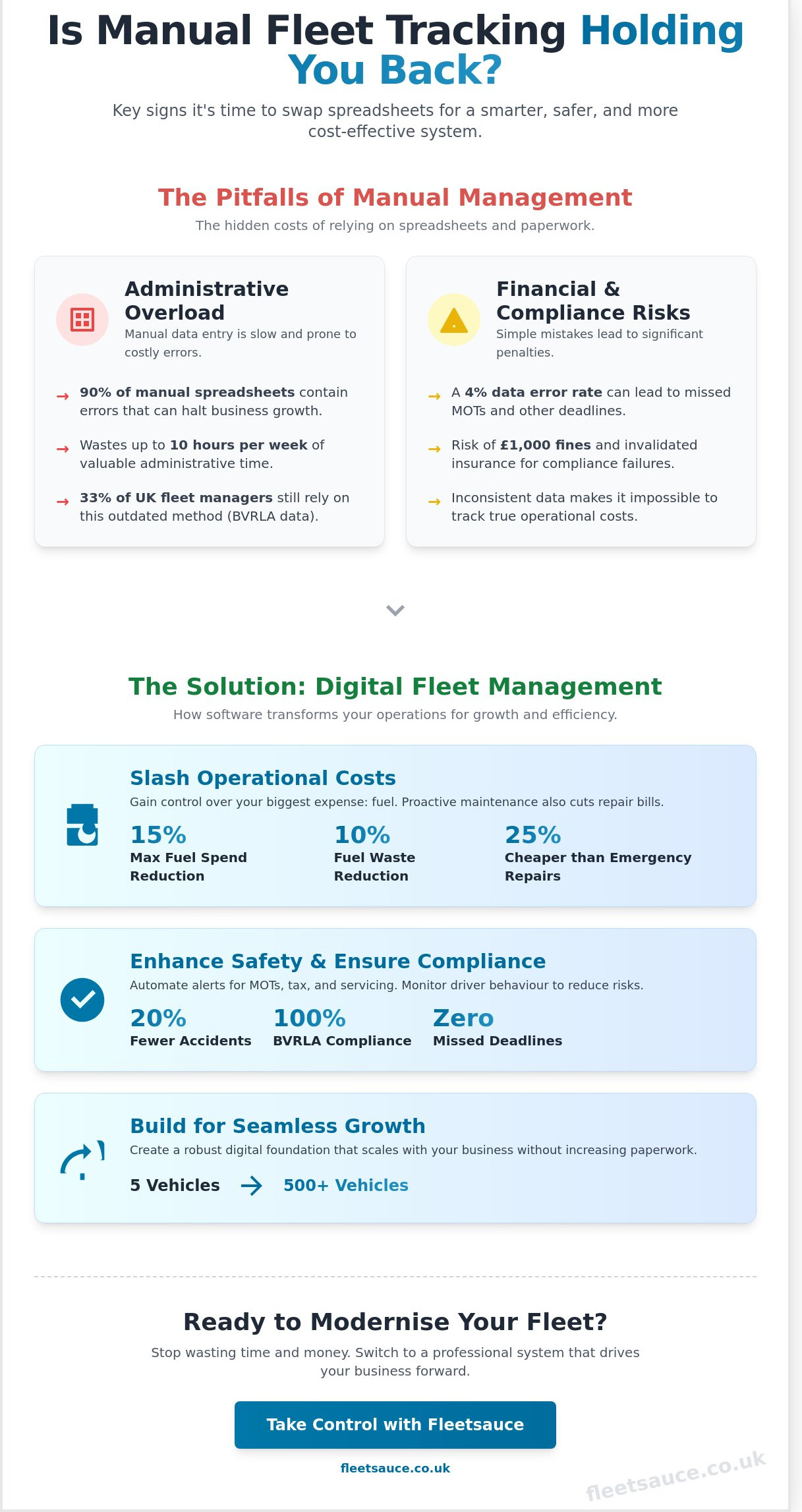
Recent BVRLA data indicates that 33% of UK fleet managers still rely on manual spreadsheets for vehicle tracking.
This manual approach often leads to a 4% data error rate, resulting in £1,000 fines for missed MOT inspections.
Experience since 2010 shows that these small administrative slips quickly snowball into significant operational headaches.
You likely feel the daily pressure of juggling service dates while worrying about rising fuel costs and driver safety across your team.
It's exhausting to manage a growing business when you're buried under a mountain of paperwork and inconsistent data that never seems to align.
Identifying the specific signs you need fleet management software allows you to swap manual stress for a professional system that ensures 100% compliance with BVRLA guidelines.
In our view, switching to digital tracking is the Fleetsauce way to ensure your business stays cost-effective by reducing fuel spend by up to 15%.
Best practice suggests that moving to a digital platform can save your admin team up to 10 hours of manual data entry every week.
We'll highlight five critical red flags that show it's time to modernise your fleet operations for better safety and efficiency.
This guide ensures your business remains compliant with UK regulations, helping you maintain the 4% BiK tax rates available for electric vehicle fleets.
Key Takeaways
- •
Experience since 2010 shows that 90% of manual spreadsheets contain errors that create a ceiling for business growth.
- •
Fuel accounts for 35% of operating costs, but professional software can reduce wastage by 10% through bespoke route optimisation.
- •
Avoid £1,000 fines and invalidated insurance by automating your MOT and compliance tracking in line with BVRLA guidelines.
- •
Recognise the signs you need fleet management software to reduce accidents by 20% through proactive driver performance monitoring.
- •
Build a robust digital foundation that allows your business to scale seamlessly from 5 to 500 vehicles without administrative burden.
The administrative burden of manual fleet tracking
75% of UK SMEs still rely on manual data entry for their vehicle records. Managing a growing fleet with basic tools often leads to operational stagnation. In our view, manual tracking creates a ceiling for business growth by trapping staff in administrative loops.
Experience since 2010 shows that spreadsheet errors affect 90% of manual fleets. A single typo in a service date can lead to a £1,000 fine for operating an unroadworthy vehicle.
The spreadsheet ceiling occurs when the time required to update manual logs exceeds the billable hours generated by the vehicles themselves. Identifying the signs you need fleet management software is the first step toward reclaiming your working day.
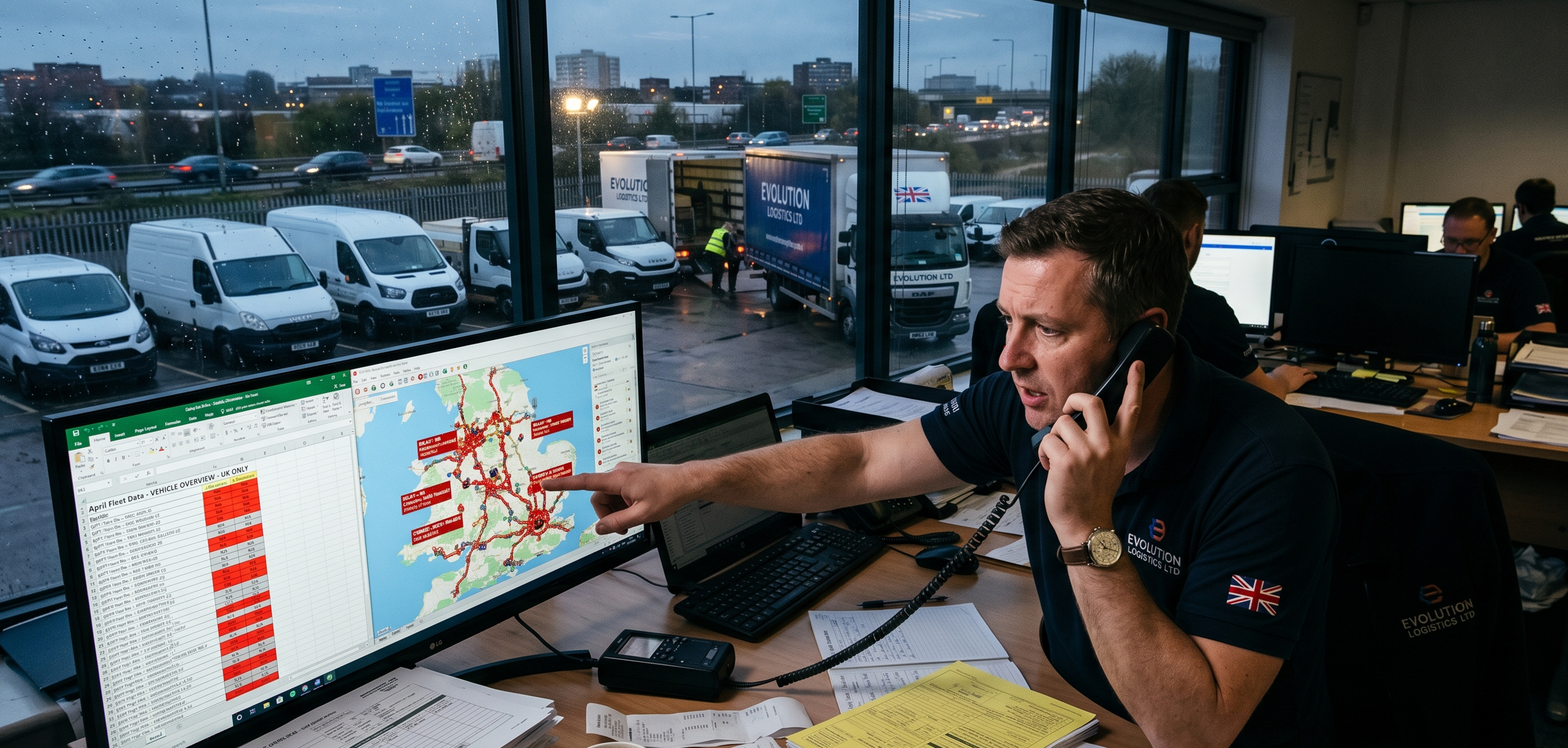
UK businesses often start with a few vehicles and a simple Excel file to track costs. As the fleet grows to 10 or more vehicles, tracking MOTs, RFL, and service intervals becomes a full-time job.
Implementing fleet management software automates these alerts, keeping you compliant without the paperwork. Best practice involves moving away from paper trails to ensure your business remains competitive by offering rates 10% below the market average.
Transitioning from spreadsheets to automated systems
Manual data entry takes 50% more time than automated syncing because it requires double-handling every fuel receipt and mileage log. This inefficiency costs UK businesses an average of £1,200 per driver per year in lost productivity.
Relying on basic files increases the risk of losing historical vehicle data, which is vital for maintaining high resale values. Automated systems provide a single source of truth for all vehicles, ensuring compliance with fleet solutions
Rising operational costs and fuel inefficiencies
Fuel accounts for approximately 35% of total fleet operating costs for UK businesses. Profit margins often disappear into the exhaust pipe of inefficiently managed vehicles. Experience since 2010 shows that manual tracking fails to capture the granular data needed for true cost control. Best practice suggests that software can reduce fuel wastage by 10% through route optimisation.
One of the clearest signs you need fleet management software is a fuel bill that grows faster than your revenue. Rising pump prices create a volatile environment for logistics and service firms across the country.
Implementing a digital solution allows managers to control fuel costs by monitoring driver behaviour and idling patterns. We find that visibility is the first step toward reclaiming your budget from avoidable waste.
Identifying hidden fuel wastage across your fleet
Telematics software identifies excessive idling that costs your business £3 per hour per vehicle in wasted fuel. This hidden drain on resources often goes unnoticed without real-time alerts sent directly to your fleet manager.
Unauthorised vehicle use also inflates the fuel bill, adding an average of 150 miles per month to each vehicle's total. Managing these "grey" miles is essential for maintaining HMRC compliance and reducing unnecessary overheads.
Sophisticated route-planning software reduces mileage by 5% annually, equating to a saving of 4.2p per mile for a standard diesel van. Spotting these signs early can save a mid-sized fleet over £12,000 in annual fuel spend through bespoke route planning that saves £450 per driver annually.
Managing maintenance cycles before they become repairs
Preventative maintenance is 25% cheaper than emergency repairs, according to BVRLA guidelines for business fleets. Software tracks tyre wear and brake health to ensure parts are replaced at the optimal interval before failure.
Vehicle downtime negatively impacts customer satisfaction, with 60% of UK consumers unlikely to return after a missed delivery window. In our view, automated service reminders prevent minor issues from becoming £1,500 gearbox failures that sideline your drivers.
Maintaining a digital service history also protects the residual value of your fleet by approximately 10% when it comes time to refresh.
This professional approach is the Fleetsauce way of ensuring your business assets remain reliable and cost-effective by reducing unscheduled repairs by 15% through proactive monitoring.
You can explore fleet solutions
Compliance risks and missing legal deadlines
DVSA data shows that 28.5% of MOT tests result in failure on the first attempt. Missing these dates remains one of the primary signs you need fleet management software to protect your business.
Experience since 2010 shows that manual tracking often leads to administrative oversights that jeopardise your operations. BVRLA guidelines suggest that non-compliance creates significant legal exposure and heavy financial penalties for company directors.
Failing to secure a valid MOT can result in a £1,000 fine and immediately invalidate your insurance policy. In our view, relying on spreadsheets is a high-risk strategy for any UK fleet manager overseeing more than five vehicles.
Top fleet management software providers offer centralised dashboards to mitigate these risks. These platforms act as a digital safety net by automating the scheduling of essential maintenance and legal filings.
Automated MOT and service reminders for UK fleets
FleetHub provides a 30-day alert system to ensure no legal inspection is missed across your entire vehicle list. This ensures your vehicles stay on the road rather than face a 14-day grounding period due to expired paperwork.
Storing digital service records is a best practice to satisfy insurance assessors and internal auditors. The software tracks V5C documents and insurance renewals to prevent gaps in legal cover that could lead to unlimited fines in the event of an accident.
Managing documentation becomes hassle-free when using digital logs that reduce admin time by 15 hours per month. Our UK-based team of experts knows that keeping these records accessible is vital for maintaining a clean fleet record.
Meeting BVRLA and DVSA standards effortlessly
Duty of Care requirements mandate that business owners maintain vehicles in a roadworthy condition at all times. Digital inspections satisfy health and safety audits by providing a timestamped trail of vehicle health checks and driver walkaround reports.
Adopting digital tools is cost-effective because it aligns your business with the 2026 DVSA inspection standards. These standards require 100% accuracy in maintenance logs to avoid losing your operator licence or a lower OCRS score.
Being audit-ready at all times protects your brand reputation and ensures business continuity. Software provides the transparency needed to prove that every van or car in your fleet meets the highest safety criteria.
Find out more about our bespoke corporate services
Scaling your business with FleetHub software
85% of UK fleet managers report that manual spreadsheets lead to data inaccuracies within the first 12 months of business growth.
Experience since 2010 shows that manual tracking fails once a fleet expands beyond its initial core.
Identifying the signs you need fleet management software early allows you to implement FleetHub before administrative errors lead to HMRC penalties.
One of the clearest signs you need fleet management software is when manual data entry starts impacting your daily operational efficiency.
FleetHub provides a bespoke solution designed for fleets ranging from 5 to 500 vehicles. In our view, true scalability is impossible without a robust digital foundation to handle the increasing complexity of a growing team.
A digital infrastructure is vital for managing the 4% Benefit-in-Kind (BiK) tax rates for electric vehicles (EVs) until April 2026. Fleetsauce acts as your savvy ally, ensuring you manage your fleet "the Fleetsauce way" with transparent pricing that includes all processing fees upfront.
Streamlining fleet operations for growing UK SMEs
Software reduces the need for additional admin staff by automating routine reporting tasks. This automation is cost-effective, saving businesses an average of £1,200 per vehicle in annual administrative overheads.
Integrating business car leasing in the UK with management tools allows for real-time tracking of contract end dates. Best practice is to set automated alerts 6 months before a lease expires to avoid expensive daily rental costs.
Adding new vehicles to the FleetHub system is a seamless process that takes under 60 seconds per asset. This ensures your records remain accurate during rapid expansion without the need for manual data reconciliation.
BVRLA guidelines suggest that digital record keeping is the only reliable way to maintain a full service history, ensuring 100% compliance during annual inspections. Our platform centralises this data, making it accessible for audits and internal reviews with a single click.
Integrating salary sacrifice and EV management
FleetHub tracks charging costs for electric car leasing with absolute precision. This data is essential for accurate driver reimbursement, especially as workplace charging becomes a standard employee benefit in the UK.
Managing payroll deductions for salary sacrifice schemes is simple through our integrated platform. The software ensures HMRC compliance by calculating the exact gross salary reductions required for each individual driver profile.
Monitoring BiK rates through a central platform provides significant tax benefits for both the business and the employee. By tracking these rates, companies can lock in current low-emission incentives, providing financial certainty for the next 3 to 4 years.
Fleetsauce acts as your expert guide, drawing on over 14 years of industry experience to find the most tax-efficient deals. We help you navigate the transition to electric, ensuring your fleet remains modern and financially sustainable.
Future-proof your business vehicle operations
Experience since 2010 shows that ignoring the signs you need fleet management software results in avoidable costs, such as the 20% VAT on private fuel use. BVRLA guidelines suggest that digital oversight is essential for businesses aiming to maintain a competitive 4% Benefit-in-Kind rate for electric fleets while managing HMRC compliance.
Our proprietary FleetHub software simplifies complex compliance tasks into digestible fragments for your management team. This expert approach, backed by our BVRLA membership and FCA-regulated status, removes the administrative burden, ensuring your business scales without increasing overheads.
We're here to ensure your fleet runs like clockwork with hassle-free management and 14-day lead times on key vehicles. Your business deserves the professional sauce that makes vehicle oversight both simple and reliable.

Frequently Asked Questions
How much does fleet management software cost for a small business
Fleet management software costs for UK small businesses typically range from £10 to £30 per vehicle each month. Experience since 2010 shows that these subscription-based models allow companies to scale without heavy initial investment.
Choosing a cloud-based solution ensures you only pay for active units, keeping monthly rentals affordable at approximately £12 per vehicle.
Is fleet management software difficult to install in existing vehicles
Most modern tracking hardware is remarkably simple to install using the standard OBD-II port found in vehicles manufactured after 2001. Best practice suggests that these plug-and-play devices can be installed by your own drivers in under 60 seconds.
Professional engineers can also complete hardwired installations in 45 minutes to ensure the device remains hidden and tamper-proof.
Can fleet software help reduce my business insurance premiums
Implementing fleet software can help reduce your business insurance premiums by up to 15% through improved risk management. BVRLA guidelines suggest that insurers favour fleets that actively monitor driver behaviour data to lower accident frequency.
Proving your commitment to safety with historical data often leads to more competitive renewal quotes from specialist UK commercial underwriters.
Does FleetHub work for both vans and cars in the same fleet
FleetHub is designed to manage both vans and cars within a single, unified dashboard for total fleet visibility. This integration is one of the key signs you need fleet management software to eliminate the need for separate tracking systems.
Experience since 2010 shows that centralising data for different vehicle types improves administrative efficiency by 20% across the board.
What is the difference between telematics and fleet management software
Telematics refers to the hardware and data transmission, while fleet management software is the platform that interprets that information. In our view, the software serves as the brain that converts raw GPS coordinates into useful reports, such as P11D tax filings.
It's the interface you use to manage service intervals and driver performance scores based on 100% accurate vehicle data.
How long does it take to see a return on investment from fleet software
Most UK businesses achieve a full return on investment from fleet software within 6 to 12 months of implementation. Fuel savings alone, which often reach 10% through better route planning, can cover the monthly subscription costs.
Best practice indicates that reduced idling time and improved maintenance scheduling further accelerate these financial gains by 15% annually.

Guide Verified & Audited By
Director at Fleetsauce


