Did you know that fleets now account for over 60% of all new electric vehicle registrations in the UK?
It is a staggering figure. Yet, many fleet managers still feel stuck when it comes to crunching the actual numbers.
You might worry about fluctuating energy prices or how last year's VED changes affect your long-term strategy. We understand that moving away from diesel feels like a leap of faith whilst the spreadsheets don't seem to align.
This guide simplifies calculating ROI on electric fleet vehicles by focusing on the specific financial levers available in 2026.
You will learn how to accurately measure the impact of the 4% Benefit-in-Kind rate and the potential for 100% first-year capital allowances.
We provide a clear framework to show that electric models reduce your total cost of ownership.
From workplace charging grants to the way salary sacrifice improves your bottom line, you'll gain the clarity needed to transition your fleet with total confidence.
Key Takeaways
- •
Learn why leasing is a smart move to avoid depreciation risks and how to balance energy costs across different charging types.
- •
Understand how the 4% BIK rate and salary sacrifice schemes provide significant tax relief for your business and employees.
- •
Master a step-by-step framework for calculating roi on electric fleet vehicles by comparing current ICE costs against real-world EV mileage forecasts.
- •
Discover how tools like FleetHub use telematics to track vehicle performance and identify ways to boost driver efficiency.
- •
See why 2026 is the ideal time to transition as emissions zones tighten and capital allowances for charging points remain available.
Table of Contents
- 01 Why calculating ROI on electric fleet vehicles matters for UK businesses in 2026 →
- 02 The five core components of electric vehicle total cost of ownership →
- 03 How tax incentives and salary sacrifice schemes improve your return →
- 04 A practical framework to calculate your fleet transition savings →
- 05 Scaling your electric fleet with Fleetsauce and FleetHub technology →
To get a bespoke analysis of your fleet costs, speak to our specialists today.
Contact Our Expert Team →Why calculating ROI on electric fleet vehicles matters for UK businesses in 2026
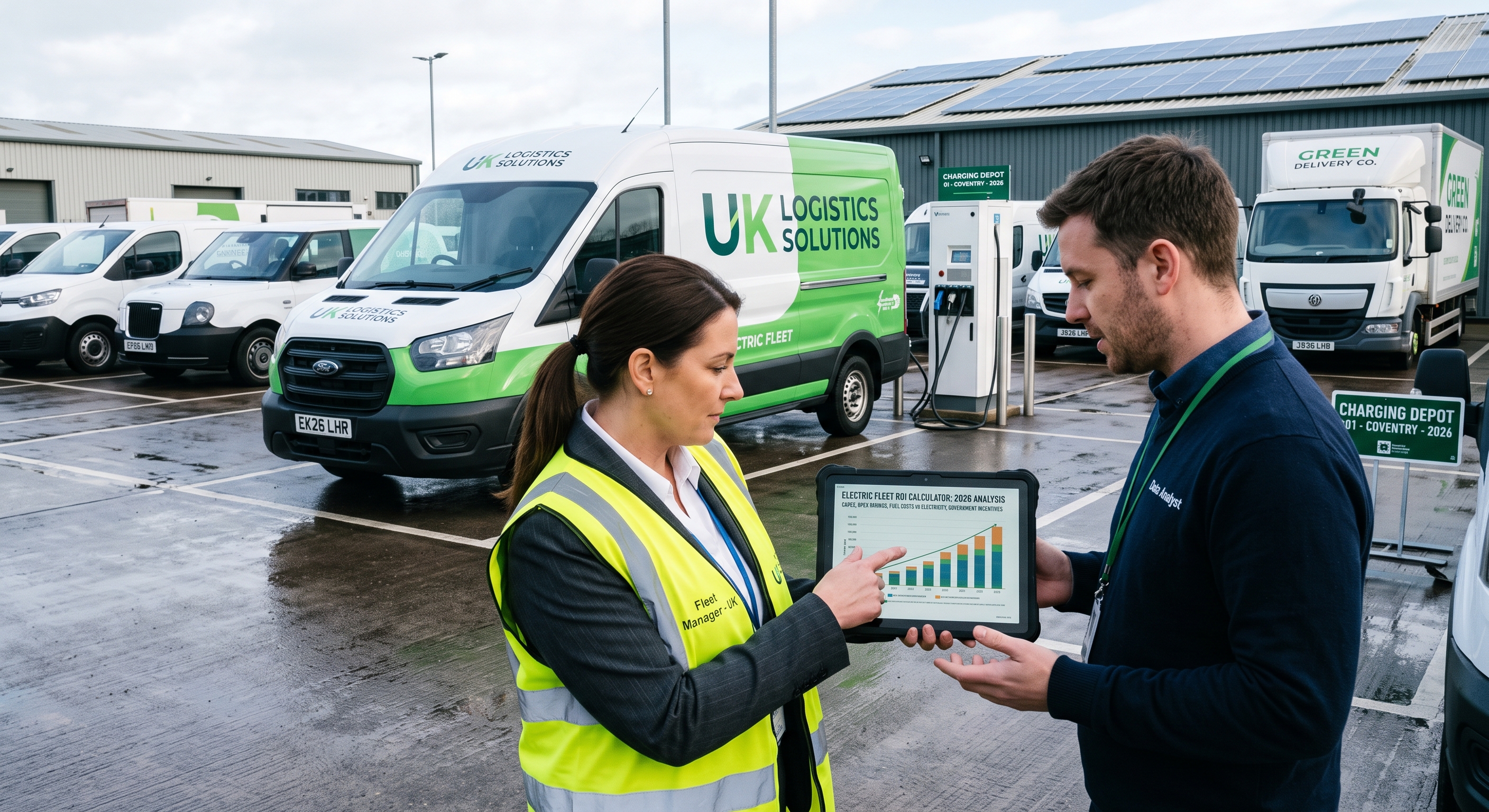
In 2026, calculating roi on electric fleet vehicles is no longer just a spreadsheet exercise for the finance department. It is a strategic necessity.
We define this return as the total financial gain your business achieves relative to the initial cost of the transition. With the UK government mandating that 22% of new car sales be zero-emission by the end of 2026, the market has shifted.
Electric vehicles have shifted from a green luxury to a core financial tool. If you aren't looking at the numbers now, you risk falling behind competitors who are already reaping the rewards.
Transitioning your fleet helps shield your business from diesel price volatility and rising urban access costs. When you choose fleet solutions focused on leasing, you manage the risk of fluctuating residual values.
This proactive approach ensures that your business contract hire decisions are backed by data rather than guesswork. A positive return on investment proves that going electric is the most sensible path for your bottom line.
Moving beyond simple fuel price comparisons
Many managers focus solely on pence per mile. Whilst fuel savings are significant, they are only one part of the story. To see the true picture, you must evaluate the five core components of electric vehicle total cost of ownership.
This includes accounting for energy market volatility by using smart charging strategies. Leasing models further improve your return by removing the uncertainty of what a vehicle will be worth in four years.
By fixing your monthly costs, you create a stable financial forecast that diesel fleets simply cannot match.
The pressure of corporate sustainability reporting
For UK SMEs, sustainability reporting is becoming a standard requirement for winning new tenders. Highlighting a clear ROI on your electric transition supports your ESG goals and builds immediate stakeholder trust.
Sticking with traditional combustion engines carries a heavy financial risk, especially as Clean Air Zones expand across the country. These daily charges can quickly erode your profit margins.
By being transparent about your fleet costs and choosing electric, you prove that your business is both modern and fiscally responsible. It is about future-proofing your operations amongst a rapidly changing regulatory environment.
If you want to see how these costs compare for your specific fleet, get in touch with our specialists for a tailored breakdown.
The five core components of electric vehicle total cost of ownership
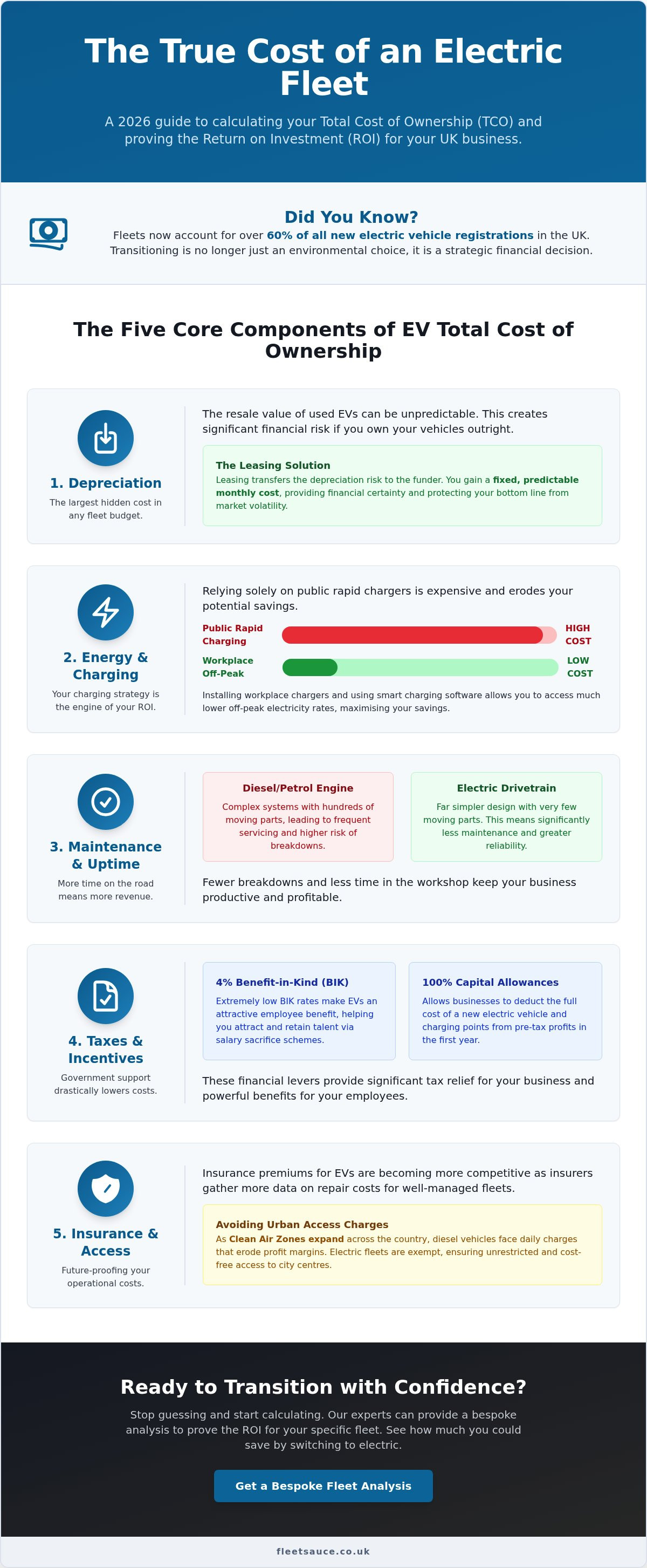
When you calculate ROI on electric fleet vehicles, focusing only on the monthly lease price is a mistake. You must look at total cost of Ownership (TCO). This holistic view accounts for every penny spent over the vehicle's life. Depreciation often acts as the largest expense in any fleet budget.
In 2026, the residual value of used EVs can be unpredictable. By choosing electric car leasing, you shift this risk to the funder. They take the hit if market values drop, providing you with financial certainty and a fixed monthly cost.
Operational uptime is another critical factor. Electric drivetrains are far simpler than their diesel counterparts. This means fewer breakdowns and less time in the workshop. Insurance premiums are also evolving.
By 2026, insurers will have years of repair-cost data, leading to more competitive rates for well-managed fleets. When your vehicles stay on the road for longer, your business remains productive and profitable.
Energy costs and charging infrastructure
Your charging strategy drives your ROI. Relying on public rapid chargers is expensive and can erode your savings.
However, installing workplace chargers allows you to access much lower electricity rates. You can learn more about how tax incentives and salary sacrifice schemes improve your return through official government data.
Smart charging software lets you draw power during off-peak hours, such as overnight. This dramatically reduces your pence-per-mile cost compared to traditional fuels.
Maintenance and SMR savings
Maintenance is where the financial benefits of electric vehicles truly shine. A typical internal combustion engine has around 2,000 moving parts, whilst an electric motor has about 20.
This simplicity leads to significantly lower Service, Maintenance, and Repair (SMR) costs. Regenerative braking also plays a huge role. It uses the motor to slow the vehicle, which preserves your brake pads and discs for much longer.
To keep your budget predictable, many businesses opt for maintenance packages. These turn variable repair bills into a manageable, fixed monthly fee that strengthens your ROI model.
If you are ready to start calculating roi on electric fleet vehicles for your own business, our team can help you build a robust financial framework today.
To see how these tax breaks could transform your bottom line, get in touch for a personalised fleet review.
Speak With Our Expert Team →How tax incentives and salary sacrifice schemes improve your return
For the 2026/27 tax year, the Benefit-in-Kind (BIK) rate for pure electric vehicles is set at 4%. This remains one of the most powerful tools for calculating roi on electric fleet vehicles. Compared to traditional petrol or diesel cars, where BIK rates often hit 30% or higher, the savings for your employees are immense.
This low tax environment makes electric cars a highly attractive part of any remuneration package. It helps with staff retention without requiring a direct increase in gross salary. You should also consider VAT recovery.
Businesses can usually reclaim 50% of the VAT on the finance element of a lease if the car has private use, and a full 100% on any maintenance costs.
The financial landscape in 2026 also rewards businesses that think ahead regarding their infrastructure. By reclaiming 100% first-year capital allowances on charging equipment, you can deduct the full cost from your pre-tax profits immediately.
This front-loads your tax savings and improves your cash flow during the initial transition period.
These incentives, combined with reduced National Insurance obligations, create a compelling case for a swift move to electric.
The power of EV salary sacrifice for SMEs
A salary sacrifice arrangement is often the missing piece in a successful ROI puzzle. It lets employees pay for a brand-new electric vehicle from their gross salary before tax is applied.
This reduces their taxable income, which in turn reduces the employer's Class 1A National Insurance contributions.
Because the scheme is typically cost-neutral to the business, the NI savings are a direct financial gain you can reinvest into your operations.
Our EV Salary Sacrifice Scheme guide explains how these mechanisms work to benefit both your people and your profit margins.
Capital allowances and government grants
Government support remains robust in 2026. The Workplace Charging Scheme (WCS) provides up to £350 per socket for up to 40 charging points, which significantly lowers your startup costs.
When calculating roi on electric fleet vehicles, don't overlook the Plug-in Van Grant. For large electric vans, this grant can be worth up to £5,000, making the transition even more lucrative for commercial fleets.
To keep your operational calculations accurate, always use the official government advisory electric rates when setting reimbursement levels for your drivers. These official figures provide the accuracy needed to prove the long-term viability of your electric fleet.
To get a personalised calculation for your business, contact our fleet consultants today.
A practical framework to calculate your fleet transition savings
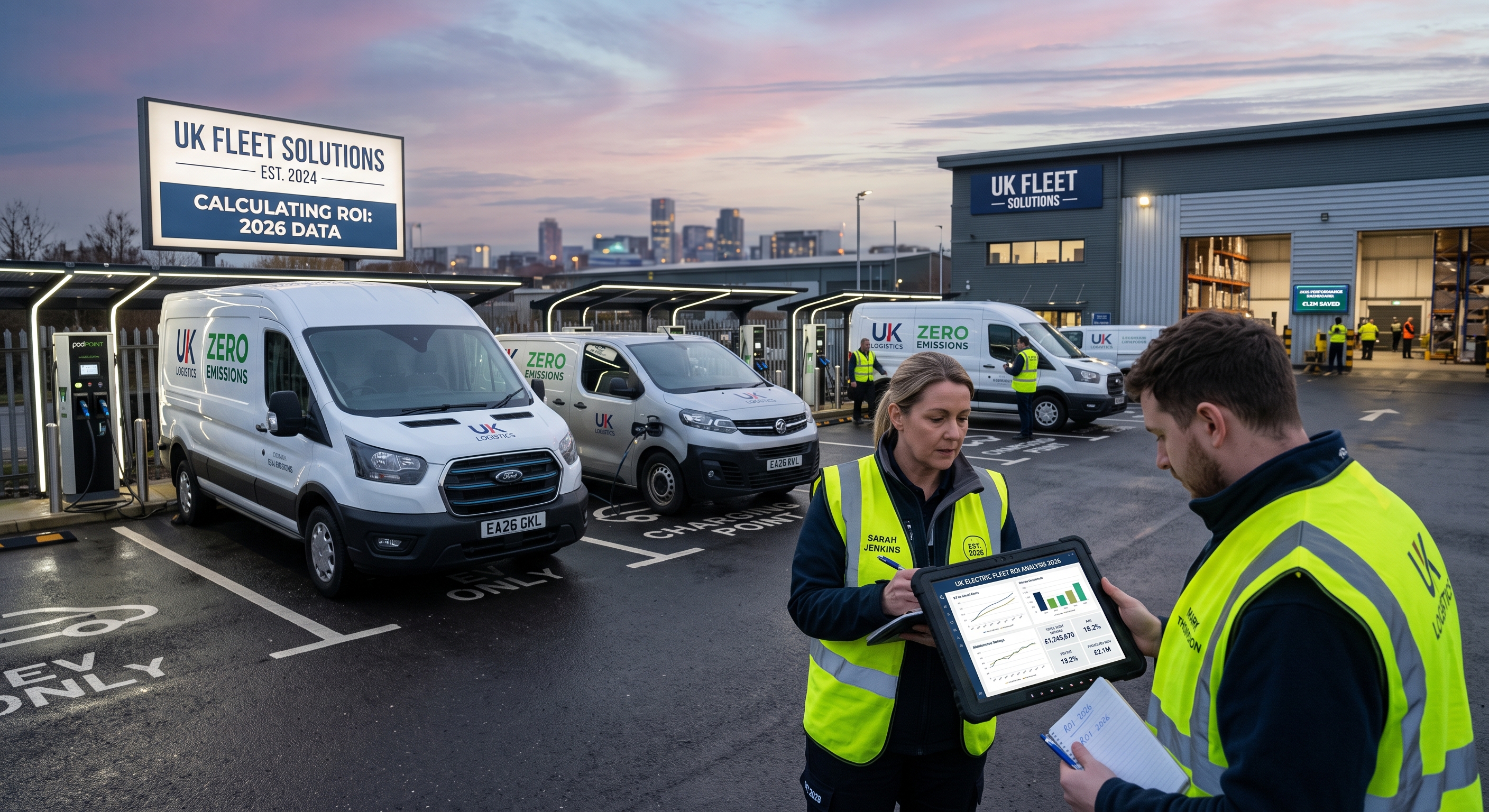
Moving from theory to a functional financial model requires a structured approach. When calculating ROI on electric fleet vehicles, start by establishing a clear baseline of your current internal combustion engine (ICE) expenditure.
This involves auditing your fuel cards and maintenance logs from the past twelve months to identify your true running costs.
Once you have this foundation, you can forecast your electric energy consumption by converting those same miles into kilowatt-hours (kWh) based on the specific models you intend to lease.
Next, apply the tax and National Insurance savings we discussed earlier. If you are using salary sacrifice, these savings can be substantial. You must also incorporate the soft ROI. While harder to put into a spreadsheet cell, the impact on employee retention and your brand reputation among eco-conscious clients is a real financial asset.
Finally, calculate your payback period to identify the exact break-even point where your cumulative savings exceed the cost of the transition. This framework provides the data-driven proof needed to justify the switch to your board.
Gathering the right data for your calculation
Accuracy depends on the quality of your inputs. You will need a detailed breakdown of your current fuel spend, insurance premiums, and any unplanned repair costs. When estimating future electricity needs, always use real-world figures rather than optimistic manufacturer claims.
We recommend looking at independent tests that reflect actual driving conditions, especially for motorway miles or winter driving. This keeps your ROI model robust even when the weather turns cold, or the terrain gets tough.
Comparing leasing versus purchase in your ROI model
Choosing the right acquisition method is vital for your cash flow. Many UK SMEs find that Business Contract Hire offers a superior ROI because it requires a much lower initial outlay. By leasing, you avoid tying up large amounts of capital in depreciating assets.
You can instead use that capital to grow your core business. Fixed monthly costs also remove the risk of nasty financial surprises, making your long-term ROI forecast far more predictable. It's about balancing operational flexibility with financial security.
To keep your data as accurate as possible, reach out to our team for a detailed analysis of your current fleet performance.
If you are ready to see how our technology can transform your fleet management, speak with our team today.
Book a Live Demonstration →Scaling your electric fleet with Fleetsauce and FleetHub technology
Scaling a fleet requires more than just adding more vehicles to your insurance policy. It demands a sophisticated way of tracking every mile and every penny.
Our FleetHub technology provides real-time visibility into vehicle performance and costs, ensuring that your initial projections stay on track.
When you are calculating ROI on electric fleet vehicles, live data is far superior to outdated manual logs. This software automates compliance and service reminders, preventing costly fines and reducing the risk of unplanned downtime that could hurt your bottom line.
Telematics also plays a vital role in your long-term success. By monitoring driver behaviour, you can identify those who might benefit from training to improve their EV efficiency. Small changes in driving style can lead to significant energy savings across a large fleet.
Partnering with a specialist broker like Fleetsauce ensures you always get the best market rates. We have the industry connections to find deals that aren't always visible to the public, helping you grow your fleet without overstretching your budget.
Real-time ROI tracking with FleetHub
Data lets you adjust your ROI forecast while your fleet is in operation. You can monitor charging behaviour to ensure employees are using the cheapest energy sources, such as off-peak workplace chargers.
For a deeper look at how this works, read our guide on fleet management software for SMEs in 2026. This level of granularity turns your fleet from a cost centre into a streamlined, efficient machine.
Expert guidance for a seamless transition
Fleetsauce helps SMEs navigate the complexity of electric vehicle selection. We provide bespoke fleet reviews to identify the highest ROI opportunities tailored to your specific business needs.
A data-led approach is the only way to ensure fleet success in a rapidly changing market, providing the accuracy you need when calculating roi on electric fleet vehicles. By combining expert human advice with powerful software, you can scale your operations with total confidence.
It's about making the transition as smooth and profitable as possible.
To see how these savings apply to your specific business, contact our expert team for a consultation.
Take the next step toward a cost-effective electric fleet
The transition to an electric fleet is a strategic move that pays dividends when you focus on the right data.
By understanding the core components of total cost of ownership and leveraging tax-efficient salary sacrifice schemes, you can unlock significant savings whilst modernising your operations.
We have shown that calculating roi on electric fleet vehicles requires a holistic view of fuel, maintenance, and tax benefits. It isn't just about going green; it's about making your business more resilient and competitive in a changing market.
With over 15 years of experience in UK vehicle leasing, our team acts as your expert guide. We provide the proprietary FleetHub software you need for real-time cost management and have dedicated specialists to handle your EV salary sacrifice implementation.
We're here to ensure your transition is smooth, transparent, and financially rewarding. You don't have to tackle the spreadsheets alone when you have a partner who understands the nuances of the 2026 tax landscape.
Request a bespoke fleet ROI review from our expert team today. Let's work together to build a fleet that drives your business forward.
Frequently Asked Questions
How long does it take for an electric fleet to pay for itself?
The payback period for an electric fleet typically falls between two and four years depending on your annual mileage. High-mileage users see a faster return because fuel savings accumulate more quickly. When calculating ROI on electric fleet vehicles, look at total savings over the entire lease term rather than just the first year of operation.
What is the biggest cost saving when switching to electric vehicles?
The most significant cost reduction comes from the lower price of electricity compared to diesel and reduced maintenance requirements.
Electric motors have far fewer moving parts; this leads to lower service bills and less time spent off the road. Businesses that utilise off-peak charging tariffs often see their energy costs drop by over 50% compared to traditional fuel spend.
How does Benefit in Kind affect business fleet ROI?
Low Benefit in Kind rates improve your ROI by making electric vehicle salary sacrifice schemes highly attractive to your staff.
For the 2026/27 tax year, the BIK rate is 4%. This low rate allows you to offer a premium benefit that reduces your employer National Insurance contributions, effectively turning your fleet into a tool for staff retention and financial efficiency.
Can I include charging infrastructure in my ROI calculation?
You should definitely include infrastructure costs in your model whilst accounting for available government support.
The Workplace Charging Scheme provides up to £350 per socket for up to 40 sockets. By including these grants and the 100% first-year capital allowances, you can accurately reflect the true initial investment required for your transition.
Does fleet management software actually improve ROI?
Fleet management software directly improves your return by providing real time data on vehicle performance and driver behaviour.
Tools like our FleetHub help you identify inefficient driving habits and automate service reminders. This proactive approach prevents costly mechanical failures and ensures your vehicles operate at peak efficiency.
What happens to ROI if electricity prices increase?
Rising electricity prices do affect your savings, but they rarely eliminate the financial advantage over fossil fuels.
You can protect your ROI by using smart charging software to take advantage of cheaper overnight rates. Even with price fluctuations, an electric drivetrain's efficiency means you'll still spend less per mile than you would on diesel.
Is the ROI different for electric vans compared to cars?
Electric vans often provide a faster return on investment than cars due to higher government grants and the heavy tax burden on diesel commercial vehicles. Large electric vans can qualify for grants up to £5,000 in 2026.
When calculating ROI on electric fleet vehicles for a commercial operation, these upfront savings significantly shorten the time to reach the break-even point.
Should I lease or buy to get the best ROI on my electric fleet?
Leasing through Business Contract Hire often provides a better ROI because it protects your business from the risk of vehicle depreciation. You avoid tying up large amounts of capital that you could use elsewhere in your company.
Fixed monthly payments make financial forecasting easier and remove uncertainty about what the vehicle will be worth in the future.

Guide Verified & Audited By
Director at Fleetsauce
Ready to Maximise Your Fleet Savings?
Transitioning to electric fleet leasing protects your business against unpredictable depreciation and volatile fuel prices. Speak with our specialists today to compare funding options and secure the ideal vehicles for your operational needs.
Why Choose Fleetsauce?
At Fleetsauce, we specialise in helping SMEs find the right car leasing solutions — not just the cheapest leasing deal.
With access to a wide range of leasing funders and hundreds of franchised dealerships across the UK, we find the best leasing deals and vehicle availability for your business and employees.
You’ll work directly with an expert dedicated account manager who understands the needs of companies — offering expert advice with a friendly, professional approach that you can always call directly.
With a five-star rating from Trustpilot, we are proud of our reviews and is evidence that we look after our new and existing customers.
Whether you're managing one vehicle or a fleet, we make business leasing simple, flexible, and cost-effective.


What our customers say...

Brilliant from start to finish, so helpful even finding a better deal than the one enquired for. Customer service so far is over and above!
Great service from start to finish and nice to able to speak to a real person when in need. Vehicle delivered without any fuss and on time.
Well, if you want an easy process in ordering a car, then use FleetSource (you will likely have to speak to a chap named Jack (who is actually 'ok', just makes out he's grumpy :) )). I ordered my new car, completed a couple of online forms, confirmed all was good, and then a month earlier than expected, I was informed it is ready for a time "convenient to me". Leasing made easy, really easy!