
Did you know that only 1.5% of commercial vehicles in the UK have successfully transitioned to electric power?
It is a surprisingly low figure, especially when you consider the significant tax advantages and operational savings on offer.
Most managers feel held back by the perceived logistical mountain of infrastructure, yet finding the right EV fleet charging solutions for business does not have to be a complex or frustrating puzzle.
We understand the pressure you are under to perform. You are likely weighing up high upfront costs against the need for strict HMRC compliance and the constant worry of vehicle downtime.
It is a lot to manage at once.
This guide promises to demystify the entire process, showing you how to build a scalable, cost-effective charging network that simplifies life for both you and your drivers whilst protecting your bottom line.
We will walk you through a clear plan for balancing workplace and home installations.
You will learn how to automate cost tracking and take full advantage of the 4% Benefit in Kind tax rate locked in for the 2026/27 tax year.
From understanding the 7p-per-mile Advisory Electricity Rate (AER) to navigating the latest smart charge point regulations, we have everything you need to keep your fleet moving efficiently.
Depot vs Home Charging Cost Splitter
Calculate your annual fleet power costs and discover the potential savings between charging locations.
Key Takeaways
- •
Learn why effective EV fleet charging solutions for business require a strategic infrastructure that scales alongside your company's growth.
- •
Compare the operational efficiency of depot-based charging for high-utilisation vehicles against the convenience and cost-effectiveness of home charging.
- •
Master HMRC compliance by understanding the latest advisory fuel rates and how to simplify the reimbursement process for your drivers.
- •
Discover how combining salary sacrifice schemes with robust charging plans can lower the total cost of vehicle ownership for everyone involved.
- •
Explore how Fleetsauce uses FleetHub to provide a centralised, real-time view of vehicle performance and administrative compliance across your entire fleet.
Table of Contents
Speak with our specialist team today to start planning your business charging infrastructure.
Defining EV Fleet Charging Solutions for Modern Business
Transitioning to an electric fleet involves a fundamental shift in how you fuel your business operations. It's not just about swapping a diesel engine for a battery.
Robust EV fleet charging solutions for business are not merely a collection of plugs on a wall; they represent a strategic energy infrastructure.
This system must be designed with scalability at its heart. You need a setup that scales as your fleet expands, ensuring your power capacity and administrative oversight keep pace with your vehicle count.
The days of simple fuel cards are quickly fading. Modern fleet managers now rely on sophisticated digital energy management to keep their teams moving.
This shift enables precise tracking of every kilowatt-hour used, providing a level of data transparency previously impossible. When you choose electric car leasing for your company, the charging strategy becomes a core part of the lease agreement itself.
It creates a seamless loop between the vehicle, the driver, and the power source, whilst reducing the manual burden on your finance team.
The Core Components of a Business Charging Strategy
Hardware is the foundation of your setup. Most businesses opt for a mix of AC chargers for overnight stays and DC rapid chargers for vehicles that need a quick turnaround during the day.
Modern EV charging networks provide the backbone for these installations, but your private setup needs dedicated software to truly shine.
This software offers real-time monitoring so you can see exactly who is charging and when. It allows you to schedule charging during off-peak hours, significantly reducing your energy bills. Power management systems are also vital.
They balance the electrical load across your entire site, preventing expensive grid upgrades and ensuring you don't experience sudden power cuts when multiple vehicles plug in simultaneously.
Why 2026 is the Critical Year for Fleet Electrification
2026 is a pivotal year for UK businesses. The government's Zero Emission Vehicle mandate is accelerating, which means internal combustion engines will become rarer and more costly to maintain. By investing in infrastructure now, you avoid the rush and potential price hikes for installation services later.
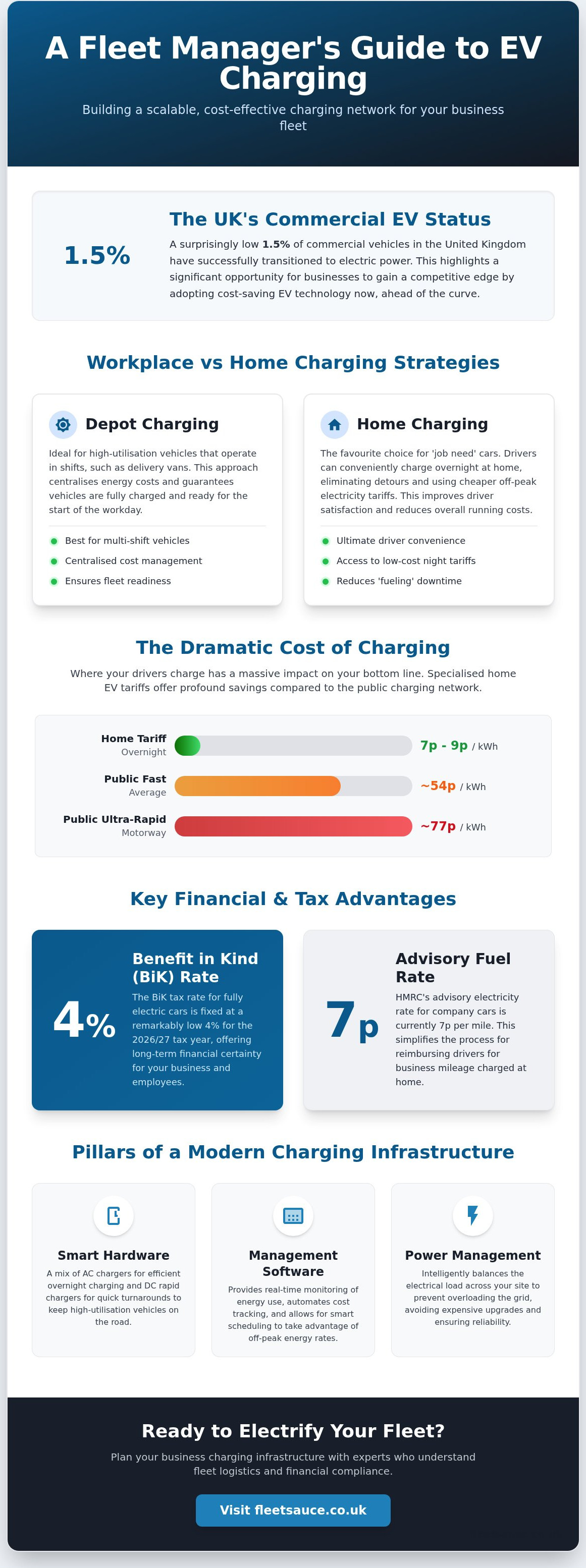
The financial logic is hard to ignore. For the 2026/2027 tax year, the Benefit in Kind (BiK) rate for fully electric cars is fixed at a remarkably low 4%. While confirmed rates rise by 1% annually up to 9% by 2029/30, this clear roadmap gives your business and your employees long-term financial certainty.
It is a win for your budget and a fantastic perk for your team's personal finances.
Contact our team today to discuss your fleet's charging needs.
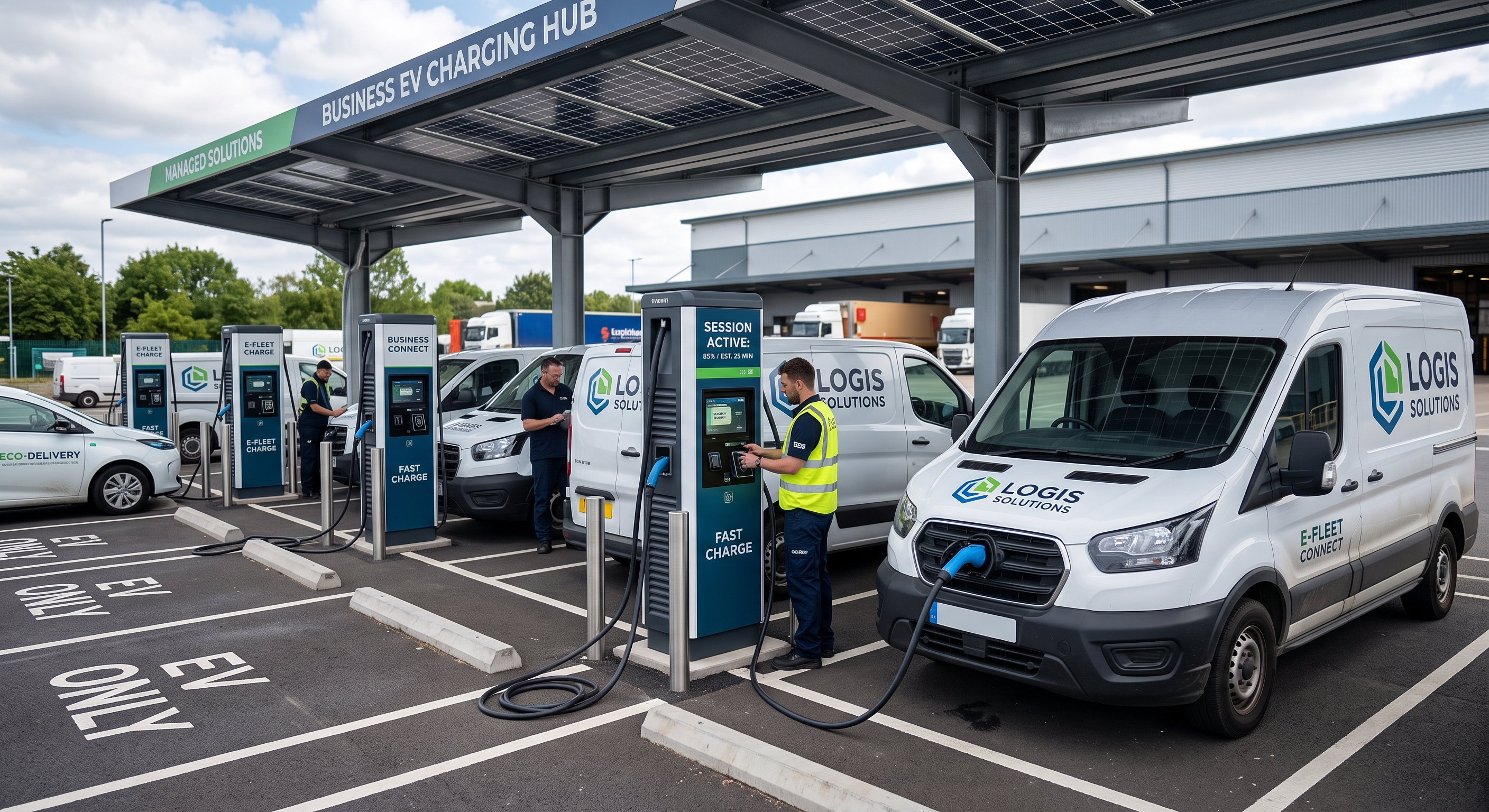
Comparing Workplace Depot and Home Charging Strategies
Choosing between depot and home charging isn't a binary decision. It is about matching the right EV fleet charging solutions for business to your specific vehicle usage.
High-utilisation vehicles, such as delivery vans that operate multi-shift patterns, thrive on depot-based charging. This centralises energy costs and ensures every vehicle is ready for the morning rush. Conversely, home charging has become the favourite choice for job-need cars.
It eliminates the need for drivers to detour to a central hub, effectively turning their driveways into private refuelling stations whilst they sleep.
The cost gap between these methods is significant. Whilst workplace electricity is often cheaper than public rates, specialised home EV tariffs can be as low as 7p-9p per kWh. This is a fraction of the cost of public charging, which averages around 54p per kWh for fast chargers and can reach 77p for ultra-rapid units.
It is also worth noting the HMRC Advisory Electricity Rate, which currently sits at 7p per mile for electric cars.
A hybrid charging model that combines workplace, home, and occasional public use offers the most flexible and cost-effective solution for UK businesses today.
The Logistics of Depot-Based Charging
When looking for guidance on EV fleets, it becomes clear that setting up a depot requires more than just buying hardware.
You must start with a comprehensive site survey to assess your current electrical capacity. In many cases, grid upgrades are necessary to support multiple chargers operating simultaneously.
Managing vehicle rotation is equally vital to ensure maximum uptime. For businesses with limited dwell time, rapid DC chargers are the best tool.
They provide a quick top-up that keeps the fleet moving without long delays, though they require a more robust power supply than standard AC units.
Empowering Employees with Home Charging
Organising home installations for remote workers can seem like an administrative headache, but it is a cornerstone of modern EV fleet charging solutions for business. You should consider whether to provide tethered chargers, which have the cable attached for convenience, or untethered units that allow drivers to use their own cables.
Both have their merits depending on the driver's vehicle choice. Drivers without off-street parking will need to look at local charging hubs or retail park installations to bridge the gap.
If you need help coordinating these various setups, you can speak to our consultants for a tailored review of your requirements.
Speak with our experts to ensure your fleet stays HMRC compliant.
Navigating HMRC Compliance and Reimbursement Logistics
HMRC compliance is often the biggest administrative hurdle when choosing EV fleet charging solutions for business. Unlike petrol or diesel, where a fuel card provides a clear receipt, electricity is frequently consumed at a driver's home.
As of June 1, 2026, HMRC set the Advisory Electricity Rate at 7p per mile for business journeys in a fully electric company car. For public charging, employers can choose to reimburse the actual receipted cost where 7p per mile does not cover the expense.
These figures are reviewed quarterly, so staying up to date is essential to avoid underpaying your drivers or overpaying taxes.
Separating business energy from personal domestic use is a complex task that requires precision.
If a business pays for a home charger installation for an employee, it is generally treated as a benefit in kind, though specific exemptions apply if the vehicle is a company car.
To keep your records audit-ready, you should maintain a clear trail of energy expenses. A robust checklist for your administration team includes:
- Digital logs of every business journey tracked via GPS or telematics.
- Automated data exports from smart home chargers to verify energy consumption.
- Monthly energy bill snapshots to verify domestic tariff rates.
- Integrated software that syncs mileage with charging data for instant reconciliation.
Automating the Reimbursement Process
Manual mileage claims are a relic of the past. Modern EV fleet charging solutions for business now use smart software to track energy consumption directly from the vehicle or the charger.
Some advanced systems even offer direct payment. Instead of the driver paying their energy provider and claiming it back, the business pays the provider directly for the electricity used for business miles.
This removes financial friction for the driver and significantly lightens the load for your finance department, ensuring everyone is paid accurately and on time.
Understanding Benefit in Kind and Tax Incentives
Benefit-in-Kind (BiK) remains the strongest incentive for employees to switch to electric vehicles.
For the 2026/2027 tax year, the BiK rate is just 4%, which is a fraction of the cost of traditional combustion vehicles. This rate will rise by 1% each year until reaching 9% in 2029/30, providing predictable, long-term stability for your fleet planning. Businesses can also benefit from capital allowances, which often allow you to claim 100% of the cost of installing charging points in the first year.
Additionally, the Workplace Charging Scheme grant remains available, offering up to 75% towards purchase and installation costs, capped at £350 per socket for up to 40 sockets.
Find out how to integrate charging into your fleet strategy by speaking with our team.
Integrating Salary Sacrifice with Charging Infrastructure
A truly effective EV fleet charging solution for business strategy does not treat the car and the charger as separate entities. By integrating your charging infrastructure with a salary sacrifice scheme, you create a holistic package that is easy for employees to understand and for your payroll team to manage.
This approach allows you to bundle the cost of a home charger directly into the monthly lease payment. It effectively spreads the initial hardware cost across the term of the agreement, making the switch to electric driving far more accessible for your staff.
The total cost-of-ownership benefits are impressive for both parties. For the employer, it reduces National Insurance contributions whilst providing a premium benefit at zero net cost to the business.
For the employee, charging their vehicle at the workplace can be provided as a tax-free benefit.
This means they can effectively refuel for free during their working day, which is a significant perk in an era of rising energy costs. It turns your office or depot into a key part of their financial well-being.
Boosting Employee Engagement through Green Benefits
Providing integrated charging solutions makes your green benefits much more attractive. Many employees are hesitant to switch because of range anxiety or the perceived hassle of installing a home unit. When you remove these barriers, you see a much higher uptake in the scheme.
This is not just about the cars. It is about showing your commitment to sustainability. Offering convenient, reliable on-site charging helps with staff retention and makes you a more appealing prospect for new talent who already drive or are considering an electric vehicle.
Financial Planning for a Multi-Vehicle Rollout
When moving from a traditional car allowance to an EV scheme, the savings can be substantial.
You are moving away from unpredictable mileage claims and high National Insurance costs towards a structured, predictable monthly cost. You should also consider the residual value of the vehicles, which is often better protected when cars are maintained through a professional fleet programme.
However, you must budget for the long term maintenance of your workplace stations. Regular software updates and physical inspections ensure your EV fleet charging solutions for business remain reliable.
By leveraging bulk leasing deals, you can often offset the initial infrastructure costs. If you are ready to see how these financial pieces fit together for your team, get in touch for a bespoke quote today.
Speak with our specialist team today to start planning your business charging infrastructure.
Streamlining Your Transition with Fleetsauce and FleetHub
Making the move to electric is a journey, not a single event. At Fleetsauce, we act as your expert guide, providing comprehensive fleet solutions that connect your vehicles directly to your energy strategy.
Many providers will sell you a charger and walk away, but we understand that EV fleet charging solutions for business only work when they are part of a wider, managed ecosystem.
We support you from the initial vehicle selection right through to the final charger installation, ensuring every piece of the puzzle fits perfectly.
Choosing the right hardware is often where managers feel most overwhelmed. Do you need a 7kW AC unit or a 50kW DC rapid charger?
Our team provides the technical clarity you need to make an informed choice. We don't just look at what is available today. We look at your business growth plans to ensure your infrastructure remains fit for purpose for years to come.
This end-to-end support removes the guesswork and prevents costly mistakes during the rollout phase.
The Power of FleetHub Management Software
Managing a modern fleet requires more than just a spreadsheet. Our fleet management software for SMEs, known as FleetHub, gives you a centralised view of your entire operation.
It simplifies the day-to-day grind of MOT tracking and service intervals, ensuring your vehicles stay safe and legal without manual effort. More importantly, FleetHub uses real-world data to show you exactly which drivers would benefit most from home charging based on their actual mileage patterns.
This data also allows you to track your total carbon footprint, making your corporate social responsibility reporting accurate and effortless.
Bespoke Solutions for Unique Business Needs
We know that a one-size-fits-all approach always fails when it comes to fleet electrification.
Every business has a different rhythm, from the routes your drivers take to the power capacity of your office site. This is why human expert support is so vital whilst navigating this transition. Whilst our technology is cutting-edge, we never lose the human touch.
We build long-term relationships through transparent communication and honest advice. You won't find high pressure sales tactics here. Instead, you will find a partner dedicated to finding the most efficient, cost effective way to keep your business moving in a zero emission world.
Talk to our team today to build a charging strategy that works for your business.
Powering Your Future Fleet Today
The road to electrification is much smoother when you have the right map. You've seen how balancing workplace and home charging can slash your overheads whilst keeping your team happy.
By mastering HMRC compliance and integrating salary sacrifice, you turn a logistical challenge into a powerful recruitment tool. Implementing EV fleet charging solutions for business is no longer just about the hardware; it's about the data and the strategy behind it.
Since 2010, we've been helping UK companies navigate the changing landscape of vehicle leasing. Our FleetHub software takes the stress out of management by providing the real-time insights you need to stay compliant and efficient.
Our established expertise in salary sacrifice schemes ensures your staff receive the best possible benefits whilst your business saves on costs. We are ready to help you bridge the gap between traditional fuel and a modern, electric future.
Speak to our expert team about your bespoke fleet charging strategy
Transitioning your fleet is a bold step towards a more sustainable and profitable future. We are here to make sure every mile is accounted for, and every vehicle is ready to go.
Frequently Asked Questions
How much does it cost to install a workplace EV charging station?
Costs vary based on the number of sockets and your existing electrical capacity. You can reduce the initial investment by using the Workplace Charging Scheme grant, which provides up to 75% of costs, capped at £350 per socket for up to 40 sockets.
A professional site survey is the best way to get an accurate picture of the infrastructure needed for your specific location before you commit to any hardware installations.
Can my business claim back VAT on the electricity used for fleet charging?
Businesses can generally reclaim VAT on electricity used to charge electric vehicles for business purposes. When charging at the workplace, the standard 20% VAT rate applies.
Reclaiming VAT on home charging is generally not permitted by HMRC because domestic electricity contracts are held by the homeowner rather than the business. It's always best to consult with your tax advisor to ensure your records meet current HMRC standards and avoid any potential audit issues.
What is the HMRC Advisory Electricity Rate for 2026?
The Advisory Electricity Rate for fully electric cars is 7p per mile as of June 1, 2026. If drivers use public charging, businesses can reimburse the actual receipted cost instead. HMRC reviews these rates quarterly, with the next update scheduled for December 1, 2026.
These rates then help you provide fair reimbursement to your staff without triggering unnecessary tax liabilities for the business.
Do I need a three-phase power supply to charge an electric van fleet?
A three-phase supply isn't essential, but it is highly beneficial for heavy vehicle use.
Whilst a standard single-phase supply limits you to 7kW charging, a three-phase setup allows for 22kW speeds or higher. This is vital for vans with large batteries that need a quick turnaround between shifts.
It ensures your EV fleet charging solutions for business remain efficient and capable of meeting high demand throughout the day.
How does a salary sacrifice scheme help with charging costs?
Salary sacrifice schemes allow employees to pay for their vehicle and charging equipment from their gross salary. This reduces their taxable income, resulting in significant National Insurance savings for the employer.
You can even bundle the cost of a home charger installation into the monthly lease payment.
This makes the transition to electric driving much more affordable for your staff whilst simplifying your payroll administration and reducing manual paperwork.
What happens if a driver does not have a driveway for home charging?
Drivers without off-street parking can rely on workplace charging or the growing public network. The UK now has over 88,000 public charging points, including 18,000 rapid and ultra-rapid chargers.
Many businesses prioritise depot-based charging for these employees to ensure they start their day with a full battery.
You can also look at local charging hubs or supermarket installations to ensure these drivers have reliable access to power.
Is workplace charging considered a taxable benefit for employees?
Providing electricity at the workplace to charge a company electric vehicle is not a taxable benefit. This is a significant perk that allows your team to refuel at no personal cost. Providing workplace charging to employees is fully tax-exempt under Section 237A of ITEPA 2003, whether the vehicle is a company car or privately owned, provided access is open to all staff.
Staying up to date on these specific rules is a core part of effectively managing EV fleet charging solutions for your business and keeping your finance team happy.
How can FleetHub help me manage my electric vehicle fleet?
FleetHub provides a centralised digital dashboard to track vehicle performance and administrative compliance. It automates MOT date tracking and service intervals, so you never miss a deadline.
The software also uses real-world data to identify which of your drivers are the best candidates for home charging.
This helps you target your infrastructure investment where it will deliver the greatest return for your business and your employees.

Guide Verified & Audited By
Director at Fleetsauce
Why Choose Fleetsauce?
At Fleetsauce, we specialise in helping SMEs find the right car leasing solutions — not just the cheapest leasing deal.
With access to a wide range of leasing funders and hundreds of franchised dealerships across the UK, we find the best leasing deals and vehicle availability for your business and employees.
You’ll work directly with an expert dedicated account manager who understands the needs of companies — offering expert advice with a friendly, professional approach that you can always call directly.
With a five-star rating from Trustpilot, we are proud of our reviews and is evidence that we look after our new and existing customers.
Whether you're managing one vehicle or a fleet, we make business leasing simple, flexible, and cost-effective.


What our customers say...

Great communication and friendly informative staff. An easy transaction and I would recommend.
1st time we've used this company for vehicle leasing, very competitive, great communication even when the colours we wanted weren't available at time of order. Worked hard to get a resolution.

I ordered a car mid December which arrived mid Jan. Slightly earlier than I was told. I dealt with Artur and Rachael who were both brilliant all the way through. Happy with the car too. I’ll definitely use again. Thanks guys.