
What if your company car fleet is quietly leaking cash because you're still following 2024 tax rules in a 2026 market?
We know that rising operational costs are a constant headache for UK business owners right now.
It's frustrating when changing HMRC regulations makes your long-term financial planning feel like guesswork, especially with Benefit-in-Kind rates for electric vehicles set to hit 4% in April 2026.
The good news is that you can still secure significant business car leasing tax benefits by staying one step ahead of the curve.
We'll show you exactly how to slash your company's tax liability through strategic vehicle selection and the latest 2026 EV incentives.
You'll discover how to lower your National Insurance contributions and reclaim up to 100% of your VAT without the usual administrative burden.
This guide provides a clear roadmap for mastering Corporation Tax reclaims and building a future-proof fleet the Fleetsauce way.
Let's dive into the details and get your business finances back on track.
Key Takeaways
- •
Discover why Business Contract Hire remains the most tax-efficient funding method by treating monthly rentals as a deductible business expense.
- •
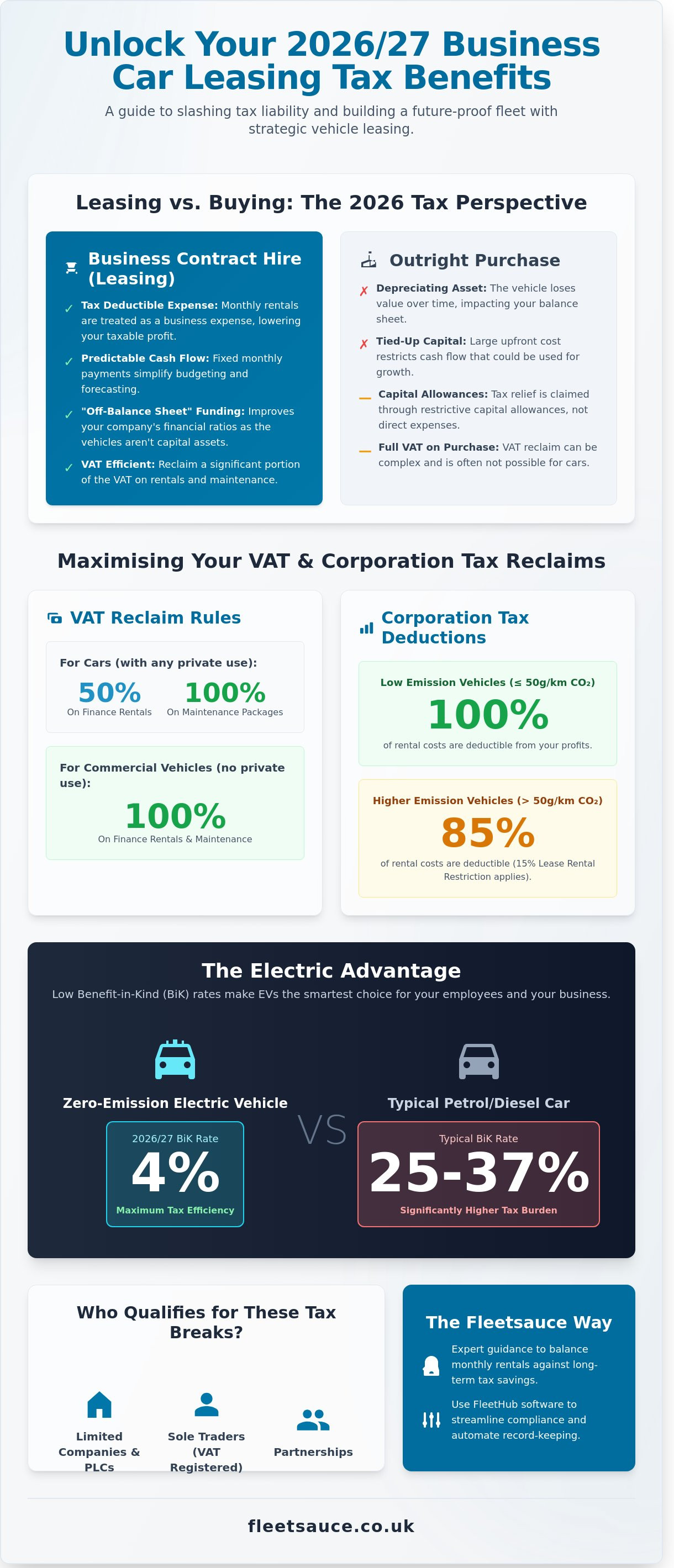
Navigate the VAT rules with confidence to reclaim 50% of rental costs and 100% of maintenance fees for your company vehicles.
- •
Maximise your business car leasing tax benefits by leveraging 2026 electric vehicle incentives and ultra-low Benefit-in-Kind (BiK) rates.
- •
Improve your company’s financial position by understanding the strategic "off-balance sheet" accounting advantages of leasing over Hire Purchase.
- •
Streamline your HMRC compliance using FleetHub software to automate essential record-keeping and manage your fleet the Fleetsauce way.
The Strategic Value of Business Car Leasing Tax Benefits in 2026
Smart SME owners view their fleet as more than just a row of parked cars. It's a financial lever.
As we move into the 2026/27 tax year, Business Contract Hire (BCH) remains the most efficient way to put your team behind the wheel without draining the company coffers.
Unlike buying a car outright, which creates a depreciating capital asset, leasing allows you to treat payments as a direct business expense.
This simple shift in accounting can significantly lower your taxable profits.
The 2026/27 tax landscape brings new considerations for fleet planning. HMRC has confirmed that Benefit-in-Kind (BiK) rates for zero-emission vehicles will rise to 4% for this period.
While this is an increase from previous years, electric vehicles still offer the most significant business car leasing tax benefits compared to petrol or diesel alternatives.
We call this the Fleetsauce way; we help you balance the monthly rental cost against these long-term tax savings to ensure your fleet remains a boost to your bottom line, not a burden.
Leasing vs Buying, The 2026 Tax Perspective
Buying a car ties up precious capital that your business could use for expansion or R&D.
From a tax standpoint, capital purchases rely on capital allowances, which can be restrictive. Leasing is different.
Your monthly rentals are usually 100% deductible against corporation tax if the car emits 50g/km of CO2 or less. For cars above this limit, you can still deduct 85% of the rental cost.
Predictable Cash Flow
Fixed monthly costs make VAT returns and profit forecasting simple.
Front-Loaded Relief
You can use a larger initial rental to offset more profit in a specific financial year
VAT Efficiency
VAT-registered businesses can reclaim 50% of the VAT on monthly rentals and 100% of the VAT on any optional maintenance packages.
Who Qualifies for Business Lease Tax Breaks?
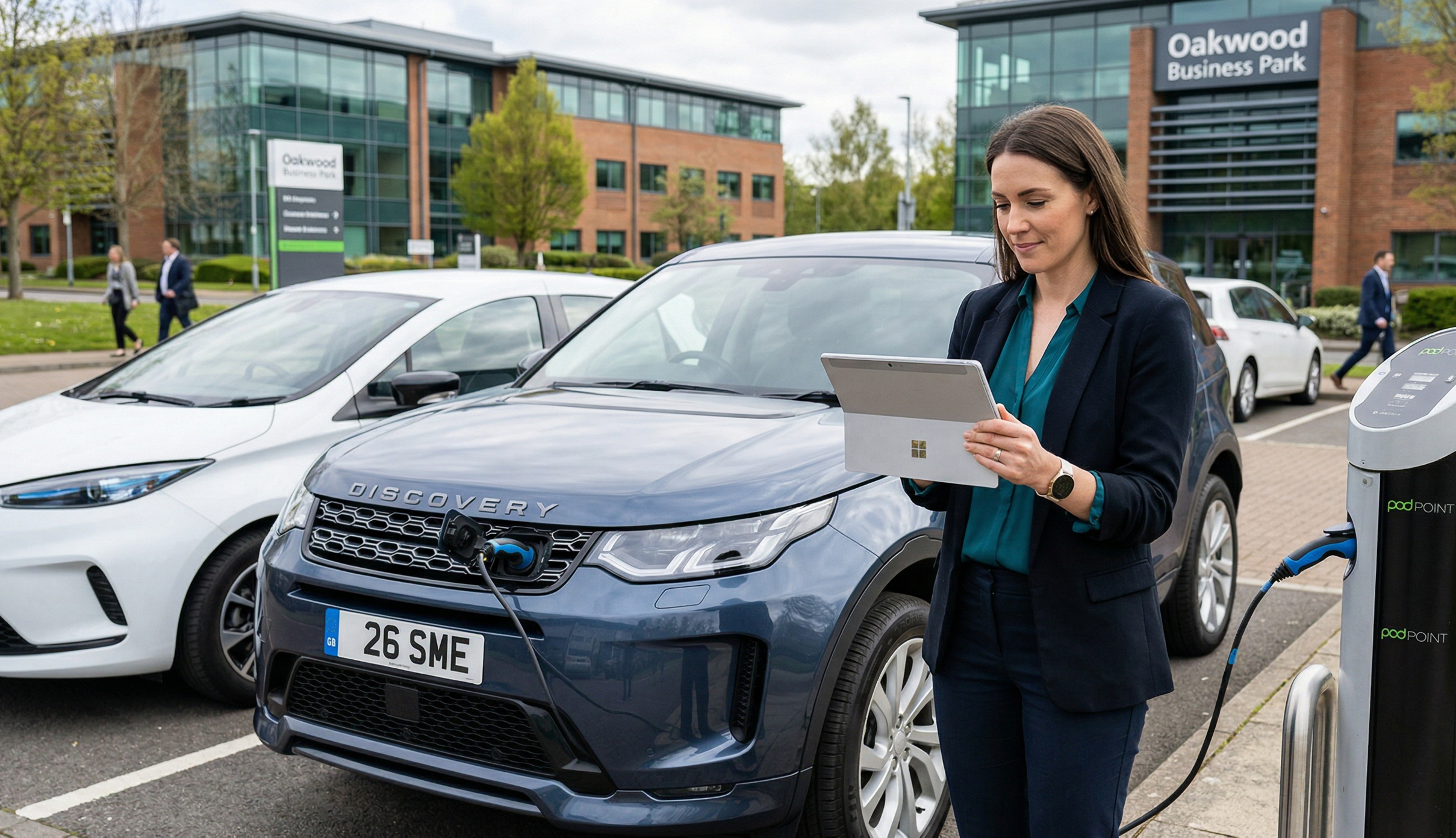
Eligibility is broader than many realise. Limited companies and PLCs are the primary beneficiaries, but VAT-registered sole traders and partnerships can also access these tax benefits for business car leasing.
The key factor is the 'business use' of the vehicle. HMRC requires clear records to distinguish between business and private miles, ensuring your tax filings are robust.
2026 is the year to finally ditch the 'grey fleet'. Relying on employees to use their personal cars and claiming mileage is a tax minefield and often costs more in the long run.
By moving to a structured lease, you gain total control over emissions, safety, and tax efficiency. It is a cleaner, more professional approach that shows your business is ready for the future.
We provide the expert guidance needed to transition your team into modern, tax-efficient vehicles with zero hassle.
Maximising VAT Reclaims and Corporation Tax Deductions
SMEs often miss out on thousands of pounds because they don't grasp the nuances of VAT recovery.
When you lease a car for business, HMRC generally allows you to reclaim 50% of the VAT on the monthly finance rentals. This 50% block accounts for the vehicle's inevitable private use.
It's a straightforward trade-off that simplifies your record-keeping and provides immediate business car leasing tax benefits without the need for complex mileage logs for every trip.
Corporation Tax offers another route to significant savings. You can slash your annual tax bill by deducting lease payments from your pre-tax profits.
Your choice of car makes a massive difference here. For vehicles with CO2 emissions of 50g/km or less, you can deduct 100% of the rental cost from your profits. If the car exceeds this 50g/km threshold, a 15% Lease Rental Restriction applies.
This means you only deduct 85% of the cost against your profits. Choosing low-emission vehicles is the Fleetsauce way to keep your tax liability lean and your fleet modern.
The VAT Distinction, Cars vs Commercial Vehicles
Commercial vehicles like the Ford Ranger or a Transit van offer a different path to efficiency.
You can often reclaim 100% of the VAT if the vehicle is used primarily for business. HMRC's 2024 guidelines define these as qualifying commercial vehicles based on payload and design.
By 2026, staying compliant will require even tighter management of mixed-use fleets to ensure you're getting every penny back. Managing a fleet with various vehicle types requires a bespoke approach to ensure maximum VAT efficiency.
You can explore our current business lease deals to see which commercial models offer the best recovery rates for your specific trade.
Maintenance and Service Tax Benefits
Opting for a maintained lease is a savvy move for your bottom line. While the finance rental has a 50% VAT cap for cars with private use, the maintenance portion is 100% VAT recoverable.
This rule applies even if the car is used for school runs or weekend trips. Maintenance packages also protect your cash flow from volatility. You avoid those lumpy £800 repair bills or unexpected tyre replacements that disrupt your monthly budgeting. It's about predictable costs and maximum recovery.
These maintenance services are considered a separate supply from the vehicle lease, which is why the 50% block doesn't apply.
It's a simple, effective way to boost the business car leasing tax benefits you receive every month.
The Electric Advantage, Low BiK and Salary Sacrifice Savings
Switching to an electric fleet isn't just a nod to sustainability. It's a calculated financial strategy.
To truly unlock the business car leasing tax benefits available to UK SMEs, you need to look at the battery.
While traditional petrol and diesel vehicles face steep tax penalties, electric vehicles (EVs) remain the most tax-efficient assets on any balance sheet.
We call this the secret sauce of modern fleet management.
Understanding BiK Rates for 2026/27
Benefit-in-Kind (BiK) determines the tax a driver pays on their company car. For the 2026/27 tax year, EVs sit at a low 4%.
This will rise by 1% annually, reaching 4% in the 2026/27 tax year. Even with this increase, the gap between EVs and internal combustion engine (ICE) vehicles remains massive. Most ICE cars currently sit at the 37% maximum BiK bracket.
- EV (2026/27) - 4% BiK rate.
- Hybrid (1-50g/km CO2) - Ranges from 8% to 16% based on electric range.
- ICE Vehicles - Up to 37% BiK rate.
A 1% increase in BiK only adds a few pounds to a monthly tax bill for an EV driver. Conversely, an employee driving a £40,000 petrol car could pay over £500 in tax alone each month.
Offering low-tax EVs is a powerful tool for staff retention.
It effectively gives your team a significant take-home pay rise without increasing your gross salary costs.
The Mechanics of EV Salary Sacrifice
Salary sacrifice is the ultimate tax hack for 2026.
It allows employees to pay for a brand-new electric car out of their gross salary, before tax and National Insurance are deducted.
This creates a triple win for the business and the driver. The employee reduces their taxable income, which lowers their Income Tax and employee National Insurance Contributions (NICs).
Employers see a direct benefit too. Because the employee's gross salary is lower, the firm pays less Class 1A NICs.
With the current employer NIC rate at 15%, the savings across a small fleet are substantial.
A business with 10 employees on a salary sacrifice scheme could save thousands of pounds annually in reduced contributions.
Managing these schemes can feel daunting for busy SME owners. That is where we step in.
The Fleetsauce way involves bespoke administration that handles the heavy lifting. We manage the contracts, payroll adjustments, and compliance, making the transition to a greener fleet completely hassle-free.
We provide the expertise so you can focus on running your business while your team enjoys the perks of premium electric motoring.
Strategic Accounting, Balance Sheet Impact and Capital Allowances
Managing your company's finances requires more than just tracking monthly outgoings. It involves protecting your borrowing power and ensuring your books look as healthy as possible to potential lenders.
Choosing business car leasing tax benefits over traditional ownership can transform your balance sheet from a list of depreciating assets into a streamlined report of operational costs.
Leasing and the SME Balance Sheet
Most UK SMEs operate under FRS 102.
This means Business Contract Hire (BCH) is often treated as an operating lease. You don't have to list the vehicle as a massive liability on your balance sheet.
Instead, the rentals are recorded as an expense in your profit and loss account. This keeps your debt-to-equity ratio low and your financial profile attractive to banks.
- Leasing preserves your existing credit lines for core business investments.
- You avoid the complex, time-consuming calculations of asset depreciation.
- Your accountant gets a clear, fixed monthly cost to track without surprises.
We see businesses improve their financial agility by choosing this route every day. It’s the Fleetsauce way to keep your capital working where it matters most: in your products and people, rather than tied up in a metal asset that loses value the moment it leaves the forecourt.
Capital Allowances and Emissions
The UK government uses tax policy to drive the transition to green energy.
If you buy a car through Hire Purchase (HP), you can claim Capital Allowances, but the rate depends heavily on CO2 emissions.
For the 2024/25 tax year, new and unused zero-emission vehicles qualify for a 100% First Year Allowance (FYA).
This allows you to deduct the full cost of the vehicle from your pre-tax profits in the very first year.
Compare this to a car emitting over 50g/km. You can only claim a 6% writing down allowance per year.
This creates a tax trap for businesses using older, high-emission fleets. By leasing an electric vehicle, you bypass these complex ownership calculations while still benefiting from the 100% VAT recovery on the service element of your contract.
It's a smarter, cleaner way to manage your fleet's financial footprint without the headache of long-term asset management.
Ready to see how much your business could save?
Our team of experts can help youfind your next tax-efficient fleet vehicle today.
Implementing Your Tax-Efficient Fleet with Fleetsauce
Starting your tax-optimised leasing journey shouldn't feel like a chore. We begin with a deep dive into your current setup, moving from an initial consultation to full FleetHub integration.
This process ensures you capture every business car leasing tax benefits opportunity from day one. One size never fits all in this industry.
A construction firm with ten diesel vans has entirely different tax obligations than a tech startup with three electric saloons.
We provide bespoke advice that aligns your fleet with your specific profit-and-loss requirements.
The Power of FleetHub for Tax Reporting
Compliance is the backbone of a healthy fleet.
FleetHub automates the record-keeping that HMRC demands, tracking MOT dates, service intervals, and exact mileage.
This visibility reduces the risk of HMRC fines, which can reach £3,000 per year for incorrect P11D filings.
Finance teams often save over 15 hours of administrative time per month by using our automated data exports. It's about replacing messy spreadsheets with real-time accuracy. You get a clear view of your fleet's performance without the headache of manual data entry.
Next Steps, Securing the Best 2026 Deals
Timing matters when you're refreshing your fleet. With Benefit-in-Kind (BIK) rates for electric vehicles set to rise to 4% in April 2026, acting now allows you to lock in current efficiencies.
We'll help you evaluate your current CO2 profile and identify opportunities to swap high-emission vehicles for tax-saving alternatives.
Our team provides a bespoke analysis of your needs to ensure your 2026 strategy is robust and cost-effective.
We look at the total cost of ownership, not just the monthly rental, to find the "sauce" that extends your budget.
Your 2026 Fleet Refresh Checklist
- Audit your current fleet's average CO2 emissions to identify high-tax vehicles.
- Confirm your VAT recovery eligibility for both monthly rentals and maintenance packages.
- Review your employee's private mileage records to ensure P11D compliance.
- Assess the impact of the 4% BIK rate on your electric vehicle drivers for the 2026/27 tax year.
- Schedule a consultation with a Fleetsauce expert to map out your transition.
Ready to add some extra flavour to your fleet strategy?
Our UK-based team is standing by to help you find the perfect balance of performance and tax efficiency.
Explore our latest business lease deals and start your journey toward a smarter, more cost-effective fleet today.
Future-Proof Your SME Fleet for 2026 and Beyond
Navigating the 2026 landscape requires a sharp focus on your bottom line. You've seen how reclaiming 50% of VAT on finance rentals and 100% on maintenance can slash overheads instantly.
With Benefit-in-Kind (BiK) rates for zero-emission vehicles confirmed at 4% for the 2026/27 tax year, the window to maximise business car leasing tax benefits through electrification is wide open.
Implementing an EV salary sacrifice scheme doesn't just lower National Insurance contributions for your SME; it rewards your team while keeping your balance sheet lean and compliant.
We're here to add the "special sauce" to your fleet strategy. Our specialist UK-based advisors provide the human touch that faceless corporations lack, while our FleetHub software handles the heavy lifting of seamless compliance and reporting. Whether you need dedicated EV salary sacrifice support or a complete fleet overhaul, we make the transition hassle-free and transparent.
It's about more than just vehicles; it's about making your business capital work harder for you.
Get a bespoke tax-efficient lease quote from the Fleetsauce experts today.
Let's get your business moving with a strategy built for the road ahead.

Frequently Asked Questions
Is a business car lease 100% tax deductible in 2026?
You can deduct 100% of your lease payments from your taxable profits if the car emits 50g/km of CO2 or less.
For any vehicle exceeding this 50g/km threshold, a 15% flat-rate restriction applies, meaning you can only claim 85% of the costs.
These rules are a vital part of business car leasing tax benefits for SMEs looking to manage their Corporation Tax effectively in 2026.
How much VAT can I reclaim on a business lease if the car is used for personal trips?
You can reclaim 50% of the VAT on your monthly lease payments if the vehicle is used for any amount of private motoring.
This 50% block is designed to cover the personal use element without requiring complex mileage logs. If you choose a separate maintenance package, you can typically reclaim 100% of the VAT on those costs, provided they're clearly invoiced.
What are the 2026 Benefit-in-Kind (BiK) rates for electric company cars?
The BiK rate for zero-emission electric vehicles is 3% for the 2026/27 tax year. This rate is scheduled to increase by 1% each year, reaching 4% in 2026/27 and 5% in 2027/28.
These low percentages indicate that switching to electric remains highly cost-effective for both directors and employees compared to traditional combustion engines.
Can a sole trader claim tax benefits on a business car lease?
Sole traders can claim tax relief on lease rentals in direct proportion to their business use.
If you use your car for business travel 60% of the time, you can deduct 60% of the lease costs from your total income on your self-assessment return.
It's a simple, effective way to drive a modern vehicle while ensuring your tax bill stays as low as possible.
How does a salary sacrifice scheme benefit the employer's tax position?
Employers save money on Class 1A National Insurance Contributions (NICs) because the employee's gross salary is reduced.
For the 2026/27 period, Class 1A NICs are set at 15%. By offering an electric car through "the Fleetsauce way," the employer pays NICs on the small BiK value rather than the higher cash salary, creating a significant saving for the company's bottom line.
Do I pay less Corporation Tax if I lease an electric van instead of a car?
You'll often find that leasing an electric van is more tax-efficient because vans aren't subject to the 15% lease rental restriction that applies to higher-emission cars.
Since vans are classed as commercial vehicles, you can usually deduct the full cost of the lease payments from your profits.
This helps you lower your Corporation Tax bill more effectively than leasing a car with CO2 emissions above 50g/km.
What happens to the tax benefits if I exceed my agreed mileage on a lease?
Excess mileage charges are treated as a standard business expense and are fully tax-deductible against your profits.
If you go over your limit, the invoice for the extra miles is handled the same way as your regular monthly rentals.
You're also entitled to reclaim 50% of the VAT on these excess charges if the car is used for personal trips.
Is maintenance included in the tax-deductible portion of a business lease?
Maintenance costs are 100% tax-deductible for businesses, regardless of the car's CO2 emissions.
While the finance part of a lease might be subject to a 15% restriction if the car is over 50g/km, the maintenance element is treated as a service cost.
This allows you to offset the entire maintenance fee against your taxable income, ensuring your fleet stays in top shape without a heavy tax burden.

Guide Verified & Audited By
Director at Fleetsauce


