Did you know that 38% of businesses now view restrictive combustion engine policies as their primary operational hurdle?
That startling figure helps explain why so many UK managers feel the pressure to evolve.
Using a comprehensive transition-to-EV fleet checklist is no longer just a "green" choice; it is a vital strategy for your commercial survival.
We know the shift feels heavy. You are likely weighing up the 4% Benefit-in-Kind rates for the 2026/27 tax year against the logistical puzzle of depot charging and range limits.
We understand that the maze of infrastructure and new tax regulations can feel overwhelming.
That is why we have built this roadmap to simplify the entire process for you. You will learn how to reduce your total cost of ownership whilst boosting employee satisfaction through modern vehicle benefits.
This guide previews every chronological step, from securing grants before the June 2026 deadlines to navigating the updated £50,000 Expensive Car Supplement threshold.
It is time to turn your fleet into a high-performance, future-proof asset that works for your business and your drivers.
Fleet Transition Readiness Scorecard
Answer five quick operational questions to calculate your electrification readiness score and receive tailored recommendations.
Key Takeaways
- •
Audit your current vehicles to identify which models are ready for immediate electrification based on their daily mileage and dwell times.
- •
Assess your business premises for depot charging capacity and establish clear policies for employee home charging reimbursement.
- •
Calculate the true total cost of ownership whilst factoring in the specific 2026 Benefit-in-Kind rates for your drivers.
- •
Boost employee satisfaction by introducing an Electric Vehicle Salary Sacrifice scheme to increase vehicle take-up.
- •
Follow our comprehensive transitioning fleet to EV checklist to monitor performance through FleetHub and protect your business continuity.
Table of Contents
If you want to start your journey with expert advice, speak to our fleet management team today.
Assessing your current fleet and operational needs
Before you order a single charger, you need to understand how your fleet actually moves.
A recent report from the Arval Fleet and Mobility Observatory found that 38% of businesses see adapting to restrictive ICE policies as their biggest challenge over the next three years.
Overcoming this starts with a comprehensive audit of every vehicle you own or lease. You should track daily mileage, idle times, and dwell periods where a vehicle sits stationary.
This data reveals which units are ready for immediate replacement and which might need more infrastructure support.
Understanding electric vehicle basics is essential here. You aren't just swapping a fuel tank for a battery; you are shifting to a model where energy management is part of the job. Identify your charging hotspots by mapping out where your vehicles spend most of their time.
If your team operates across a wide geographical area, you will need to pinpoint where public rapid chargers intersect with your most common routes. The first item on your transitioning-to-EV checklist should be a heatmap of your operations to ensure no driver is left stranded.
Conducting a vehicle suitability assessment
Not every vehicle is a candidate for a straight swap today. Review your daily mileage patterns against real-world ranges, not manufacturer claims. For those looking at electric van leasing, payload is critical.
Batteries are heavy, and their weight can reduce your legal carrying capacity. Categorise your fleet into three groups. Some drivers can charge at home, whilst others will rely entirely on depot hubs or the public network.
Passenger cars often transition faster, thanks to the excellent electric car leasing options available for 2026.
Analysing operational duty cycles
Dwell times are your best friend. Look for vehicles that remain stationary for more than four hours.
These windows are perfect for slower, cheaper AC charging that preserves battery health. If your operations involve heavy towing, be aware that this significantly impacts range. Document these specific requirements early to avoid operational downtime. By mapping your existing routes against the national charging network, you ensure that service delivery remains seamless throughout the transition.
This data-driven approach prevents range anxiety from affecting your team's performance and keeps your business moving without interruption.
To discuss your specific infrastructure needs with an expert, get in touch with our team.
Designing your charging infrastructure and power strategy
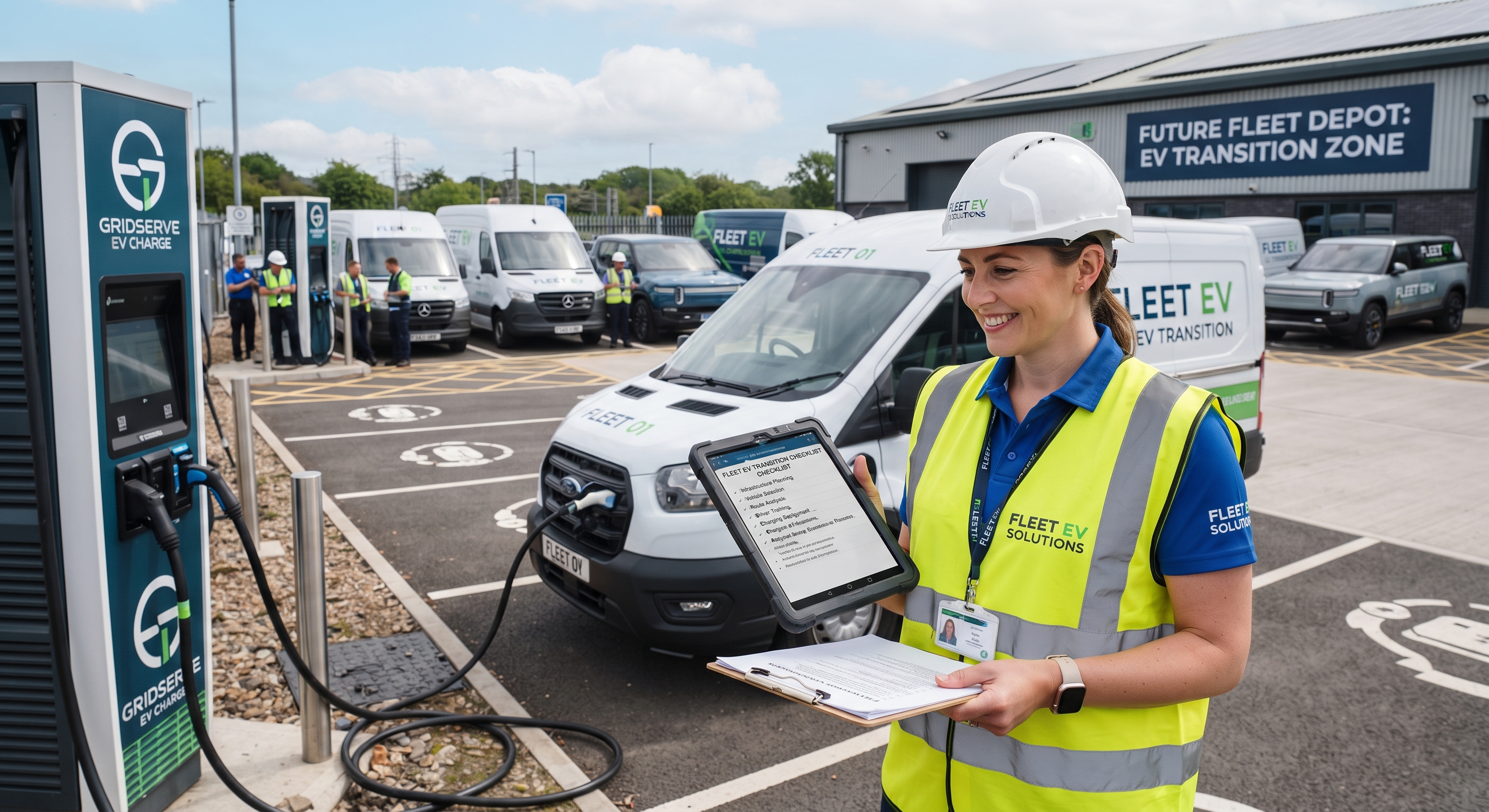
Your charging setup is the heartbeat of your new operation. It requires a strategy that balances immediate needs with future growth.
Before installing any hardware, you must assess the current power capacity at your business premises. Many older sites weren't built to handle the simultaneous draw of multiple rapid chargers.
This assessment is a vital part of any fleet transition to EV checklist. You should also investigate available grants from the Office for Zero Emission Vehicles. The Workplace Charging Scheme currently offers up to £350 per socket for up to 40 sockets.
For larger organisations, the Depot Charging Scheme provides even more significant support, though you must act quickly as the first application window closes on June 30, 2026.
Choosing the right hardware matters just as much. You'll need to decide between tethered and untethered units.
Tethered chargers have a permanently attached cable, which is much more convenient for busy depot environments. Untethered units require drivers to use their own cables, offering more flexibility for different vehicle types.
This EV fleet implementation checklist provides further technical guidance on selecting equipment that matches your specific duty cycles.
Depot and workplace charging solutions
Consulting with an electrical engineer is a non-negotiable step. They'll determine if your local grid needs an upgrade to support your new chargers.
We recommend planning for future scalability from day one. It's far cheaper to install extra cabling and ducting now than to dig up your car park again in two years.
You should also implement smart charging software. This technology manages peak loads by staggering charge times, protecting your site's power supply and reducing energy costs. If you need help coordinating these technical requirements, our fleet solutions team can guide you through the process.
Managing home and public charging
For drivers with off-street parking, home charging is the most cost-effective solution. Organise these installations early and set a clear reimbursement policy. This ensures drivers aren't out of pocket for business miles.
When your team is on the road, select a fuel card provider that integrates both electric and traditional fuels to simplify admin.
You must also define clear rules for public charging. Whilst ultra-rapid chargers are convenient, they're significantly more expensive than standard depot or home rates. Adding these rules to your transitioning fleet to EV checklist keeps operational costs under control. Speak with our consultants for a tailored strategy.
To see how much your business could save, get a custom quote today.

Analysing total cost of ownership and tax benefits
Moving a fleet to electric power requires a shift in how you view your budget. You shouldn't just look at the monthly lease rate; you must look at the Total Cost of Ownership (TCO). This includes everything from insurance and maintenance to the significant tax breaks currently available.
A robust EV transition checklist should prioritise these financial metrics to prove the business case to your board. For instance, from April 2026, the threshold for the Expensive Car Supplement for zero-emission vehicles has increased to £50,000.
This gives you more room to choose premium models without the heavy tax penalty that usually hits high-value vehicles.
Corporation tax relief is another major factor for your balance sheet. Although the 100% first-year capital allowance for new zero-emission cars ends on March 31, 2026, leasing remains an efficient way to manage these costs.
By opting for a lease, you can often offset the costs against your taxable profits, keeping your business cash flow healthy whilst you modernise your fleet.
Understanding 2026 tax implications
The tax landscape for the 2026/27 period is very favourable for electric adoption. The Benefit-in-Kind (BiK) rate for fully electric cars is fixed at just 4%. Compare this to high-emission petrol or diesel vehicles, which can reach up to 37%.
This massive gap makes electric car leasing a powerful tool for employee retention and satisfaction. Employers also benefit directly from reduced Class 1A National Insurance contributions, as these are calculated based on the vehicle benefit's low taxable value.
Comparing ICE versus EV running costs
Maintenance is where electric vehicles truly shine. With fewer moving parts, there are no gearboxes, clutches, or complex exhaust systems to fail. You should also account for the updated Vehicle Excise Duty (VED) rates.
From the 2026/27 tax year, electric vehicles are liable for a £10 first-year rate followed by a standard rate of £195. Even with these new charges, the fuel savings remain substantial. Adding these figures to your transitioning fleet to ev checklist allows for more accurate forecasting.
The table below shows the typical pence per mile (PPM) comparison based on current UK energy and fuel trends.
| Fuel Type | Average Pence Per Mile | Annual Cost (10,000 miles) |
|---|---|---|
| Diesel (Internal Combustion) | 16p | £1,600 |
| Electric (Home Charging) | 5p | £500 |
| Electric (Public Rapid) | 18p | £1,800 |
Keep a close eye on future pay-per-mile tax discussions. Whilst no definitive plans are in place yet, staying ahead of these trends by monitoring your real-world energy consumption is vital.
This data will help you refine future vehicle selections and keep your fleet lean and cost-effective for years to come.
To find out how our team can help you engage your drivers, get in touch with us today.
Engaging drivers through salary sacrifice and training
Your transition is only as successful as the people behind the wheel. While financial and logistical plans are vital, winning over your workforce keeps the business moving.
A robust EV transition checklist must prioritise clear communication to dispel myths and build excitement. This is where you move from spreadsheets to staff satisfaction. You can address the fear of change by showing drivers that an electric vehicle isn't just a tool for work, but a significant personal benefit.
Update your fleet policy to reflect new responsibilities, such as charging etiquette and cable care, to ensure everyone is on the same page.
The role of salary sacrifice in transition
Implementing an EV salary sacrifice scheme is perhaps the most effective way to drive adoption. It lets employees pay for a brand-new electric car from their gross salary, typically saving between 20% and 50% compared to a personal lease.
For many, this means accessing a premium Tesla or Audi for less than the monthly cost of a used petrol car. These schemes are designed to be cost-neutral for the employer.
The savings in National Insurance contributions usually cover the administrative running costs. It also helps you manage grey fleet risks by moving staff out of older, less reliable personal vehicles and into modern, safe, and fully maintained electric models.
Driver education and change management
Education is the best cure for range anxiety. Organise test drive days and workshops to help your team understand the transition from litres to kilowatt-hours.
A key part of your fleet transition checklist should be a bespoke training programme. This should focus on driving techniques like regenerative braking. Mastering this can significantly extend a vehicle's range in urban environments. Provide digital guides that explain how to use the various UK charging networks.
This ensures your drivers feel confident when they aren't at the depot or charging at home.
Gathering feedback from your early adopters is also a powerful tool. When colleagues share their positive experiences, it naturally encourages the rest of the workforce to make the switch.
If you are ready to launch a scheme that your staff will love, contact our salary sacrifice specialists.
To learn how our digital tools can simplify your fleet oversight, get in touch with our team today.
Streamlining operations with FleetHub and ongoing monitoring
The hard work of vehicle selection is done, but the real test is the day-to-day management of a mixed fleet.
You need a system that handles both your legacy diesel vans and your new electric cars without doubling your workload. This is a vital stage in your fleet transition to EV checklist. Fleet management software for SMEs lets you track real-world performance in real time.
You can monitor energy consumption to see if your vehicles are hitting the range targets you predicted in your initial audit. It's about turning data into a competitive advantage.
Compliance doesn't stop just because the fuel source has changed. Electric vans weighing between 3.5 and 4.25 tonnes now fall under the Class 7 MOT regime, requiring their first test after three years.
Automating these reminders through a digital platform ensures you never miss a deadline. Telematics data is also your secret weapon. It identifies which remaining combustion vehicles idle excessively or drive short, predictable routes.
These are your prime candidates for the next phase of electrification, allowing you to scale your transition with confidence.
Using FleetHub for transition management
FleetHub centralises all your vehicle data into one clear view. You can compare the running costs of your electric units against your remaining petrol models to validate your savings. It's not just about the vehicles; it's about the people.
The software tracks driver behaviour to ensure your team charges efficiently and uses regenerative braking correctly.
Managing maintenance schedules through a single dashboard prevents the admin headache of juggling different service intervals for diverse engine types. This level of transparency builds immediate trust with your stakeholders.
Future-proofing your fleet strategy
A static plan will quickly become outdated. Review your fleet management services annually to stay ahead of rapid technological shifts.
This lets you adapt to new government regulations, such as mandatory payroll reporting for company car benefits starting in April 2026. Stay informed about local clean air zones that might affect your routes.
Finally, start planning for replacement cycles now. Whether you are considering the second life of EV batteries or looking at the latest BiK rates, a proactive EV fleet transition checklist keeps your business resilient and ready for the 2030 deadline.
Speak to our fleet experts about your transition today
Future-proof your business with a smarter fleet
Transitioning to an electric fleet is about more than just replacing vehicles; it's about evolving your business model for a sustainable future.
You now have the knowledge to audit your operations, maximise tax efficiencies, and win over your drivers with high-value benefits. This transitioning fleet to EV checklist ensures your logistical and financial foundations are rock solid before the 2030 deadline arrives.
You can maintain business continuity whilst reducing your total cost of ownership and building a greener reputation amongst your clients and competitors alike.
We make that move effortless. Whether you need our innovative FleetHub management software to track performance or an expert salary sacrifice implementation to delight your team, our bespoke solutions for UK SMEs are tailored to your unique requirements.
Don't let the complexity of grid upgrades or shifting BiK rates slow your progress. The road to zero emissions is much smoother when you have a savvy ally by your side. Speak to our fleet experts about your transition today and turn these plans into a high-performance reality.

Frequently Asked Questions
What is the most important item on a transitioning fleet to EV checklist?
The most critical item on any transitioning fleet-to-EV checklist is a comprehensive audit of your current vehicle duty cycles and mileage patterns.
You cannot make informed decisions about range or infrastructure without understanding exactly how your fleet moves each day.
This data identifies which vehicles can be swapped immediately for electric models and which require more complex logistical planning to ensure service delivery remains uninterrupted.
How much can a business save by switching to an electric fleet in 2026?
Businesses can save significantly through lower fuel costs and reduced maintenance requirements because electric motors have far fewer moving parts than internal combustion engines.
For example, employees can save between 20% and 50% on new vehicles through salary sacrifice schemes.
Additionally, the 4% Benefit-in-Kind rate for the 2026/27 tax year offers substantial National Insurance savings for employers compared with high-emission petrol alternatives.
What are the Benefit-in-Kind rates for electric cars in the 2026/27 tax year?
The Benefit-in-Kind rate for fully electric cars in the 2026/27 tax year is fixed at 4%. This rate is scheduled to increase incrementally by 1% each year thereafter, reaching 5% in 2027/28 and eventually 9% by the 2029/30 tax year.
These low rates remain a primary driver for adoption, making electric vehicles significantly more tax-efficient for your employees than traditional petrol or diesel cars.
Can small businesses install rapid chargers at their premises?
Small businesses can install rapid chargers if their existing electrical capacity supports the high power draw. Consult an electrical engineer to determine whether a grid upgrade is necessary before purchasing any hardware.
Grants like the Workplace Charging Scheme can provide up to £350 per socket to help offset the initial installation costs for up to 40 charging sockets across your sites.
How do I reimburse employees for charging their company EV at home?
You can reimburse employees using the Advisory Electricity Rate set by HMRC, which is currently the simplest method for tax-free reimbursement.
Some businesses prefer to pay the actual cost of electricity used for business miles instead.
This approach requires smart home chargers that provide detailed energy usage reports to separate personal and professional consumption, ensuring your expense claims are accurate and transparent for tax purposes.
Is an EV salary sacrifice scheme difficult for an SME to manage?
Managing an EV salary sacrifice scheme is straightforward for SMEs when you partner with a specialist provider that handles the administrative heavy lifting.
The provider manages vehicle selection and maintenance, while your payroll team simply adjusts gross salary deductions.
These schemes are designed to be cost-neutral for the business and often result in overall savings because employer National Insurance contributions are reduced.
What happens if an electric vehicle range is not enough for a specific job?
If an electric vehicle's range doesn't meet the requirements for a specific high-mileage task, you might consider short-term leasing for specific projects.
However, modern EVs often provide over 200 miles of real-world range, which covers most UK daily journeys. Including a detailed range assessment in your EV transition checklist helps ensure you match the right vehicle to the right operational duty cycle.
How does fleet management software help with the switch to electric?
Fleet management software helps by centralising data on energy consumption, charging schedules, and vehicle performance in one digital dashboard.
It allows you to monitor real-world efficiency and automate service reminders for your new electric assets to ensure fleet compliance.
With this digital oversight, you can identify further opportunities for electrification and ensure your entire operation remains cost-effective throughout the transition process.

Guide Verified & Audited By
Director at Fleetsauce
Why Choose Fleetsauce?
At Fleetsauce, we specialise in helping SMEs find the right car leasing solutions — not just the cheapest leasing deal.
With access to a wide range of leasing funders and hundreds of franchised dealerships across the UK, we find the best leasing deals and vehicle availability for your business and employees.
You’ll work directly with an expert dedicated account manager who understands the needs of companies — offering expert advice with a friendly, professional approach that you can always call directly.
With a five-star rating from Trustpilot, we are proud of our reviews and is evidence that we look after our new and existing customers.
Whether you're managing one vehicle or a fleet, we make business leasing simple, flexible, and cost-effective.


What our customers say...

Thank you to everyone, especially to Artur and Caitlin, for their great customer service. They were always polite and quick to respond to any queries throughout the process, from the initial quote to the delivery of my car.
Artur and Caitlin were excellent from start to finish, I would recommend them and Fleetsauce to anyone. I will certainly be using them again in the future.
Working with Steve at Fleetsauce was great as he listened to what options I was considering and then quickly put together vehicles that were available. Once I had decided what I wanted Steve then quickly put everything into motion. We have recently received 3 new vans and shortly will be looking at taking delivery of a new company car. Great service and fully recommend Fleetsauce.