
By 2026, 24% of all new vans sold in the UK must be zero-emission to comply with the government's ZEV mandate. It is a significant shift that is quickly turning the traditional diesel engine into a financial liability for many firms.
You are likely feeling the pressure of these looming deadlines, perhaps worrying if an electric van lease can actually handle a full day of multi-drop deliveries without a flat battery. We understand those concerns because we talk to business owners facing them every single day.
This guide simplifies the transition by showing you how to turn 2026 regulations into a competitive advantage.
You will discover how to slash your monthly overhead, navigate the latest tax brackets, and choose vehicles that truly meet your operational needs.
We have stripped away the jargon to provide a clear roadmap for future-proofing your fleet the Fleetsauce way.
From HMRC updates to the latest long-range models, here is everything you need to keep your business moving efficiently without the high upfront costs of buying outright.
Key Takeaways
- •
Master the 2026 ZEV mandate to future-proof your business against rising diesel costs and shifting UK regulations.
- •
Uncover the full financial picture by comparing Total Cost of Ownership (TCO) and maximising VAT reclamation on your next electric van lease.
- •
Learn how to accurately match battery range and payload capacity to your specific trade requirements for peak operational performance.
- •
Simplify your transition with bespoke fleet solutions and tech-driven tools like FleetHub that take the hassle out of vehicle management.
Table of Contents
Why 2026 is the Pivotal Year for an Electric Van Lease
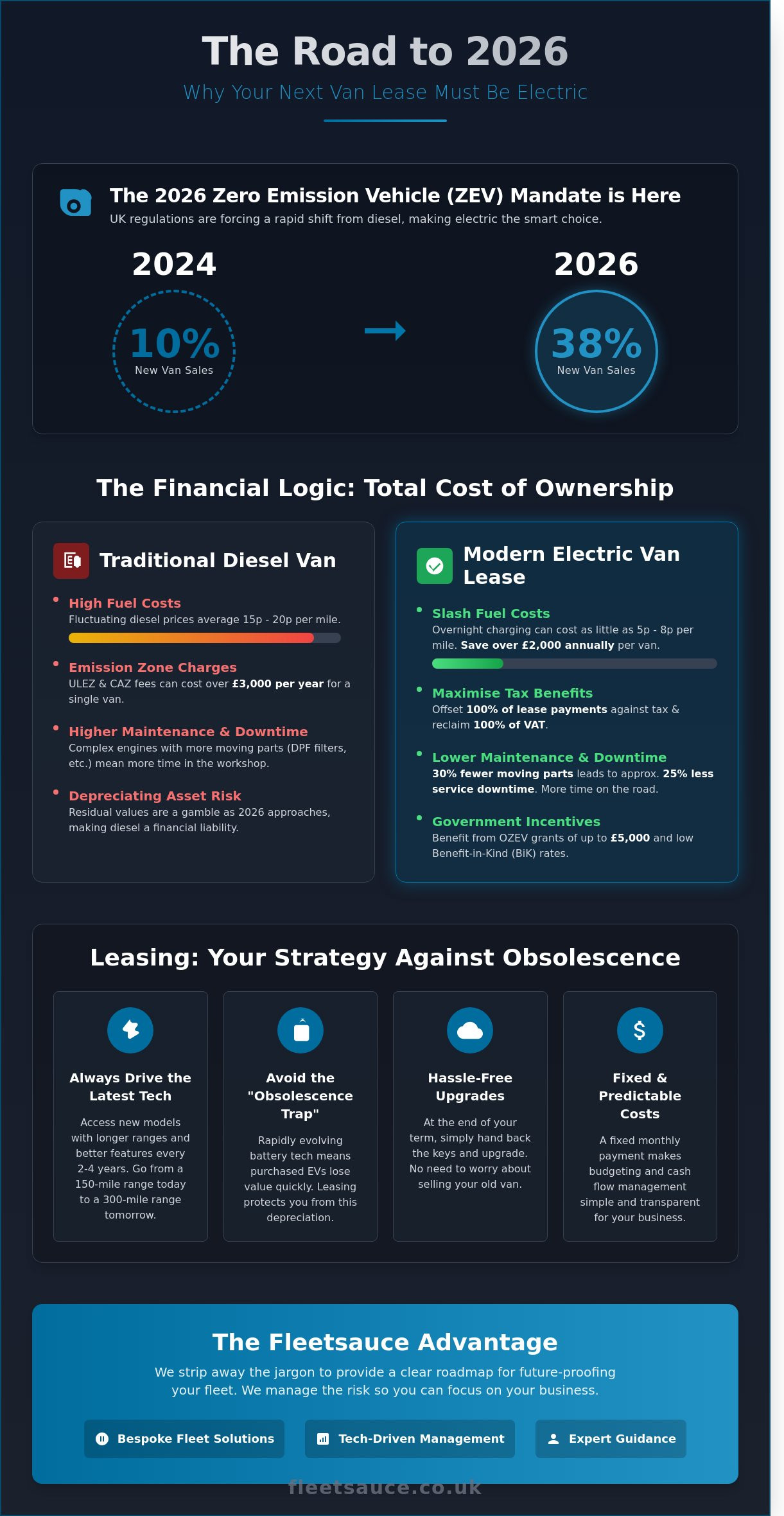
2026 is a definitive line in the sand for UK businesses. The government's Zero Emission Vehicle (ZEV) mandate requires 38% of new van sales to be zero-emission by 2026, a sharp rise from the 10% target in 2024.
This regulation forces a massive shift in what manufacturers build and sell. If you're looking for an electric van lease, this year marks the moment when supply, infrastructure, and policy finally align.
You'll see the landscape of electric van manufacturers shift rapidly as they prioritise electric production over traditional combustion engines to avoid heavy fines.
Diesel prices remained volatile throughout 2024, often hovering around £1.50 per litre. Meanwhile, commercial electricity rates are showing signs of long-term stability as the UK grid decarbonises.
Staying with diesel doesn't just cost more at the pump. It incurs additional costs within urban areas. With the ongoing expansion of Ultra Low Emission Zones (ULEZ) and the increasing prevalence of Clean Air Zones (CAZs) across the country, operating a non-compliant van can cost your business up to £12.50 every single day.
These costs add up to over £3,000 a year for a single vehicle entering such a zone daily.
Understanding the ZEV Mandate Impact
Manufacturers are now prioritising electric platforms to avoid government penalties. This means the best tech and the most competitive deals are moving toward EVs. Residual values for late-model diesel vans are becoming a gamble.
Choosing the Fleetsauce way means you aren't left holding a depreciating asset. We help you pivot your fleet strategy before the 2026 deadline makes diesel a liability. By switching now, you secure access to the newest models before the 2026 rush begins.
Leasing as a Risk Management Strategy
Battery technology moves fast. A van with a 150-mile range today might be replaced by a 300-mile model in three years.
Choosing an electric van lease lets you avoid the "obsolescence trap" where older EV tech loses value quickly. You get a fixed-term contract with predictable monthly costs, which is vital for business cash flow. We manage the disposal risk at the end of the term. You simply hand the keys back and upgrade to the latest tech.
It's a hassle-free way to keep your business moving without worrying about falling resale prices.
The Financial Logic, Comparing TCO and Tax Benefits
Monthly rentals tell only half the story. To understand the true value of an electric van lease, you must look at the Total Cost of Ownership (TCO).
This metric provides a transparent view of your total investment by combining the lease price with fuel, tax, and servicing costs.
When you crunch these numbers, the "expensive" electric option often proves to be the most economical choice for your bottom line.
Tax Efficiencies for Business Contract Hire
Leasing an electric commercial vehicle unlocks significant tax advantages that simple ownership cannot match.
Businesses can typically offset 100% of their monthly lease payments against taxable profits, directly reducing Corporation Tax obligations.
This is a major win for cash flow management. If your organisation is VAT registered, you can usually reclaim 100% of the VAT on your monthly rentals, provided the van is used exclusively for business purposes.
The UK government continues to incentivise the transition through the Office for Zero Emission Vehicles (OZEV). Currently, government grants for electric vans provide up to £2,500 for small vans and £5,000 for larger models. These grants are applied at the source, helping us keep your initial rentals and monthly costs highly competitive.
Regarding Benefit-in-Kind (BiK), electric vans remain a strategic choice. While zero-emission vans will move to a flat-rate BiK charge from April 2025, this fixed cost remains remarkably low compared to the percentage-based tax brackets applied to passenger cars.
For drivers, this represents a massive win in take-home pay through 2026 and beyond.
Fuel and Maintenance Savings
Fuel represents the highest variable cost for any fleet. In 2026, diesel prices continue to fluctuate, often sitting around 15p to 20p per mile for standard transit-sized vans. In contrast, charging an electric van on a dedicated business overnight tariff can cost as little as 5p to 8p per mile.
For a van covering 20,000 miles a year, this equates to an annual fuel saving of over £2,000.
This is the Fleetsauce way of driving efficiency.
Fleet maintenance is where the financial logic becomes undeniable. Electric drivetrains have roughly 30% fewer moving parts than internal combustion engines. You can forget about expensive DPF filters, spark plugs, or complex gearbox repairs.
This simplicity reduces service downtime by approximately 25%, keeping your drivers on the road rather than in the workshop.
To make life even easier, our Fleetsauce maintenance packages offer fixed-cost peace of mind.
We handle the logistics and the costs, ensuring your fleet stays operational without any nasty surprises. It is a bespoke approach designed to take the hassle out of your daily operations.
Ready to see how the numbers stack up for your business? Explore our latest electric van leasing deals and get a tailored quote today.
Operational Reality, Range, Payload, and Charging
Choosing an electric van lease means looking past the glossy brochure figures to see how a vehicle handles a rainy Tuesday in November.
Operational success depends on matching the battery to your specific duty cycle. If your drivers cover 150 miles a day, a van with a 200-mile range provides the perfect safety net.
However, payload and weather play massive roles in your daily efficiency.
The "payload penalty" is a common worry that's now mostly a myth. UK legislation allows drivers with a standard Category B licence to operate alternatively fuelled vehicles up to 4.25 tonnes, compared to the usual 3.5-tonne limit for diesel.
This 750kg allowance directly compensates for the weight of the battery pack. It ensures your carrying capacity stays high without requiring a specialised HGV licence.
To help with the transition, businesses can still access government grants for electric vans, which offer up to £5,000 for large vans, making the upfront logic even stronger.
Decoding WLTP Range for Real-World Use
WLTP figures are useful for comparisons, but they don't tell the whole story. We advise fleet managers to budget for 70% of the official range during the winter months. Cold temperatures affect battery chemistry, and heating the cabin draws significant power. By 2026, the market will have shifted.
The latest Renault Master E-Tech delivers an official range of 285 miles, meaning even with a 30% winter drop, you still have nearly 200 usable miles.
Selecting the right battery size is the "secret sauce" to avoiding overspending on capacity you'll never use.
Charging Strategies for Busy Fleets
Charging is the heartbeat of your operation. For multi-drop delivery businesses, rapid charging at 100kW or higher can add 80% charge in about 45 minutes, perfect for a driver's lunch break. However, the most cost-effective method remains a "home-first" policy. With roughly 60% of UK van drivers taking their vehicles home, installing domestic chargers is a smart move.
Our FleetHub platform simplifies this by tracking every charging session. It automatically separates business miles from personal use, making expense reimbursement easy without the paperwork headache. It's a professional, hassle-free way to keep your team moving while keeping costs transparent.
When you secure an electric van lease through Fleetsauce, we don't just hand over the keys. We help you map out these charging requirements to ensure your fleet stays productive from day one.
It's about finding the balance between battery size, charging speed, and daily mileage to keep your business profitable.
Choosing the Right Electric Van for Your Business
Finding the perfect match for your fleet involves more than just picking a brand you like. It's about operational reality.
You need to calculate your maximum payload requirements immediately. Electric batteries are heavy; they naturally reduce the weight you can carry compared to older diesel models. However, the UK government currently allows a 4.25-tonne derogation. This means drivers with a standard Category B licence can operate heavier electric vans that would otherwise require a C1 licence.
It's a massive win for businesses that need extra capacity without the added training costs.
Range anxiety is a thing of the past if you plan properly. Track your daily mileage for at least 14 days. If your drivers average 80 to 100 miles per day, almost every modern electric van lease option on the market will suffice.
Focus on your downtime instead.
If your van sits idle for eight hours overnight, a 7kW wallbox will fully charge most 50kWh batteries while your team sleeps.
For those doing 200 miles or more, look for vans with 100kW rapid charging to ensure 10-80% top-ups take less than 45 minutes.
Don't ignore the fine print on battery health. Most manufacturers, such as Vauxhall and Ford, now offer an 8-year or 100,000-mile battery warranty. We recommend checking the state-of-health (SOH) guarantees.
Most brands promise at least 70% capacity over that period. If you need a bespoke setup, like a refrigerated unit or a tipper, check lead times for chassis cabs now. Factory orders for 2026 models are already filling up, with wait times often stretching between six and nine months for specialised conversions.
Small vs Medium vs Large E-Vans
Small electric vans like the Renault Kangoo E-Tech are the kings of the city.
They offer a volume of roughly 3.3 to 4.2 cubic metres, making them ideal for "last-mile" couriers. Medium vans remain the UK's most popular choice.
Models like the Volkswagen ID. Buzz Cargo balance a professional image with a 650kg payload. For maximum volume, the Ford E-Transit offers up to 15.1 cubic metres.
It's the heavy hitter for those who refuse to compromise on space.
Key Features to Look For
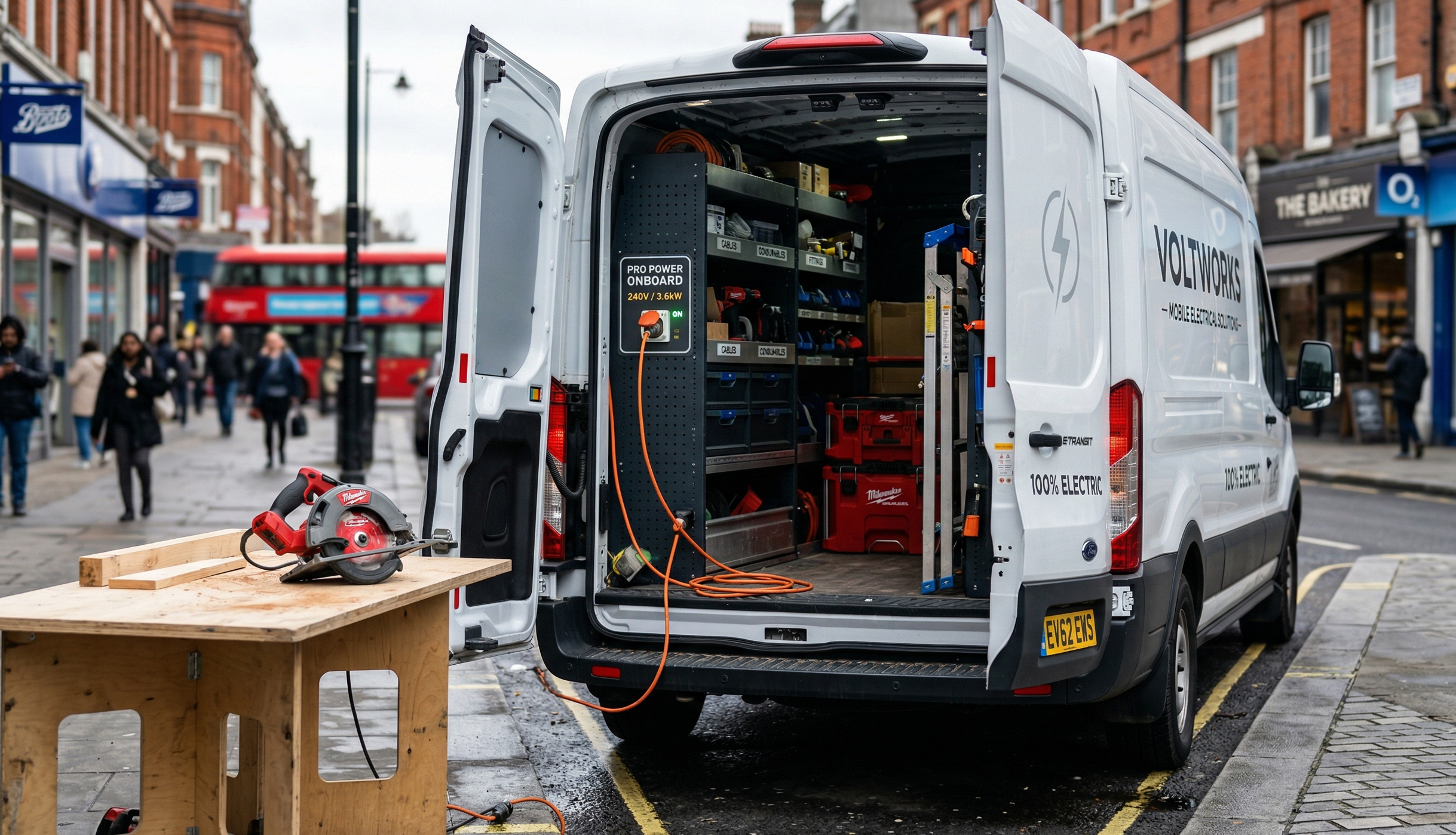
V2L (Vehicle-to-Load) technology is a game-changer for tradespeople. It allows you to plug power tools directly into the van's battery, essentially turning your vehicle into a mobile power station.
Inside the cabin, EVs offer a much quieter, more refined environment. This reduces driver fatigue significantly. Always test the regenerative braking settings too.
Strong "one-pedal" driving modes are perfect for stop-start London traffic, as they feed energy back into the battery every time you lift off the accelerator.
Ready to upgrade your fleet? Explore our most competitive electric van lease offers and find the right fit for your trade.
The Fleetsauce Advantage, Bespoke Fleet Solutions
Transitioning to a zero-emission fleet shouldn't feel like a leap into the unknown. We make the process simple.
Our team provides bespoke leasing quotes based on your actual business mileage.
Whether you're a local courier covering 50 miles a day or a national contractor hitting the motorway, we build the contract around your specific requirements.
We don't believe in one-size-fits-all finance.
You won't talk to a bot or a generic call centre. Our UK-based team consists of real people who live and breathe the UK van market.
We understand that a business in the Highlands has different needs than one operating inside London's Ultra Low Emission Zone.
We help you manage compliance and maintenance so your fleet stays on the road and your business keeps moving.
Our experts handle the technical details so you can focus on your core operations.
FleetHub, Your Command Centre
Managing an electric van lease requires data to ensure you're getting the best return on investment.
FleetHub is our bespoke answer to fleet management. It tracks EV performance and driver efficiency in real-time.
This allows you to identify which drivers might need more training on regenerative braking or where charging schedules can be improved to save costs.
-
Automated MOT and service reminders ensure you never miss a deadline.
-
Real-time performance tracking helps reduce energy consumption across the fleet.
-
All lease documentation is centralised for easy access during audits or vehicle handovers.
By centralising your data, you reduce the administrative burden of running multiple vehicles. FleetHub ensures your transition to electric is backed by hard numbers, not guesswork.
Getting Started with Fleetsauce
Our consultation process is where we find "the sauce" for your business. We look at your charging infrastructure, daily routes, and payload requirements.
We've helped businesses transition fleets of 10 or more vehicles by providing clear, data-driven advice.
Transparency is our priority. You'll see clear pricing with no hidden admin fees. We want to be your long-term partner, not just a one-time provider.
The shift to electric is a significant change, but it doesn't have to be a headache. We'll guide you through the latest grants and tax incentives available in the UK market. Ready to upgrade?
You can explore our latest electric van lease deals today and see how much your business could save by making the switch to a cleaner, more efficient fleet.
Our team is ready to help you find the perfect match for your business needs.
Future-Proof Your Fleet for 2026 and Beyond
The road to 2026 is already paved with clear financial advantages for UK businesses. With the ZEV mandate requiring 38% of new van sales to be zero-emission by 2026, transitioning isn't just about sustainability; it's about staying ahead of major regulatory shifts.
You'll slash your Total Cost of Ownership through lower fuel expenses and reduced maintenance, while taking full advantage of current tax incentives. It's a strategic move that protects your bottom line as urban access regulations tighten across the country.
Securing the right electric van lease shouldn't feel like a chore. We provide a transparent, commission-based brokerage service that puts your specific business needs first.
Our UK-based team of experts handles the technical heavy lifting, ensuring your new vehicles meet every range and payload requirement.
You'll also get our FleetHub management software included to keep your operations running smoothly.
We're real people based in the UK, ready to bring "the sauce" to your fleet strategy with honest advice and bespoke solutions.
Take the first step toward a cleaner, more profitable future today.
Get a Bespoke Electric Van Lease Quote and let's get your business moving.
Frequently Asked Questions
Is an electric van lease cheaper than a diesel lease in 2026?
Yes, while the monthly rental for an electric van lease might be 10% to 15% higher than a diesel equivalent, the total cost of ownership is usually lower.
You save approximately £150 for every 1,000 miles driven because electricity costs significantly less than diesel. With the UK's ZEV mandate requiring 38% of new van sales to be zero-emission in 2026, manufacturers are offering aggressive discounts to hit their targets.
How long does it take to charge a commercial electric van?
Most modern commercial vans take between 30 and 45 minutes to reach 80% charge when using a 100kW rapid public charger.
If you're charging at the office or a driver's home with a standard 7kW wallbox, a full charge typically takes 8 to 12 hours.
This makes overnight charging the most efficient way to ensure your fleet is ready for work every morning.
Can I reclaim VAT on my electric van lease payments?
You can usually reclaim 100% of the VAT on your electric van lease payments if your business is VAT registered and the vehicle is used for business purposes.
Unlike cars, which are often subject to a 50% VAT reclaim, vans are classed as commercial vehicles by HMRC.
This provides a clear financial benefit for businesses looking to reduce their tax liability while upgrading their fleet.
What happens if the battery fails during my lease term?
You don't need to worry about battery degradation, as almost all manufacturers offer a dedicated battery warranty of 8 years or 100,000 miles.
Since a standard lease term lasts between 2 and 5 years, the battery is fully covered by the manufacturer for the duration of your contract.
We only partner with reputable brands to ensure your business stays mobile without any unexpected repair bills.
Are there still government grants for electric vans in 2026?
The UK government's Plug-in Van Grant has historically offered up to £2,500 for small vans and £5,000 for large vans to bridge the price gap.
While these specific subsidies are regularly reviewed, the ZEV mandate now places the financial responsibility on manufacturers to lower prices.
This shift means you'll often find better value through manufacturer-supported finance deals than through direct government grants alone.
How do I manage charging for drivers who take their vans home?
You can easily manage home charging with smart chargers that track energy usage specifically for the vehicle. Drivers can then be reimbursed at the HMRC Advisory Electricity Rate, currently 8p per mile.
Many modern fleet management systems now automate this process, sync with the driver's energy provider, and generate accurate reports, making your admin completely hassle-free.
Do electric vans have a lower payload capacity than diesel ones?
Electric vans actually maintain competitive payloads because the UK government allows drivers with a standard Category B licence to drive alternative-fuel vehicles up to 4.25 tonnes.
This is a significant increase from the 3.5-tonne limit for diesel vans, specifically designed to offset the weight of the battery pack. It means you can carry the same heavy loads without putting your drivers through HGV training.
What is the best electric van for a small business in 2026?
The Ford E-Transit is currently the top choice for most businesses due to its 196-mile range and versatile load space.
If you need something more compact for city deliveries, the Vauxhall Vivaro Electric offers a great balance of range and payload at a very competitive price point. Our team helps you compare these models to find the "sauce" that fits your specific daily mileage and cargo needs.

Guide Verified & Audited By
Director at Fleetsauce