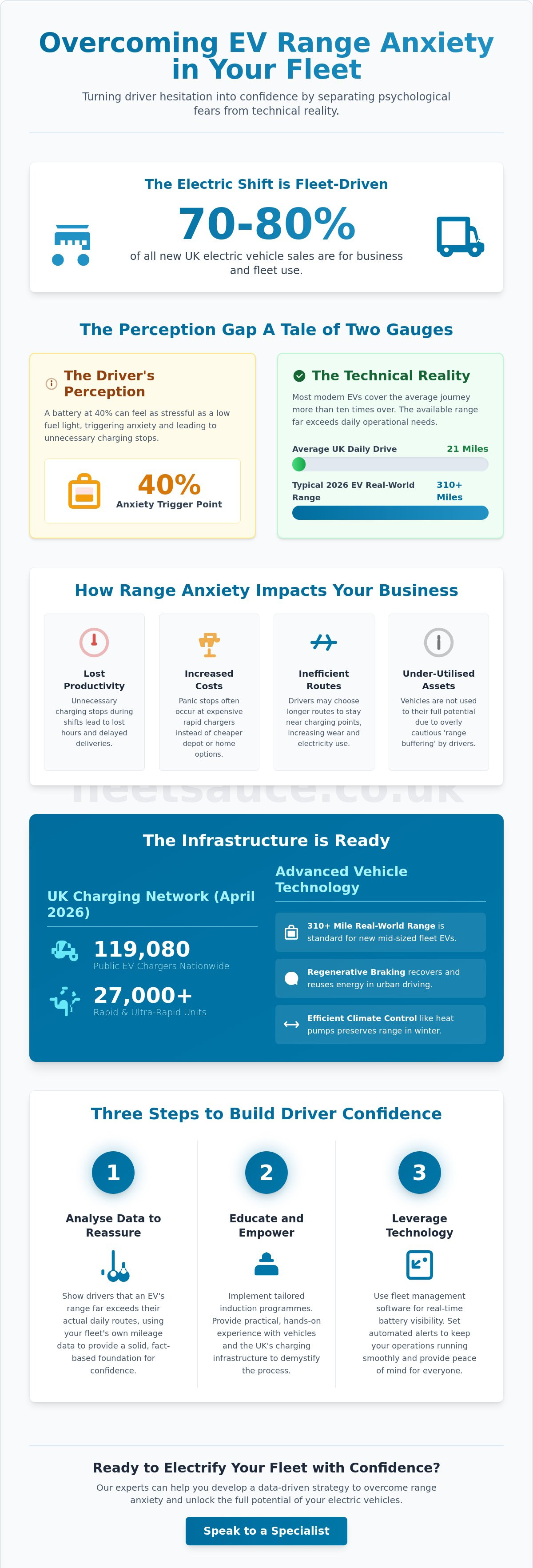
Did you know that 70% to 80% of all new electric vehicle sales in the UK are now driven by fleet and business registrations?
Despite this massive shift, your team may still hesitate to swap their diesel keys for a plug-in alternative.
You have likely noticed that managing driver range anxiety in EV fleet operations is often more about tackling psychological barriers than technical ones.
It is frustrating to see productivity dip because a driver makes an unnecessary charging stop out of fear rather than necessity.
We know moving to a zero-emission future can feel like a complex puzzle. You want a confident workforce and optimised routes that do not leave your drivers stranded or stressed.
This guide shows you how to turn that hesitation into confidence by addressing the psychological and technical roots of range anxiety.
We will explore how to use data to reassure your team, keep your fleet moving efficiently, and take full advantage of lower Benefit in Kind costs.
From understanding 2026 ZEV mandate requirements to mastering smart route planning, you'll discover how to transform your fleet into a high-performing electric powerhouse.
Key Takeaways
- •
Understand why range anxiety persists despite battery improvements and how to tackle these psychological barriers through clear communication.
- •
Explore how 2026 battery technology and the ultra-rapid charging network simplify managing driver range anxiety in EV fleet management.
- •
Identify the best EV candidates for your business by matching real-world vehicle range to your fleet's daily mileage data.
- •
Boost workforce productivity with tailored driver induction programmes that provide practical experience with the UK's charging infrastructure.
- •
Use FleetHub to gain real-time visibility of battery levels and set automated alerts to keep your operations running smoothly.
Table of Contents
Understanding Range Anxiety in the Modern UK Fleet
Many fleet managers face a peculiar challenge. Their vehicles have the range, but their drivers lack the confidence to use it. To move forward, we must first address What is range anxiety? and why it remains such a potent hurdle.
At its core, it is the psychological fear that an electric vehicle will run out of charge before reaching its destination or a charging point. Although modern EVs in 2026 often deliver real-world ranges over 300 miles, the fear persists.
This matters because fleet and business registrations account for 70% to 80% of all new electric vehicle sales in the UK.
We are putting more people into EVs than ever, but the internal combustion engine's legacy still sits firmly in the driver's seat.
The gap between perception and reality is vast. Research from March 2026 shows that the average daily driving distance in the UK is approximately 21 miles.
Most electric cars can cover this distance ten times over without needing a plug. However, a driver seeing a battery at 40% often feels as much stress as seeing a fuel light flicker on a diesel van.
This psychological weight can lead to refused routes or excessive downtime as drivers seek out "safety" charges they do not actually need. It creates a friction point that slows down your entire operation.
The Psychological Barrier to Electrification
Drivers often struggle to shift from a petrol-station mindset to a smartphone-charging model. You don't wait for your phone to hit 1% before plugging it in; you charge it whilst you sleep or work.
When drivers lack this confidence, their behaviour changes. They might drive more tentatively or refuse specific long-distance jobs. This anxiety is particularly prevalent amongst high-mileage drivers who have spent decades relying on the visible reassurance of fuel gauges.
Managing driver range anxiety in EV fleet environments involves breaking these old habits. It requires proving that the vehicle is a tool they can trust, not a liability that might leave them stranded on the hard shoulder.
Impact on Business Productivity
When range anxiety takes hold, your bottom line suffers. Drivers may make unnecessary charging stops during their shift, costing hours and delaying deliveries.
These stops often happen at expensive rapid chargers because drivers panic, rather than at cheaper depot or home chargers. Your administrative team may also get bogged down with complaints about vehicle suitability.
Some drivers even choose longer, less efficient routes simply because they pass more public charging points. This "safety first" routing increases wear and tear and wastes electricity.
Effectively managing driver range anxiety in EV fleet operations ensures your team stays on the most efficient path. It eliminates the "range buffer" drivers often build in, which can leave vehicles under-utilised throughout the working week.
Contact our experts to discuss your fleet transition.
The Technical Reality of Electric Vehicle Range in 2026
The UK charging network has transformed. As of April 2026, there are 119,080 public EV chargers across the country. Over 27,000 of these are rapid or ultra-rapid units. This means your drivers are never far from a high-speed boost. Modern battery tech has also leapt forward.
Many new models now offer real-world ranges of over 300 miles as standard. This shifts the conversation from "Can I make it?" to "When is it most convenient to stop?". Managing driver range anxiety in EV fleet logistics is now supported by a robust infrastructure that barely existed a few years ago.
Understanding the technical reality of EV range helps demystify these machines for your workforce.
Modern thermal management systems keep batteries at the right temperature, while heat pumps ensure cold winter mornings don't drain the battery just to keep the cabin warm. In urban environments, regenerative braking actually puts energy back into the battery every time a driver lifts off the pedal.
This self-sustaining cycle rewards efficient driving and extends the distance between plugs.
Advancements in Battery Density and Efficiency
By 2026, the average mid-sized fleet EV comfortably delivers a real-world range of 310 miles on a single charge.
This is a vast improvement over models from five years ago, which often struggled to break the 200-mile barrier in mixed conditions. Higher energy density means smaller, lighter batteries that do more work.
Solid-state components in premium models are already starting to influence the wider market. These developments provide the ultimate safety net for managing driver range anxiety in EV fleet operations.
Real World Factors Affecting Mileage
Range is not a static number. For electric vans, payload and towing significantly affect how far a charge lasts.
A fully loaded van on a motorway will deplete its battery faster than a half-empty vehicle in stop-start city traffic. High motorway speeds are more demanding than urban routes where regenerative braking thrives.
To help, 2026 EV navigation systems now integrate live weather forecasting. They adjust range estimates based on wind speed and temperature in real time. This level of precision gives your team total transparency. If you want to find the right vehicle for your specific routes, you can browse our latest electric car leasing deals to see current range specifications.
Strategic Vehicle Selection and Data Driven Planning
Data is your most powerful tool for overcoming hesitation. Managing driver range anxiety in EV fleet management is much easier when you start with the right hardware. Start by evaluating the actual daily mileage of every vehicle in your current fleet.
Whilst a driver might remember the one time they drove 300 miles in a day, your telematics will likely show that their average is much lower. In the UK, the average daily driving distance is approximately 21 miles.
Showing this data to a driver is often the first step in dismantling their fear.
When selecting new vehicles, we recommend a simple 20% safety buffer. Choose an EV with a real-world range that exceeds your longest typical daily route by at least 20%.
This extra capacity accounts for unexpected diversions, heavy traffic, or extreme weather conditions without the driver needing to worry about the battery percentage.
You also need to consider charging speeds. For vehicles that occasionally make long-distance trips, choose models with high-speed charging so stops are brief and don't disrupt the workday.
Selecting the Right EV for Specific Roles
Not every driver needs a long-distance cruiser. High-mileage sales representatives or regional managers will benefit from the extensive range and Supercharger access in our Tesla lease deals.
These vehicles are designed for the motorway and offer the software integration needed to plan stops automatically. Conversely, urban delivery drivers can often use vehicles with smaller, lighter batteries.
These are more efficient in city traffic and easier to charge at a depot. Premium models often reduce anxiety because their on-board computers accurately predict remaining range based on driving style and terrain.
Data-Driven Route Optimisation
Planning is the antidote to anxiety. Use historical trip data to map exactly where and when your vehicles will need to charge.
Fleet management technology gives you peace of mind by letting you identify charging deserts before they become a problem. Prioritise routes that end at locations with existing infrastructure, such as a driver's home or a company depot.
This ensures the vehicle starts every day with a full battery. For national travel, modern route planners can now identify high-power hubs with multiple stalls, which reduces the risk of arriving at a broken or occupied charger.
Empowering Drivers Through Education and Infrastructure
Knowledge is the ultimate cure for uncertainty. While technical specifications are vital, how your team interacts with their vehicles determines the success of your transition. Managing driver range anxiety in EV fleet operations requires a shift from passive ownership to active management.
You can't simply hand over the keys and expect old habits to work. A comprehensive induction programme ensures every driver understands how to get the most from their battery.
Include hands-on sessions where drivers practice using different charger types, from rapid motorway hubs to slower destination units at the office.
Effective Driver Training and Behavioural Change
Teach your drivers the art of one-pedal driving. This technique uses the motor to slow the vehicle, which recovers energy that would otherwise be lost as heat during braking. It's a game-changer for urban routes.
You should also explain how to interpret the dashboard correctly. A battery percentage is often more reliable than a fluctuating 'miles remaining' estimate, which can change based on the last few minutes of driving.
Another key tip is pre-conditioning. By heating or cooling the cabin whilst the car is still plugged in, the driver uses grid power rather than battery energy. This simple habit preserves range for the journey and ensures drivers start their day in comfort.
Establishing a Robust Charging Infrastructure
In EV fleet settings, infrastructure is the physical backbone of driver confidence. Installing workplace charging points guarantees that every shift starts with a full battery. It removes the stress of finding a public charger before the day even begins.
Also consider supporting employees with home charging, as it is often the most cost-effective and convenient option. For the public network, provide every driver with a universal RFID card or a dedicated app.
This eliminates the frustration of arriving at a charger only to find it requires a specific account they don't have. Finally, establish clear protocols if the battery hits a low threshold. Knowing exactly who to call or where to go at 10% provides a vital safety net that keeps your team moving without fear.
To ensure your infrastructure is ready for 2026, you can contact our fleet specialists for tailored advice.
Leveraging Fleet Management Technology for Peace of Mind
Technology provides the ultimate safety net for your operations. Whilst training and infrastructure build a solid foundation, real-time data ensures that nothing is left to chance. Managing driver range anxiety in EV fleet environments becomes much simpler when you have total visibility over every vehicle in your care.
With advanced software, you can shift from reactive problem-solving to a proactive, data-led approach that keeps drivers moving with confidence.
Visibility is the enemy of anxiety. When a driver knows that their manager can see their battery level and is ready to support them, the psychological pressure lifts. Use historical reporting to track which drivers are achieving the best efficiency.
This data lets you celebrate and reward efficient driving behaviour, making range management a positive part of your company culture. It shifts the conversation from fear of running out to pride in getting the most out of every kilowatt.
Monitoring Performance with FleetHub Software
FleetHub gives you a single point of truth for your entire operation. Having all your vehicle data in one central location is essential for maintaining safety and compliance across a busy fleet.
You can easily link fleet management software for SMEs to your charging cost tracking to understand the true total cost of ownership for every EV. The system can even provide proactive MOT and service reminders.
Regular maintenance is vital to protect battery health and ensure your vehicles deliver maximum range for your team.
Automated alerts are a key feature. You can set specific thresholds so that both the manager and the driver receive a notification if a battery reaches a critical level, such as 15%.
This helps you find a solution before a low battery becomes a real problem. It provides a digital co-pilot for your drivers, reinforcing the idea that the business is actively supporting their journey.
Supporting Employees with Salary Sacrifice Schemes
One of the most effective ways to reduce resistance is to give drivers a choice. An EV salary sacrifice scheme makes premium, long-range vehicles far more affordable for your employees.
When a driver can choose their favourite high-spec model with a massive battery, their range concerns often vanish instantly. They feel more in control of the transition because they have chosen the tool that best fits their lifestyle and driving habits.
The financial benefits are equally compelling.
Both employers and employees enjoy significant tax savings when choosing electric over traditional fuel types. Lower Benefit in Kind rates make these high-end models a smart financial move and a practical one. By offering these schemes, you demonstrate that you are a modern, forward-thinking employer.
This support is a powerful tool for managing driver range anxiety during EV fleet transitions, turning a corporate requirement into a highly valued employee benefit.
Driving Your Fleet Forward with Confidence
Empower your team by pairing the right vehicle selection with robust driver education to overcome past psychological barriers.
Transitioning to an electric fleet in 2026 is no longer a leap into the unknown but a strategic move toward efficiency. By utilising real-time data and modern charging infrastructure, you turn a perceived risk into a streamlined operational advantage.
Successfully managing driver range anxiety in EV fleet operations requires this precise blend of technical reliability and human support.
Get total peace of mind with our expert advice on UK charging infrastructure and FleetHub's real-time monitoring.
Optimise your fleet with bespoke salary sacrifice schemes and long-term models that make your transition both profitable and popular with your workforce. Contact our fleet specialists to discuss your EV transition and discover how we can help you hit your sustainability targets without missing a beat.
The road to zero emissions is wide open, and we are here to ensure you lead the way.
Frequently Asked Questions
Is range anxiety still a valid concern for UK fleets in 2026?
In 2026, range anxiety is primarily a psychological hurdle rather than a technical one. With over 119,000 public chargers now active across the UK, the physical infrastructure is ready to support your business.
Most concerns today stem from unfamiliarity with the new technology. Giving your team the right tools and data is the most effective way to manage driver range anxiety in EV fleet operations.
How much range does an electric car actually lose in cold British weather?
Most modern electric vehicles lose 10% to 20% of their range in typical British winter conditions. This reduction happens because cold batteries are less efficient and the cabin heater uses more energy. However, vehicles equipped with heat pumps mitigate this loss significantly.
We recommend that managers account for this seasonal variation when planning longer winter routes to keep drivers confident year-round.
Can I monitor my drivers' battery levels in real time?
Yes, you can see your fleet's energy status in real time through our FleetHub software. This platform lets you monitor battery levels in real time and receive automated alerts when a vehicle drops below a set threshold.
Having this data at your fingertips makes managing driver range anxiety in EV fleet logistics proactive. It helps you support drivers before a problem arises.
How much does it cost to train drivers for an electric fleet transition?
Training costs depend on your workforce size and the depth of the induction programme you choose.
While there is an initial investment, the long-term savings in productivity and reduced public charging costs are substantial. Proper education prevents unnecessary stops and ensures your drivers are using efficient techniques like regenerative braking.
We can help you find a training solution that fits your specific business needs.
What happens if a driver runs out of charge on a motorway?
If a driver runs out of charge on a motorway, they should follow standard breakdown procedures and contact their recovery provider. Many modern recovery services now carry mobile charging units that can provide enough energy to reach the next charger.
Alternatively, they can tow the vehicle to the nearest rapid charging station. In 2026, this is rare, but having a clear protocol in place reduces driver stress.
Is it better to lease an EV with a larger battery than the driver needs?
Leasing a vehicle with a slightly larger battery than strictly required is often a wise strategic choice.
We suggest a 20% safety buffer above the longest daily route to account for traffic, weather, or unexpected diversions. This extra capacity provides a vital psychological safety net for your team.
It ensures the vehicle remains a reliable tool even when the day doesn't go exactly to plan.
Can salary sacrifice help reduce range anxiety amongst my staff?
Salary sacrifice schemes are an excellent way to give your staff access to premium electric cars with superior range.
Because these schemes use gross salary, high-end models with larger batteries become much more affordable for the average employee. When a driver chooses their own vehicle, they are more likely to pick a model they trust.
This sense of ownership reduces resistance and builds immediate confidence in the technology.
How often do electric fleet vehicles actually need to use the public charging network?
Most fleet vehicles only need the public charging network for exceptionally long journeys or unexpected route changes.
If you have installed workplace charging or support home charging, your drivers will start every day with a full battery.
With the average UK daily driving distance at just 21 miles, a single charge can often last an entire working week. Public chargers serve as a useful backup rather than a daily necessity.

Guide Verified & Audited By
Director at Fleetsauce
Ready to Overcome Range Anxiety in Your EV Fleet?
Equip your drivers with cutting-edge 2026 battery technology, robust route planning, and real-time fleet management tools. Speak with our EV specialists today for tailored guidance.
Why Choose Fleetsauce?
At Fleetsauce, we specialise in helping SMEs find the right car leasing solutions — not just the cheapest leasing deal.
With access to a wide range of leasing funders and hundreds of franchised dealerships across the UK, we find the best leasing deals and vehicle availability for your business and employees.
You’ll work directly with an expert dedicated account manager who understands the needs of companies — offering expert advice with a friendly, professional approach that you can always call directly.
With a five-star rating from Trustpilot, we are proud of our reviews and is evidence that we look after our new and existing customers.
Whether you're managing one vehicle or a fleet, we make business leasing simple, flexible, and cost-effective.




What our customers say...

Excellent service from Fleet Sauce. Artur especially went the extra mile to find a vehicle which he duly did. Would recommend using Fleet Sauce!
A smooth process from start to finish, with help available when needed and swift responses to any questions.
Everything went very smoothly. Great service and deal. Thank you.


