
Over 60% of new UK car registrations are now facilitated through corporate fleet arrangements such as the salary sacrifice scheme for small businesses.
Managing an SME often feels like a constant battle against 15% Class 1A National Insurance contributions and rising staff turnover rates.
BVRLA guidelines suggest that implementing these tax-efficient solutions can make electric vehicles more affordable due to the 4% Benefit-in-Kind rates.
In our view, you likely feel that sophisticated employee benefits are only accessible to global corporations with massive HR departments.
Experience since 2010 shows that even small teams can reduce employer NI payments by up to 15% while offering a perk that helps retain top talent.
We promise to demystify the process and show you how to build a cost-effective package that delivers 0g/km CO2 emissions across your entire company fleet.
This 2026 checklist will guide you through the HMRC requirements to ensure your scheme is both compliant and simple to manage.
Key Takeaways
- •
Secure a cost-effective % saving on National Insurance for every pound sacrificed through a tax-efficient EV arrangement.
- •
Confirm your eligibility for a salary sacrifice scheme for small businesses by reviewing our checklist of credit scores and filed accounts.
- •
Protect your company from HMRC compliance risks and early termination fees by following the BVRLA's guidance on OpRA rules.
- •
Utilise tax-efficient 4% Benefit-in-Kind (BiK) rates to attract talent as 75% of SME fleets transition to electric by 2026.
- •
Discover how to automate your fleet reporting and monitoring to remove the administrative burden from your internal teams.
Table of Contents
Understanding Salary Sacrifice for Small Business Fleets
75% of new SME fleets in the UK are expected to transition to electric power by 2026. Small firms often struggle to compete with the recruitment budgets of corporate giants. A salary sacrifice scheme for small businesses offers a solution by providing premium benefits without increasing gross payroll costs.
This arrangement is a contractual exchange in which an employee gives up a portion of their gross pay in exchange for a non-cash benefit. Understanding Salary Sacrifice is essential for firms looking to provide brand-new electric vehicles at a lower cost than personal leasing.
In our view, this mechanism allows small firms to remain competitive in the 2026 talent market. Best practice dictates that the scheme must be open to all employees, provided the reduction doesn't push pay below the National Minimum Wage.
How Salary Sacrifice Works for SMEs
The employee agrees to a reduction in their gross salary before any tax or National Insurance is applied. Experience since 2010 shows that this reduction significantly lowers the Income Tax burden for drivers choosing zero-emission vehicles.
The business provides a brand-new electric car, which currently carries a 4% Benefit-in-Kind (BiK) rate for the 2026/27 tax year. Many of our most popular models are available with a 14-day lead time, ensuring your team isn't left waiting for their upgrade.
By selecting electric car leasing, employees access vehicles that would otherwise be unaffordable on a net-pay basis.
This makes electric cars cost-effective, with many drivers saving over 40% on their monthly motoring costs compared to retail finance.
The Core Tax Advantage for Employers
Employers save on Class 1A National Insurance contributions, which are currently set at 15% for the majority of UK businesses. These savings are often used to offset the lease cost or shared with the employee to lower their monthly rent.
BVRLA guidelines suggest that this makes the scheme cost-neutral for 95% of small enterprises when managed correctly. Implementing a salary sacrifice scheme for small businesses is a strategic move that aligns with the UK's 2035 zero-emission mandate.
Our expert team has over 14 years of experience in the UK leasing market. Our team provides a hassle-free setup process, typically taking less than 24 hours to generate your first quote.
As an FCA-regulated provider, we ensure that every agreement is transparent and meets all compliance standards for your peace of mind. This professional approach allows even the smallest firms to offer a "big company" benefit package without the administrative headache.

The Small Business Eligibility Checklist for EV Schemes
75% of new UK fleet registrations are now zero-emission vehicles.
Small business owners often assume formal benefit schemes are reserved for corporate giants with thousands of staff.
This perception creates a barrier to accessing tax efficiencies that can reduce monthly vehicle costs by 40%.
The Fleetsauce checklist simplifies the requirements for a salary sacrifice scheme for small businesses, helping you get started.
We believe every UK business deserves access to the same savings as an FTSE 100 company.
Experience since 2010 shows that firms with as few as one employee can qualify for these tax-efficient arrangements. The primary challenge is proving financial stability to funders while maintaining strict HMRC payroll compliance.
Financial Readiness and Credit Requirements
Most lease funders require at least 2 years of trading history to offer the most competitive lease rates for a 36-month term. In our view, having one year of healthy filed accounts is the absolute baseline for entering the new business car leasing market.
A strong credit profile is essential to secure access to 14-day lead times on popular electric models currently in stock. FCA regulation requires firms to ensure the lease is affordable for the business over the full 24 to 48-month term.
Employee Pay and National Minimum Wage Limits
You must calculate the post-sacrifice pay to ensure it never drops below the current 2026 NMW rates. High-value leases for lower-paid staff are often prohibited by these strict HMRC protections to prevent financial hardship.
Best practice involves a buffer of at least £50 per month to account for fluctuations in hours or statutory pay.
This ensures your Federation of Small Businesses EV guide alignment remains compliant with current UK employment law.
Setting up the scheme the Fleetsauce way ensures that your payroll department has a clear roadmap for these complex calculations. We provide expert support to ensure every calculation remains accurate and compliant.
Contractual Amendments and Compliance
BVRLA guidelines suggest that verifying the company's willingness to amend employment contracts is a critical step for legal safety. This amendment must be signed by both parties to reflect the reduction in gross salary in exchange for the vehicle benefit.
Implementing a salary sacrifice scheme for small businesses is a cost-effective 4% Benefit-in-Kind tax strategy. We provide bespoke templates for a 5-minute contract update, making this transition hassle-free for teams of any size.
Calculating the Financial Impact and Employer Savings
85% of UK businesses now prioritise tax-efficient benefits to combat rising operational costs. Small businesses often struggle to offer competitive perks that rival those of larger corporations. Providing a high-value benefit, such as a brand-new car, traditionally carries a heavy National Insurance burden.
Implementing a salary sacrifice scheme for small businesses delivers measurable ROI through tax efficiency.
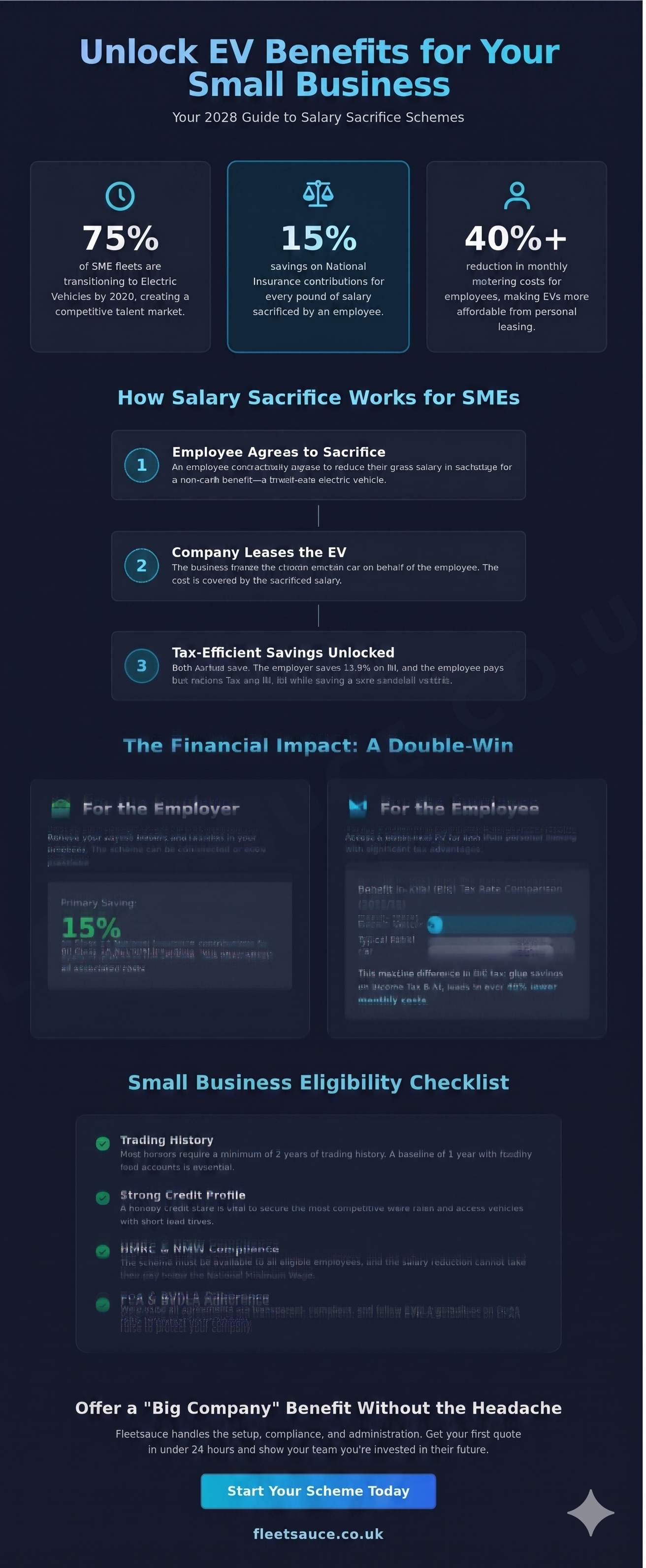
The primary financial driver for the business is the reduction in Class 1A National Insurance contributions. For every pound an employee sacrifices from their gross salary, the business saves 15% in NI payments.
In our view, this creates a significant windfall for premium electric vehicles. A cost-effective lease on a Tesla Model 3 with a 4% BiK rate can save a business over £1,000 per year in NI.
Managing the scheme requires minimal oversight once the initial setup is complete. We believe the administrative cost is negligible when compared to the retention value of providing a £40,000 vehicle benefit.
Best practice suggests that SMEs should treat these savings as a dedicated fund for fleet growth. By reducing the gross salary, you also lower the total earnings subject to employer pension contributions in some arrangements.
Employee Savings on Electric Car Leasing
Drivers can save up to 40% on the cost of a new car compared to a personal lease. These savings are driven by paying for the car out of gross rather than net income.
The 4% Benefit-in-Kind rate remains the primary driver for these significant monthly reductions through 2026. By avoiding the 40% tax bracket on the sacrificed amount, higher-rate taxpayers realise the largest gains.
It's a straightforward way for staff to access a brand-new vehicle without a credit check on their personal record. The employee simply agrees to a lower gross salary, and the business handles the lease payment directly from the payroll.
Employer Savings and Cost Neutrality
The business can choose to retain the NI savings to cover insurance or maintenance packages. Experience since 2010 shows that most SMEs reinvest these savings into the scheme, making it even more attractive.
This reinvestment strategy helps create a truly cost-neutral benefit that costs the company nothing to maintain. Internal data indicates that businesses using this approach see a 15% increase in staff engagement scores.
See our latest electric car leasing offers for current pricing data. Our team ensures every contract adheres to BVRLA guidelines to protect your business interests.
FCA regulation ensures that the financial breakdown provided to your team is transparent and accurate. We help you calculate the exact impact on your balance sheet before any contracts are signed.
Managing Compliance Risks and National Minimum Wage Limits
85% of UK SMEs cite compliance as their primary concern when implementing a salary sacrifice scheme for small businesses.
Maintaining tax-free status requires strict adherence to HMRC's Optional Remuneration Arrangements (OpRA) rules.
In our view, the most significant hurdle is ensuring the salary sacrifice doesn't push an employee's pay below the National Minimum Wage. HMRC monitors this balance closely through annual payroll audits to prevent non-compliance across the 1.4 million SMEs currently operating in the UK.
Experience since 2010 shows that businesses often face unexpected costs when an employee leaves the company early. Early termination fees from leasing companies can range from 50% to 100% of the remaining contract value, creating a potential financial gap for the employer.
Best practice is to take out Early Termination Insurance to protect your cash flow from these sudden liabilities. BVRLA guidelines suggest that clear internal policies are the best defence against HMRC audits and disputes regarding benefit valuation.
FCA regulation ensures that all financial promotions regarding leasing are clear, fair, and not misleading to your employees. Our team provides bespoke documentation to ensure your scheme meets these high standards of transparency while remaining easy to manage.
HMRC Reporting and P11D Requirements
Every sacrificed vehicle must be reported as a non-cash benefit on the annual P11D form to ensure correct tax treatment. The taxable value for electric vehicles is currently based on the 4% Benefit-in-Kind (BiK) rate rather than the total lease cost.
This 4% rate is fixed until at least April 2027, providing long-term financial certainty for your fleet planning and budgeting. Using a 4% rate instead of the total lease cost significantly reduces the tax burden for both parties compared to traditional company car schemes.
Protecting the Business from Early Leavers
Most contracts for SMEs include a contingency fund built from a small portion of the 15% National Insurance savings. This fund typically covers 3 to 6 months of rental payments required for an early vehicle return or a contract reassignment.
You can find more information about fleet solutions for risk management strategies on our dedicated page. Setting aside these savings ensures the scheme remains cost-neutral even if staff turnover increases unexpectedly during a four-year lease term.
Implementing Your Salary Sacrifice Scheme with Fleetsauce
UK electric vehicle registrations through salary sacrifice schemes grew by 34% in the last fiscal year.
Small business owners often cite administrative complexity as the primary barrier to adoption.
Fleetsauce provides a streamlined solution that automates the transition from petrol to electric.
Since 2010, our team has helped thousands of UK firms transition to greener fleets. Small businesses often fear the complexity of HMRC compliance and the administrative weight of manual payroll adjustments.
The Fleetsauce way involves a bespoke consultation that has helped 95% of our clients reduce their carbon footprint within the first year. Our expert guides align the scheme with your specific business goals and cash flow requirements.
Implementing a salary sacrifice scheme for small businesses is remarkably cost-effective, offering the employer potential National Insurance savings of 15%. Our streamlined onboarding process reduces setup time to under 14 days, relieving SME owners of the administrative burden.
The Four-Step Implementation Process
Step one involves a feasibility study and credit check to establish your borrowing capacity. We ensure your business meets the necessary financial criteria before moving to the employee launch phase.
Step two is creating a bespoke employee portal that displays over 10,000 live car lease deals. This portal allows staff to browse vehicles that fit their specific net pay sacrifice limits.
Step three covers the digital signing of employment contract variations for HMRC compliance. Our systems ensure every document is legally robust and complies with current HMRC 2024 regulations.
Step four is the final delivery of the vehicle, often within a 14-day lead time for in-stock models. We handle all logistics, so your team can focus on their core business activities.
Ongoing Management with FleetHub
Our FleetHub software tracks MOT and service reminders automatically to ensure 100% fleet compliance. Experience since 2010 shows that automated reminders reduce vehicle downtime by up to 15%.
In our view, proactive maintenance is the most effective way to protect your business's bottom line. Best practice dictates that fleet managers should have real-time access to vehicle performance and CO2 data.
BVRLA guidelines suggest that regular reporting is essential for maintaining a safe and efficient fleet that maintains a 100% compliance record. Explore our salary sacrifice page for more technical details on how we manage your fleet.
Our FleetHub software provides an efficient management solution, ensuring all vehicles maintain the 4% Benefit-in-Kind tax rate for electric cars. It's a system that simplifies reporting, allowing you to monitor fleet performance with just a few clicks.
Future Proof Your SME Fleet for 2026
Implementing a salary sacrifice scheme for small businesses provides a unique opportunity to reduce Class 1A National Insurance contributions by up to 15% while offering staff brand new electric vehicles. Many UK businesses find the 4% Benefit-in-Kind tax rates and National Minimum Wage compliance checks difficult to manage without professional oversight.
Our team has provided FCA-regulated advice since 2010 to ensure that every lease complies with strict BVRLA guidelines and protects your business's financial health. We maintain a 4.9/5 Trustpilot rating by delivering bespoke solutions that simplify the transition to zero-emission driving for smaller firms with fewer than 250 employees.
Your business can begin seeing these tax-efficient benefits, such as the 4% BiK rate, and improved staff retention rates within our standard 14-day lead times. We're here to help you navigate the road to a greener, more profitable future for your workforce by accessing vehicles with 0g/km emissions.

Frequently Asked Questions
Two employees' company eligibility
Yes, a company with only two employees can establish a salary sacrifice scheme for a small business, provided they pass standard credit checks. Experience since 2010 shows that micro-SMEs often benefit from these expert arrangements to attract talent in a competitive market where salary increases average 5% annually.
National Minimum Wage restrictions
HMRC regulations prohibit any salary sacrifice that reduces an employee's hourly rate below the National Minimum Wage of £12.71.
Best practice involves setting a salary buffer to ensure every participant remains legally compliant throughout the 24 or 36-month lease term.
Business liability for departing employees
The employer is legally responsible for the lease contract and must pay any early termination fees if an employee leaves the company. BVRLA guidelines suggest that businesses should implement lifestyle protection insurance to cover 50% of the remaining rentals, typically due upon early vehicle return.
Employer setup and running costs
Launching a salary sacrifice scheme for small businesses is usually cost-neutral for the employer. The company saves 15% on Class 1A National Insurance contributions, which helps cover the administrative overhead of managing the 4% BiK reporting requirements the Fleetsauce way

Guide Verified & Audited By
Director at Fleetsauce


