
Choosing a vehicle based solely on the monthly lease rate is often the most expensive mistake a fleet manager or driver can make.
Whilst a low sticker price looks tempting on paper, the real financial impact is hidden beneath layers of depreciation, fuel expenses, and shifting tax regulations.
To avoid budget-draining surprises, you need a reliable company car cost calculator UK strategy that accounts for the full 2026/27 fiscal landscape.
At Fleetsauce, we know how frustrating it is to juggle unpredictable maintenance bills or feel confused by the latest Benefit in Kind (BiK) adjustments.
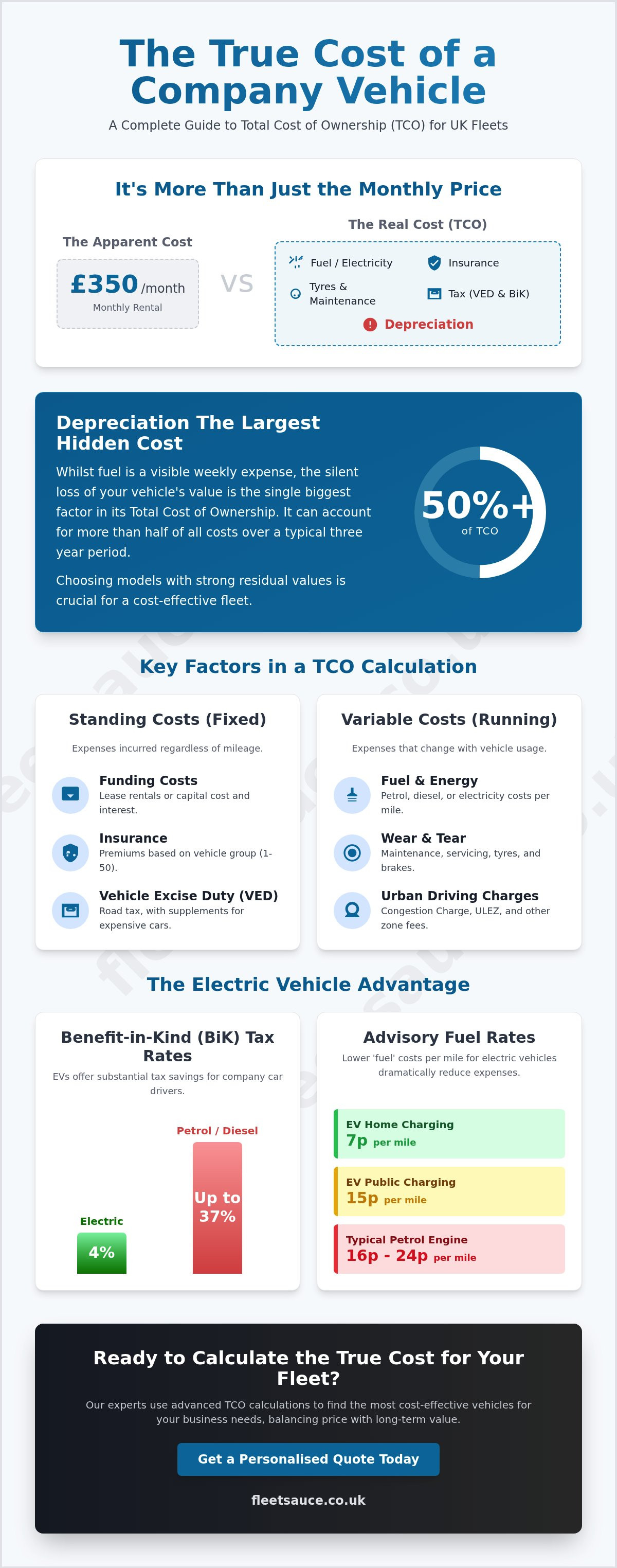
It's exhausting trying to keep track of the 4% BiK rate for electric vehicles or the new £200 standard VED rate.
This guide promises to help you master these hidden costs, allowing you to calculate true value beyond the initial price tag.
You'll gain a clear framework for comparing models and discover how to reduce overheads through tax-efficient choices.
We'll explore everything from the expensive car supplement for EVs over £50,000 to the impact of various city driving charges.
By the end, you'll have the tools to keep your monthly outgoings predictable and your fleet lean.
Company Car Total Cost of Ownership Calculator
Estimate true whole-life fleet costs including lease rates, fuel, maintenance, road tax, and employer National Insurance.
Vehicle Details and Usage
Projected Total Cost
Key Takeaways
- •
Look beyond the monthly rental price to understand the total cost of ownership by including every penny spent from acquisition until disposal.
- •
Recognise that depreciation is the single largest factor in your vehicle's value and learn how to manage this hidden cost effectively.
- •
Compare the benefits of leasing versus buying to see how Business Contract Hire can shield your business from used-car market volatility.
- •
Maximise your tax efficiency by using a company car cost calculator UK to evaluate the significant BiK and VAT advantages of switching to electric vehicles.
- •
Use FleetHub to automate cost tracking and avoid unexpected fines for missed MOTs or compliance issues.
Table of Contents
To find the best vehicle for your business needs, get in touch with our expert team today for a personalised consultation.
What is total cost of ownership for a car?
Understanding a vehicle's full financial commitment requires looking far beyond the initial invoice or monthly rental figure. What is total cost of ownership (TCO) exactly?
It is the sum of every single expense your business will incur from the moment you sign the contract until the vehicle is returned or sold. This includes acquisition, fuel, insurance, maintenance, and the often overlooked impact of tax and depreciation.
Focusing only on the purchase price or monthly rental is a common mistake for many UK businesses. A vehicle with a lower monthly fee might actually cost you more over its lifetime if it has poor fuel efficiency or high Benefit in Kind (BiK) rates.
Using a robust UK company car cost calculator strategy helps you see the bigger picture. In the UK, most businesses operate on a 3 to 4-year window. This timeframe is the "sweet spot" where you can maximise vehicle reliability whilst capturing the best possible residual value before maintenance costs begin to climb.
To truly compare different models, savvy fleet managers use the pence per mile (PPM) metric.
By dividing the total cost by the expected mileage, you get a single, clear figure that makes it easy to compare a petrol hatchback against a premium electric SUV. It turns complex variables into a simple number that fits perfectly into your balance sheet.
Why TCO is the ultimate metric for UK fleets
TCO is the most effective way to select vehicles that retain their value over time. It helps you justify the higher list price of electric car leasing by uncovering the massive savings in fuel and tax that aren't immediately obvious.
For SMEs, this level of detail is vital for accurate budgeting and cash flow forecasting. It keeps your monthly outgoings predictable and prevents unexpected bills at the end of the term.
The difference between price and value
A cheaper car often results in a higher TCO because its poor residual value makes the overall cost of use more expensive.
High depreciation models might look like bargains initially, but premium brands like BMW or Audi often prove cheaper over three years because they are worth significantly more at the end of the contract.
At Fleetsauce, we help you identify these value gaps through expert advice, ensuring your company car cost calculator UK results lead to the smartest financial choice for your specific needs.
To see how these costs apply to your specific fleet requirements, reach out to our advisors for a tailored cost breakdown.

Key factors in a car cost of ownership calculator
Building an accurate company car cost calculator UK requires a disciplined look at two distinct categories: standing costs and variable costs.
Standing costs are the fixed expenses that exist regardless of whether the car leaves the driveway. These include vehicle excise duty (VED), insurance premiums, and the capital cost or lease rentals.
Variable costs are the "pay-as-you-go" elements, such as fuel or electricity, and the gradual wear on components like tyres and brakes.
When identifying the Key factors in a car's cost of ownership, it's essential to recognise that depreciation is the single largest expense.
It often accounts for 50% or more of the total cost over 3 years. Whilst fuel is a visible weekly expense, the silent loss of vehicle value usually drains your budget much faster. Energy costs have also become a complex variable in 2026.
With advisory fuel rates for electric cars sitting at 7 pence per mile for home charging and 15 pence per mile for public charging, where your drivers "refuel" significantly impacts the final TCO.
Insurance groups also play a pivotal role in your annual budget. Vehicles are categorised into groups from 1 to 50, with higher numbers attracting steeper premiums.
Many modern electric vehicles sit in higher insurance groups because of specialised repair requirements, but this is often balanced by their lower tax profile.
If you're unsure how these variables stack up for your business, speaking with a fleet specialist can help clarify your projected spend.
Depreciation and residual values
Residual value is the estimated worth of a car at the end of its lease term or ownership period. For leasing companies, this figure is vital because it determines how much of the car's value you are actually "using" during the contract.
Factors like brand reputation, market demand, and even the car's colour influence this. Competitive car lease deals often reflect strong residual values, as the funder can lower the monthly rental if they know the car will be worth more when it's returned.
Service, maintenance, and repair costs
Service, Maintenance, and Repair (SMR) estimates cover everything from scheduled oil changes to replacing wear-and-tear items like brake pads and tyres. These costs tend to rise as a vehicle ages, which is why many businesses prefer fixed-cost maintenance packages.
Including a maintenance plan in your company car cost calculator UK ensures your monthly outgoings remain static, protecting your cash flow from the shock of a £600 set of new tyres or an unexpected mechanical fault.
If you're ready to see how these figures stack up for your business, contactour team for a bespoke analysis.
Comparing TCO for leasing versus buying
Deciding whether to buy your vehicles outright or lease them is a pivotal moment in any fleet strategy. Buying a car requires a significant upfront capital outlay, often tying up tens of thousands of pounds in a single depreciating asset. In contrast, leasing typically requires a much smaller initial rental.
This difference is a core component of any company car cost calculator UK, as it fundamentally changes how your business allocates its resources.
Leasing provides a unique layer of protection against the volatile used car market. When you buy a vehicle, you carry the full risk of unexpected depreciation.
If a model's market value drops suddenly because of new technology or regulatory changes, your business takes the hit on its balance sheet. With Business Contract Hire, the leasing company keeps that risk.
You pay only for the use of the vehicle, and at the end of the term, you hand the keys back without worrying about resale value.
Cash flow and opportunity cost
Keeping capital within your business allows you to invest in growth, stock, or staff rather than sinking it into a fleet.
Leasing finance often comes with competitive interest rates tailored for business users, which can be more cost-effective than a standard bank loan. Whilst buying puts an asset on your balance sheet, it also carries the liability of depreciation. Leasing keeps your debt-to-equity ratio healthier, making it easier to secure funding for other projects when you need it most.
Disposal and end-of-life costs
Selling a used company car is often an administrative headache. You have to deal with valeting, mechanical prep work, and the uncertainty of auction fees, which can eat into your returns. Leasing offers a much cleaner exit strategy. By following the BVRLA's transparent fair wear and tear guides, you know exactly what is expected when you return the vehicle.
No awkward negotiations or tyre kickers to deal with; you just move on to your next vehicle every 3 to 4 years. This predictability is why many use a company car cost calculator UK to justify the move away from outright ownership.
To understand how these tax savings apply to your specific business structure, speak with our financial experts today.
Tax benefits and electric vehicle TCO
Tax efficiency is the engine room of a modern fleet. If your company car cost calculator UK doesn't account for the current tax revolution, you are missing the biggest savings available.
Electric vehicles (EVs) have fundamentally changed the total cost of ownership landscape for UK businesses. While the list price of an EV might be higher than its petrol equivalent, tax breaks often make it significantly cheaper to run over a 3- or 4-year term.
Beyond standard leasing, many organisations now utilise an electric car salary sacrifice scheme to provide vehicles to their staff.
This allows employees to pay for a car out of their gross salary, reducing their Income Tax and National Insurance contributions. For the employer, it often results in lower National Insurance bills, creating a win-win scenario that slashes the effective cost of acquiring a vehicle.
These savings are often substantial enough to offset the higher insurance premiums associated with some electric models.
Benefit in Kind and employee savings
Benefit in Kind (BiK) is a tax on employees for the private use of a company car. For the 2026/27 tax year, the BiK rate for pure electric vehicles is set at a remarkably low 4%. Compare this to a petrol SUV, where a higher-rate taxpayer could easily pay between £4,000 and £10,000 per year in tax.
Switching to electric car leasing can reduce that annual tax bill to just a few hundred pounds. This massive saving is essentially a pay rise for your drivers, making EVs a powerful tool for staff retention.
Corporation Tax and VAT recovery
Your business can also reclaim 50% of the VAT on lease rentals if the car is used for both business and private trips. If you use the vehicle strictly for business, you can often reclaim 100% of the VAT.
Maintenance is even more tax-efficient; you can typically reclaim 100% of the VAT on your maintenance packages regardless of private use. Lease payments are also generally fully deductible from pre-tax profits, which lowers your overall Corporation Tax bill. These layered benefits often make the net cost of a lease far lower than the gross figure shown on a quote.
Ready to see the real-world impact on your bottom line?
You can request a tax-efficiency audit from our team to find the most cost-effective models for your fleet.
To see how our technology can transform your business operations, contact our specialist team for a demo today.
Using FleetHub to manage your total costs
Managing a fleet using manual spreadsheets is a recipe for missed deadlines and budget leaks. In the fast-paced market of 2026, real-time monitoring of your total cost of ownership is a necessity, not a luxury.
FleetHub acts as your digital company car cost calculator UK, providing a live, bird's-eye view of every penny spent across your entire vehicle lineup.
It goes beyond static, one-time quotes to show your fleet's real-world financial performance. You can track mileage deviations, fuel spend, and even the efficiency of different charging habits amongst your drivers.
Compliance is another area where costs can spiral if you don't manage it tightly. The software tracks critical dates for MOTs, servicing, and driver licence checks. A single missed MOT doesn't just risk a fine; it can invalidate your insurance and lead to catastrophic financial exposure.
Automated alerts ensure you never miss a deadline, keeping your outgoings predictable and your drivers safe.
This proactive approach prevents emergency maintenance bills that often disrupt a company's cash flow, keeping your fleet a lean asset rather than a financial burden.
Streamlining fleet operations
FleetHub centralises every driver record and vehicle data point into one accessible location. This eliminates the heavy administrative overhead that often plagues growing businesses.
By using fleet management software for SMEs, you can automate routine tasks and focus on your core business growth.
It removes the guesswork from management, allowing you to see exactly which vehicles cost you the most in maintenance or fuel while identifying opportunities for further tax savings.
Making informed decisions for 2026 and beyond
Historical data is your best ally for future procurement. By reviewing how specific models have performed over their 3- or 4-year cycle, you can predict the TCO for new acquisitions with pinpoint accuracy. You'll know exactly which brands retain their value and which ones become a liability as they age.
This data-driven strategy ensures that your next company car cost calculator UK session is based on facts rather than manufacturer estimates, allowing for a more honest comparison between models.
At Fleetsauce, we don't just hand you a software login and leave. You get a dedicated account manager who uses this data to provide expert, human-led advice. We combine modern technology with a personal touch to find the best fleet solutions for your bespoke needs.
This partnership ensures you aren't just buying a service; you are gaining a savvy ally in the vehicle selection process.
We help you manage the complex world of BiK rates and VED changes with confidence and ease, ensuring your fleet stays ahead of the curve.
To start optimising your business fleet and uncovering hidden savings, reach out to our advisors for a tailored consultation.
Future-proof your fleet strategy today
Mastering the total cost of ownership is the only way to protect your business from the volatility of the 2026 automotive market.
By shifting your focus from monthly price tags to a comprehensive whole-life value model, you ensure that every vehicle in your fleet delivers genuine value. We have explored how the right tax strategy and a robust company car cost calculator UK approach can transform your balance sheet whilst keeping your drivers happy.
As an independent vehicle leasing brokerage founded in 2010, Fleetsauce combines industry expertise with modern technology.
Our innovative FleetHub software simplifies management by tracking compliance and costs in real time, whilst our specialists offer tailored advice on tax-efficient EV salary sacrifice schemes. We are here to ensure your transition to a modern fleet is both seamless and profitable.
Contact our expert team today for a bespoke TCO analysis.
We look forward to helping you navigate the complexities of vehicle finance and building a more sustainable, cost-effective future for your company.

Frequently Asked Questions
What is the highest cost in car ownership?
Depreciation is the single largest expense in vehicle ownership, often accounting for half of the total cost over a 3-year period.
It represents the difference between the car's initial price and its value when sold or returned.
Whilst fuel and insurance are more visible, the silent loss of residual value has a far greater impact on your business budget. Choosing models with strong market demand helps mitigate this loss effectively.
How does a car TCO calculator work for UK businesses?
A UK company car cost calculator works by combining fixed costs like lease rentals, VED, and insurance with variable expenses such as fuel and maintenance. It provides a holistic view of the vehicle's financial impact over a specific term, usually 3 to 4 years.
By calculating these factors together, businesses can identify the true pence-per-mile cost. This allows for accurate comparisons between different fuel types and helps you choose the most efficient models.
Is it cheaper to lease or buy a car when considering TCO?
Leasing is frequently the more cost-effective option for businesses because it removes the risk of unexpected depreciation.
While buying requires a large upfront capital outlay, leasing lets you pay for the vehicle's use through fixed monthly rentals.
This approach protects your cash flow and offers significant tax advantages, such as VAT recovery and Corporation Tax relief, which are often unavailable or restricted when purchasing a vehicle outright.
How do electric cars affect the total cost of ownership?
Electric cars significantly lower the total cost of ownership through reduced fuel expenses and massive tax savings. Despite having higher initial list prices, the 4% Benefit in Kind rate for 2026/27 makes them incredibly affordable for employees. Additionally, businesses benefit from lower National Insurance contributions and reduced maintenance requirements.
EVs have fewer moving parts than traditional internal combustion engines, which naturally leads to fewer service visits and lower repair costs over time.
Can I reclaim VAT on my business car lease?
You can typically reclaim 50% of the VAT on your lease rentals if you use the car for both business and private journeys. If you use the vehicle strictly for business purposes, you may be able to reclaim the full 100%.
For maintenance packages, businesses are usually entitled to reclaim 100% of the VAT regardless of private use. This makes leasing a highly tax-efficient way to manage your fleet.
What is Benefit in Kind and how does it impact my costs?
Benefit in Kind is a tax paid by employees who use a company vehicle for private travel. It is calculated based on the car's P11D value and its CO2 emissions.
For 2026, choosing a low-emission or electric vehicle is vital, as the BiK rates are substantially lower than for petrol or diesel models. This reduces the tax burden on your staff whilst lowering your Class 1A National Insurance obligations.
How often should I review my fleet TCO?
You should review your fleet TCO at least once a year or whenever significant regulatory changes occur.
The UK tax landscape and vehicle values shift frequently, as seen with the 2026 VED updates for electric vehicles.
Regular reviews using a company car cost calculator UK strategy ensure your procurement remains aligned with the most tax-efficient models. It also helps you identify when high-mileage vehicles should be replaced sooner to avoid rising maintenance costs.
Does maintenance insurance reduce my total cost of ownership?
Maintenance packages reduce your total cost of ownership by providing predictable, fixed monthly outgoings. Instead of facing unexpected bills for tyres, brakes, or mechanical faults, you pay a set fee that covers all essential servicing and repairs.
This prevents budget volatility and ensures your vehicles are always maintained to manufacturer standards.
It also simplifies your administration, as all service costs are consolidated into a single, VAT-recoverable monthly payment for your business.

Guide Verified & Audited By
Director at Fleetsauce
Ready to Cut Your Total Fleet Costs?
Look beyond basic monthly rental rates to uncover true whole-life vehicle costs. Speak with our fleet specialists today for a comprehensive company car cost calculation covering depreciation, Benefit in Kind tax, maintenance, and fuel efficiency.
Why Choose Fleetsauce?
At Fleetsauce, we specialise in helping SMEs find the right car leasing solutions — not just the cheapest leasing deal.
With access to a wide range of leasing funders and hundreds of franchised dealerships across the UK, we find the best leasing deals and vehicle availability for your business and employees.
You’ll work directly with an expert dedicated account manager who understands the needs of companies — offering expert advice with a friendly, professional approach that you can always call directly.
With a five-star rating from Trustpilot, we are proud of our reviews and is evidence that we look after our new and existing customers.
Whether you're managing one vehicle or a fleet, we make business leasing simple, flexible, and cost-effective.


