
Over 40,000 UK businesses have already utilised government support to install chargepoints since the scheme began.
The workplace ev charging grant uk now offers up to £500 per socket for installations completed after 1 April 2026.
Rising electricity prices and the complexity of OZEV paperwork make electrifying your fleet feel like a daunting task for many directors.
Fortunately, we understand that managing employee expectations for on-site charging is a priority for modern fleet managers looking to retain talent.
This guide reveals how your business can secure up to £20,000 in funding to install up to 40 sockets across your various premises.
As leasing specialists, we advocate for using these grants to create a cost-effective 75% reduction in your initial infrastructure outlay.
We'll break down the latest 2026 eligibility rules and the specific steps required to claim your OZEV vouchers before the March 2027 deadline.
Discover how to future-proof your parking facilities and support tax-efficient salary sacrifice schemes that save employees up to 40% on their monthly rentals.
Key Takeaways
- •
Learn how to claim up to £500 per socket through the Workplace EV Charging Grant UK, covering 75% of total installation costs for up to 40 sockets.
- •
Secure a digital voucher worth up to £20,000 per business by confirming your Companies House registration and designated off-street parking.
- •
Utilise the 2026 state-funded education grant of £2,000 per socket to support your school or nursery transition with up to £80,000 in funding.
- •
Combine on-site charging with electric vehicle salary sacrifice to capitalise on the current 4% Benefit-in-Kind tax rates for employees.
- •
Secure your funding before the scheme closes on 31 March 2027 by coordinating with an OZEV-authorised installer for a compliant setup.
Table of Contents
-
Financial benefits and cost-effective infrastructure planning
-
Strategic fleet management with workplace charging solutions
Workplace Charging Scheme explained for UK businesses
The Workplace Charging Scheme (WCS) operates as a voucher-based system designed to lower the barrier for companies adopting electric vehicles. As leasing specialists, we advocate for early applications to secure these funds before the scheme officially closes on 31 March 2027.
Eligible organisations can claim for up to 40 individual charging sockets across multiple business sites under the current OZEV rules. This provides a cost-effective £20,000 maximum benefit for companies looking to electrify their entire staff parking area.
Modern units must be smart-enabled to qualify for the 75% subsidy provided by the UK government for electric vehicles. These intelligent systems allow for detailed energy reporting and load balancing across your premises.
By reducing the initial hardware outlay, businesses can focus their capital on electric car leasing and fleet expansion. The grant effectively covers up to 75% of the total purchase and installation costs, including VAT.
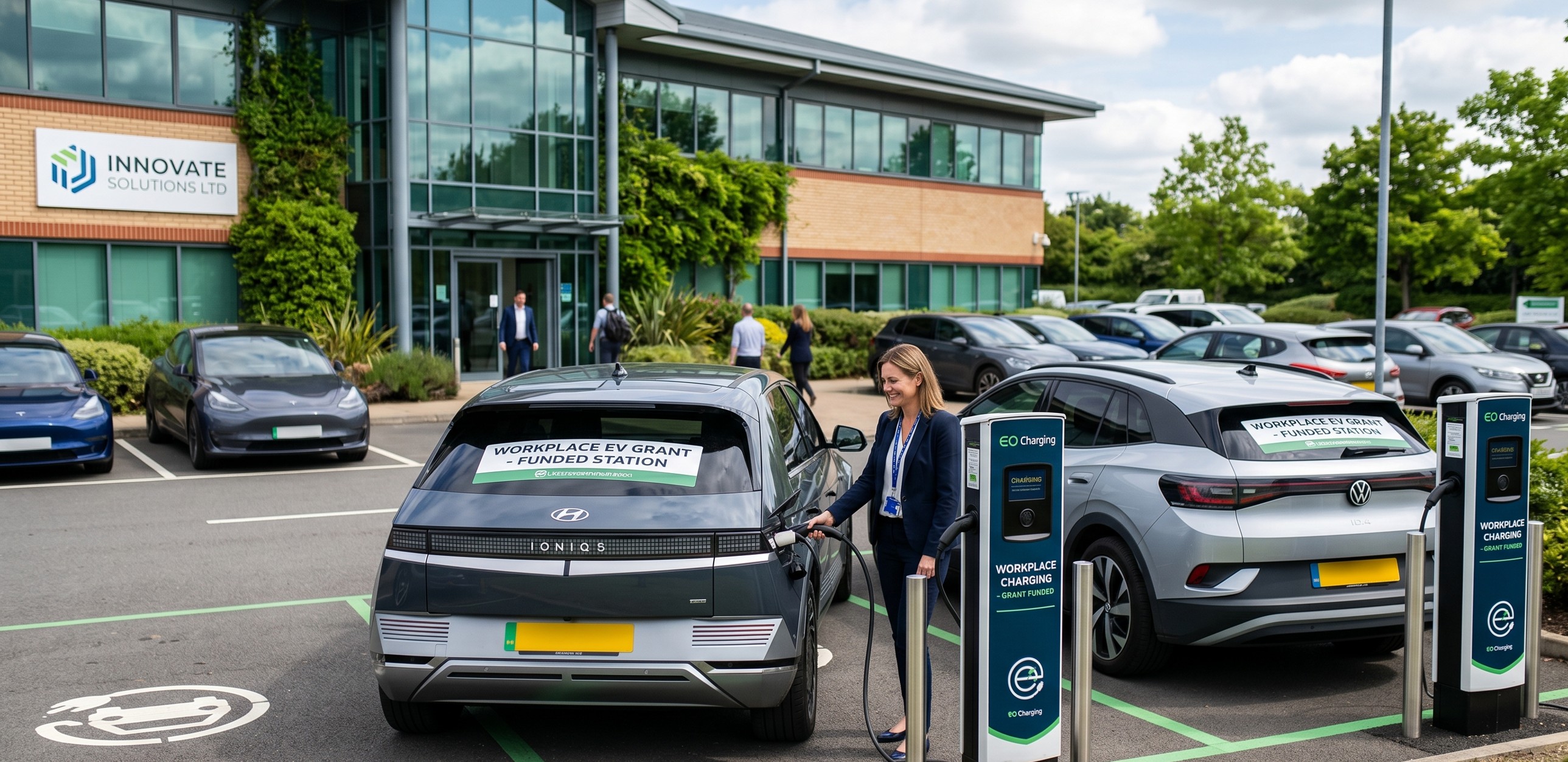
Core objectives of the 2026 grant extension
Government funding aims to support the 2035 transition by subsidising workplace infrastructure during this critical final rollout phase. Fortunately, the scheme now includes specific provisions for small accommodation businesses and charities to ensure wider access.
The WCS serves as a cost-effective 75% cost-reduction tool for UK SMEs looking to install hardware. Best practice involves integrating these chargers with electric vehicle salary sacrifice schemes to boost employee satisfaction.
Grant caps and financial limits for 2026
The maximum grant rate increased on 1 April 2026 to £500 per socket for standard businesses. Total funding is capped at £20,000 per applicant across the maximum 40 allowed sockets.
Installations completed before April 2026 only qualify for the lower £350 per socket rate. Your business must use an OZEV-authorised installer to claim the workplace EV charging grant in the UK and receive the 75% reimbursement.
In our view, the 180-day voucher validity period offers sufficient time to coordinate with contractors and finalise site surveys. Vouchers must be claimed within this six-month window to ensure the funding remains secured against your project costs.
Select your next company vehicle from our range of new business car leasing options to complement your upgraded charging facilities.
Eligibility criteria for the OZEV workplace grant
Businesses must be registered in the United Kingdom with a valid Companies House number or a VAT registration to apply for support. This ensures that only legitimate trading entities benefit from the workplace EV charging grant in the UK when upgrading their premises.
Best practice dictates ensuring your site has designated off-street parking clearly associated with the business premises. The spaces must be for the exclusive use of staff or fleet vehicles rather than general public access or shared residential zones.
In our view, landlords must provide written consent before any infrastructure work commences on leased sites. Fortunately, most commercial property owners support these upgrades as they increase the building's long-term utility and appeal for future tenants.
Public sector organisations and registered charities are fully eligible for the same £ 500-per-socket voucher. This provides an affordable 75% subsidy for non-profit entities looking to reduce their operational carbon footprint whilst lowering fleet overheads.
Before finalising your application, browse our electric car leasing deals to find the most efficient models for your team.
Eligible organisations and site requirements
Your business must occupy the premises or own the property to qualify for the government voucher. As leasing specialists, we advocate checking that 100% of the site is located in England, Wales, Scotland, or Northern Ireland.
Parking spaces must be private and situated away from public highways to meet OZEV safety standards. This requirement ensures that the UK workplace EV charging grant supports dedicated business infrastructure rather than general street parking.
Special provisions for education institutions
State-funded schools can access a significantly higher grant of £2,000 per socket in 2026. This enhanced support covers 75% of costs, up to a maximum of £80,000, for the 40 sockets allowed per institution.
Independent schools remain eligible for support but fall under the standard £500-per-socket business cap. This distinction reflects the government's priority of electrifying public-sector education hubs first to support local community transition goals.
Staff members at these institutions can also benefit from electric vehicle salary sacrifice schemes to maximise their take-home pay. Combining on-site charging with tax-efficient leasing creates a compelling benefit package for recruitment and retention.
Maximise your fleet efficiency by viewing our special offers on the latest electric models today.
Financial benefits and cost-effective infrastructure planning
Planning a cost-effective £500 grant application requires balancing the initial subsidy against the total hardware and labour spend. Most standard installations average between £800 and £1,500 per socket before the voucher is applied.
Businesses can recover 20% VAT on top of the grant if they are VAT-registered and the vehicles are used for business purposes. This additional saving further reduces the net cost for qualifying UK companies during the installation phase.
As a BVRLA member, Fleetsauce understands that infrastructure remains the primary barrier to successful fleet electrification for many SMEs. We help our clients navigate these financial hurdles to ensure a smooth transition to greener transport solutions.
Fortunately, installing chargers now prevents future price hikes as demand for qualified electrical contractors increases toward the 2030 deadline. Securing your workplace EV charging grant in the UK early locks in current labour rates before the market becomes saturated.
Calculating the total cost of ownership
Compare the cost of a £1,200 installation, reduced to £700 after the grant, against the rising expense of public charging at 70p per kWh. In many cases, charging on-site costs as little as 25p per kWh, leading to significant annual fuel savings for the business.
We identify the 75% subsidy as the primary driver for achieving a 24-month ROI on your charging hardware. This rapid payback period makes the investment highly attractive for businesses running high-mileage fleets with multiple drivers.
On-site infrastructure significantly reduces employee range anxiety for those using electric car leasing. Providing reliable charging at the office ensures drivers start their journeys with a full battery every morning, without having to search for public charging points.
VAT and tax considerations for charging
The 75% grant is calculated against the total invoice cost, including VAT, rather than just the net figure. This ensures the workplace EV charging grant UK provides the maximum possible financial relief for the applicant across their entire project.
Workplace charging is currently a tax-free benefit for employees, unlike the provision of traditional petrol or diesel, which is subject to high taxes. This makes it a cost-effective 0% Benefit-in-Kind perk for staff members who charge their personal or company vehicles at work.
Hardware purchases also qualify for capital allowances, potentially reducing your corporation tax by 25p for every £1 spent on equipment. This layered tax strategy ensures that your business maximises every available incentive during the electrification process.
Speak to our experts today to discover how fleet management services can streamline your OZEV infrastructure rollout.
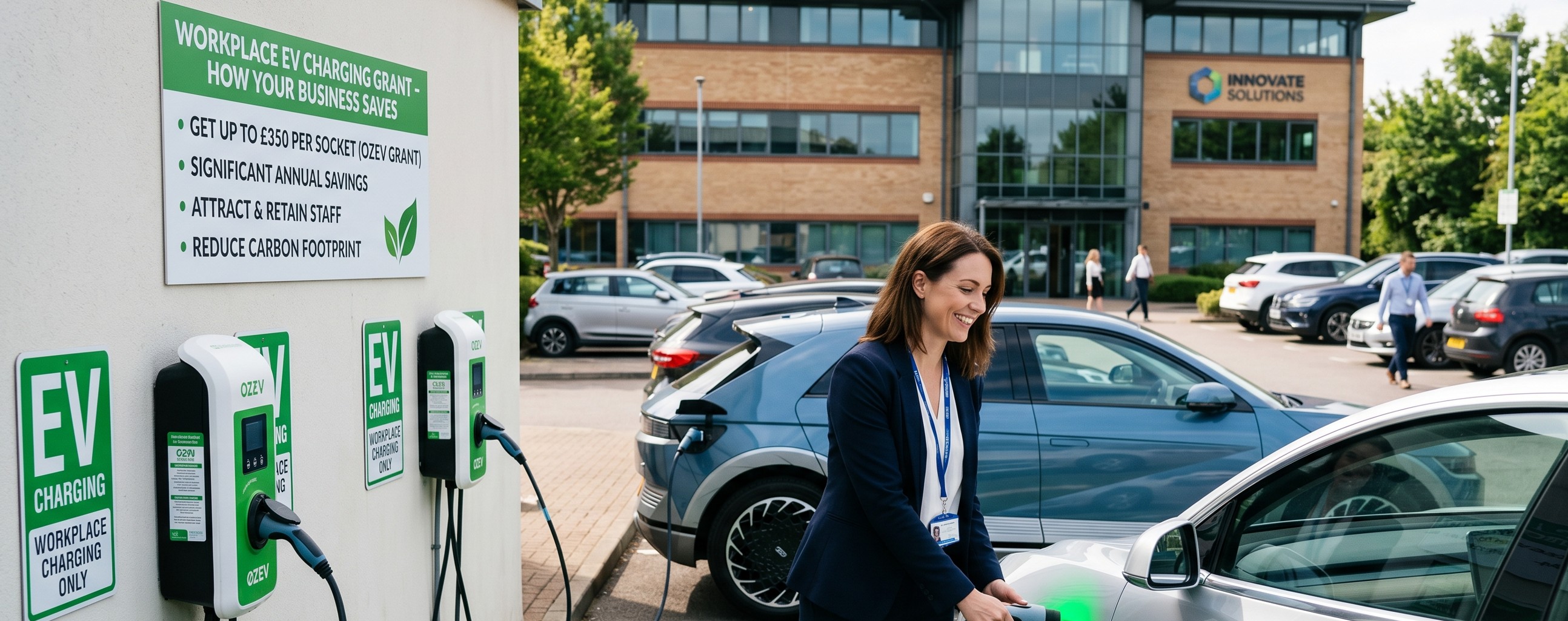
Application process and salary sacrifice integration
The application begins with a straightforward online form using your Company Registration Number (CRN) or VAT registration details. Once approved, the Office for Zero Emission Vehicles (OZEV) issues a digital voucher directly to your business inbox.
Vouchers remain valid for 180 days from the date of approval, according to the latest May 2026 guidelines. You must ensure the installation is finished and the claim is submitted within this six-month window to secure your funding.
Best practice is to choose an OZEV-authorised installer before requesting your voucher, to ensure technical compliance with smart-charging regulations. Fortunately, these experts handle the technical data submission, meaning your business only pays the net cost after the 75% discount is applied.
Integrating these chargers with a salary sacrifice scheme maximises employee uptake by providing convenient on-site fueling for their new vehicles. This combination creates a cost-effective 75% reduction in infrastructure costs for businesses looking to lower their carbon footprint.
As leasing specialists, we advocate for checking your site's load capacity before applying for the workplace EV charging grant in the UK. This prevents delays during the final installation phase and ensures your hardware is ready for use immediately.
Step-by-step application guide
Step 1 involves conducting a site survey with an authorised installer to determine your building's electrical load capacity. They will confirm if your existing supply can handle multiple standard 7kW sockets.
Step 2 requires submitting the WCS application via the GOV.UK portal to receive your unique voucher code. You'll need your CRN and evidence of off-street parking to pass the initial screening.
Step 3 is the physical installation, after which the installer claims the 75% discount directly from the government. This protects your company's cash flow by removing the need for a traditional rebate process.
Linking infrastructure to employee benefits
Workplace chargers support the low 4% Benefit-in-Kind (BiK) rate for employees opting for a zero-emission car. Providing this infrastructure helps staff avoid the higher costs of public charging networks.
In our view, providing free charging at work is the ultimate "green" perk for 2026. It enhances the appeal of your benefit package to those without home charging facilities.
Link this hardware to our fleet solutions for managing driver records and energy usage. This ensures accurate P11D reporting for your new business car leasing fleet.
Access our electric van leasing deals to start building your sustainable commercial fleet today.
Strategic fleet management with workplace charging solutions
Scaling a fleet requires more than just hardware; it requires intelligent load management and reporting. Intelligent software prevents your building's power supply from overloading when 40 vehicles plug in simultaneously at the start of the working day.
Fortunately, modern chargers integrate with software to track kWh usage per driver for accurate P11D reporting. This granular data allows fleet managers to monitor energy costs down to the penny for every mile driven.
As leasing specialists, we advocate for dual-socket pedestals to maximise the 40-socket grant limit. This strategy ensures you secure the full £20,000 allowance whilst providing 40 individual charging points for your expanding team.
Efficient infrastructure planning ensures your new business car leasing strategy remains sustainable. The UK workplace EV charging grant serves as the financial foundation for this long-term transition into the 2030s.
Implementing a cost-effective 75% reduction in infrastructure costs through the grant allows for greater budget allocation to premium vehicle specifications. In our view, the hardware you choose today must be capable of receiving over-the-air updates to remain relevant for the next decade.
Future-proofing your business premises
Consider passive wiring for future bays whilst the ground is open for the initial grant-funded units. This proactive step reduces future installation costs by 60% as you won't need to repeat expensive groundwork for subsequent sockets.
High-mileage van fleets often require 22kW chargers to provide a faster turnaround between shifts. These units can add approximately 80 miles of range in just two hours for compatible electric vans used in local logistics.
As a BVRLA member, we emphasise following strict industry standards when choosing your fleet charging partners. Best practice is to select hardware that supports the Open Charge Point Protocol (OCPP) to avoid being locked into a single software provider.
The Fleetsauce approach to electrification
We provide bespoke advice that aligns your vehicle lease with your infrastructure capabilities. Our team helps navigate the 75% grant landscape to ensure you never overpay for your transition to zero-emission motoring.
We assist with business car leasing UK strategies that integrate seamlessly with your on-site charging setup. This holistic approach ensures your fleet remains competitive and compliant throughout 2026 and beyond.
Our experts analyse your specific mileage requirements to recommend the best mix of 7kW and 22kW sockets for your site. By partnering with us, you gain access to a UK-based team of real people dedicated to simplifying your fleet management journey.
Contact our expert team to align your fleet with the latest WCS grants to ensure your business remains competitive in a zero-emission market.
Electrify your business premises before the 2027 deadline
Securing the workplace EV charging grant in the UK provides your business with a cost-effective 75% reduction in hardware and installation expenses. This allows your organisation to install up to 40 sockets across multiple UK sites before the scheme closes on 31 March 2027.
As leasing specialists, we advocate integrating these chargers with a 4% Benefit-in-Kind tax rate to maximise staff savings. Fortunately, our FCA-regulated experts provide the bespoke advice needed to navigate OZEV regulations and secure your digital vouchers.
Best practice is to act now to lock in current equipment prices before contractor demand increases. Our BVRLA membership ensures your business receives the expert guidance needed for a seamless, sustainable fleet transition.
Contact our expert team to align your fleet with the latest WCS grants to ensure your business remains compliant with current OZEV regulations.
Frequently Asked Questions
Grant value for standard businesses in 2026
The grant provides a cost-effective £500 per socket for any installations completed after 1 April 2026. This subsidy covers up to 75% of the total purchase and installation costs, including the 20% VAT element.
Maximum socket limits per applicant
Under current OZEV rules, businesses are restricted to a maximum of 40 sockets across all their UK sites. This allows for a total funding claim of £20,000 per company registration number.
Eligibility for businesses in leased premises
You can claim the Workplace EV Charging Grant UK for leased offices, provided you have designated off-street parking and written consent from the landlord. Best practice is to ensure the property has a separate meter to track the 20% VAT recovery on business electricity.
Costs exceeding the government subsidy cap
Your business is responsible for any installation costs that go beyond the £500 per socket voucher value. If a dual-socket pedestal costs £1,800, the grant pays £1,000 whilst the business settles the remaining £800.
Taxation on workplace electricity for staff
Employees do not pay any Benefit-in-Kind tax on electricity provided at the workplace for charging their vehicles. This creates a tax-efficient 0% P11D value for staff compared to the high costs of providing fossil fuels.
Retrospective grant applications for existing hardware
The scheme does not allow for retrospective claims on chargers that have already been installed or commissioned. Fortunately, you can apply for new sockets at the same site, provided you have not yet reached the 40-socket limit.
Final deadline for the Workplace Charging Scheme
As leasing specialists, we advocate applying before the current scheme closes on 31 March 2027 for all new voucher applications. Vouchers issued on the final day will remain valid for 180 days to allow for installation completion.
Charity eligibility for enhanced education funding
Charities are only eligible for the standard £500 per socket rate unless they are specifically a state-funded education institution. In our view, the higher £2,000 grant remains strictly ring-fenced for schools and nurseries.

Guide Verified & Audited By
Director at Fleetsauce


