
Company car tax in the Autumn Budget 2026 reaches a lot of people. HMRC estimates that 920,000 employees who drive a company car, and at least 160,000 businesses that provide them, will be affected by the new rates for 2030/31.
If you run a fleet, the headlines only tell you half of it. A lease you sign this winter could run through company car tax rises, a new pay-per-mile charge, a change to payroll reporting and new capital allowance rates before the car goes back.
That makes it easy to budget on this year's numbers and get caught out later.
We'll show you how the 28 October announcements change the cost of business contract hire, what your drivers will pay and what you need to do before April 2027.
We compare electric, plug-in hybrid and petrol cars across the next five tax years, then cover vans, mileage rates, vehicle tax, VAT and lease rental relief, with every rate taken from GOV.UK. Most of these measures still need legislation, so treat them as announced plans until the Finance Bill becomes law.
Key Takeaways
- •
Learn how company car tax rises to 10% for electric cars in 2030/31, and why rates over the whole lease term matter more than the rate today.
- •
Discover why plug-in hybrid drivers face a steep rise in April 2028, as the electric range bands disappear.
- •
Understand how payrolling from 6 April 2027 changes the way you report company cars, vans and fuel.
- •
Compare the 12% writing down allowance for bought cars with the tax relief your business gets on lease rentals.
- •
Identify the van benefit, mileage rate and vehicle tax changes to build into your 2027/28 fleet budget.
Table of Contents
What the Autumn Budget 2026 changed for company car tax
Company car tax is worked out from the car's list price, any taxable accessories and a percentage based on its CO2 emissions. That percentage sets the Benefit-in-Kind (BIK) value, and your driver pays Income Tax on the result.
The Budget added one more year to the published rates. HM Treasury has now set out company car tax up to the end of 2030/31, so a four year lease starting today can be costed from start to finish.
The increase itself is small. Every band goes up by 1 percentage point in 2030/31, to a maximum of 40%. The bigger changes come earlier, and they were already in the pipeline before the Budget.
Electric, hybrid and petrol rates to 2030/31
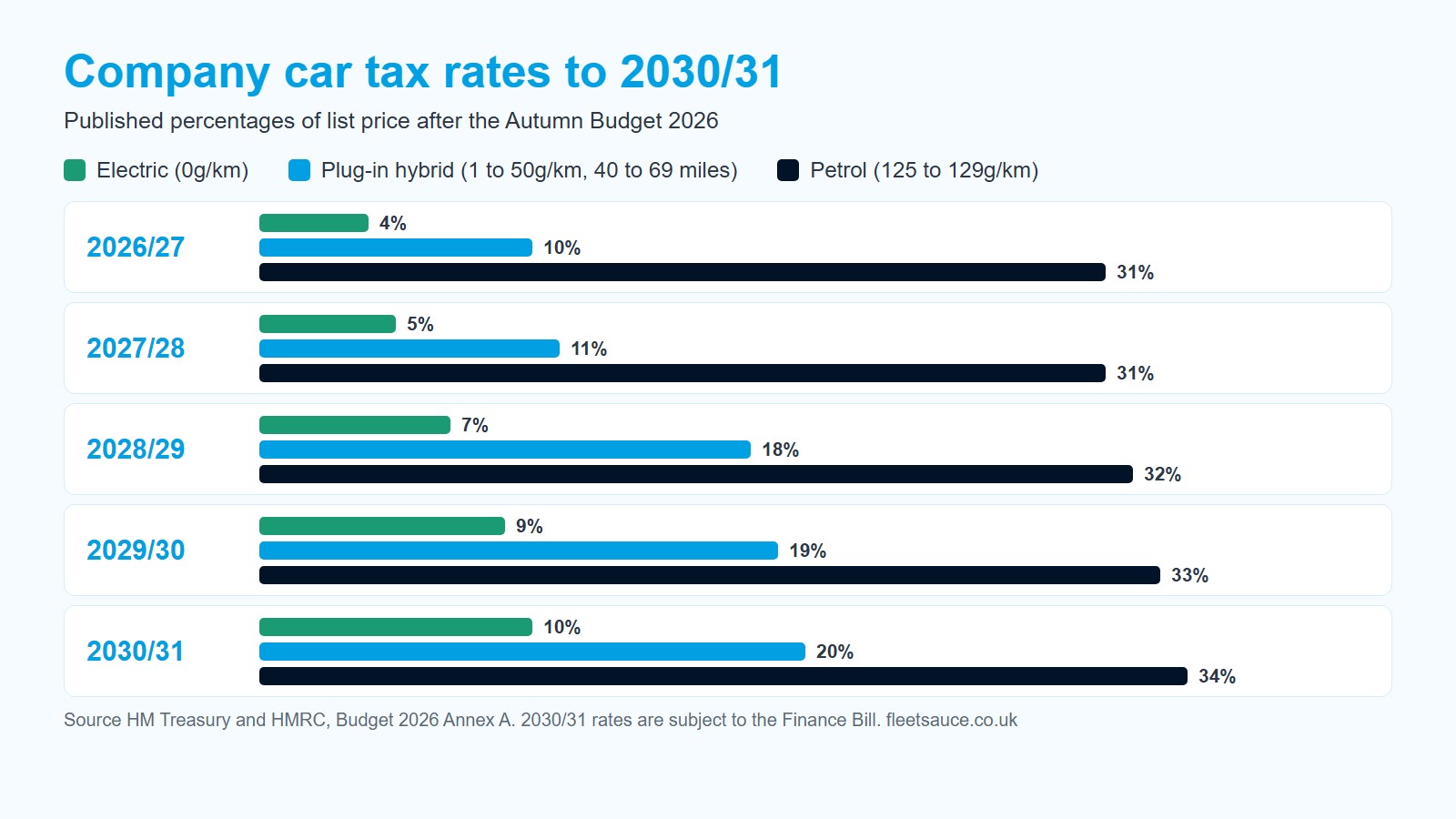
The table uses the rates in Annex A of the Budget tax tables. We've picked a petrol car at 125g/km and a plug-in hybrid with an electric range of 40 to 69 miles as examples. Your own car may sit in a different band.
| Tax year | Electric (0g/km) | Plug-in hybrid (1 to 50g/km, 40 to 69 miles) | Petrol (125 to 129g/km) |
|---|---|---|---|
| 2026/27 | 4% | 10% | 31% |
| 2027/28 | 5% | 11% | 31% |
| 2028/29 | 7% | 18% | 32% |
| 2029/30 | 9% | 19% | 33% |
| 2030/31 | 10% | 20% | 34% |
Electric cars keep a clear advantage. Even in 2030/31, a driver in a fully electric car is taxed on 10% of the list price, against 34% for our petrol example.
Take a car with a list price of £40,000 and a driver who pays 40% Income Tax. In 2026/27 the electric car has a BIK value of £1,600, so the driver pays £640. In 2030/31 the value is £4,000 and the tax is £1,600.
A petrol car at the same price and 125g/km has a BIK value of £12,400 in 2026/27, which costs the same driver £4,960. By 2030/31 that becomes £13,600 and £5,440.
Diesel cars that don't meet the RDE2 standard still carry a 4 point supplement, subject to the maximum rate for the year.
Why plug-in hybrids need a closer look
The line in the table that deserves most attention is April 2028. Until then, plug-in hybrids are banded by how far they can travel on electric power alone. From 2028/29 those bands go, and every car emitting 1 to 50g/km moves to 18%.
For our example, the rate jumps from 11% to 18% in one step. On a £40,000 list price, the 40% taxpayer goes from £1,760 in 2027/28 to £2,880 in 2028/29, an extra £1,120 a year.
A hybrid with more than 130 miles of electric range has further to go, from 5% to 18%. One with less than 30 miles only moves from 17% to 18%, as it starts much closer.
There's a second date to note. The Budget tables confirm that some plug-in hybrids registered and made available from 1 January 2025 have a deemed CO2 figure of 1g/km until 5 April 2028, depending on their emissions standard. After that, a car tested to the newer standards could move to a higher band.
None of this makes plug-in hybrids a poor choice. They still suit drivers with long trips or patchy charging. It does mean you should price each tax year of the lease before you order, and our plug-in hybrid lease deals are a good place to compare options.
Pay-per-mile and vehicle tax on leased electric cars
The Budget confirmed that Electric Vehicle Excise Duty (eVED) is still going ahead. It will start on 1 April 2028, so it falls within many of the leases being signed now.
Vehicle tax is also rising in line with the Retail Prices Index from 1 April 2027. Both belong in your whole life cost figures.
How eVED will work from April 2028
HMRC's eVED policy paper sets the starting rates at 3p a mile for battery electric and hydrogen fuel cell cars, and 1.5p a mile for plug-in hybrids. The rates will then rise with the Consumer Prices Index from 2029/30.
A company electric car covering 12,000 miles a year would pay £360 at the starting rate (12,000 multiplied by 3p). A plug-in hybrid with the same mileage would pay £180, whether those miles are driven on petrol or electric power.
Drivers or keepers will give an odometer reading and estimate the next year's mileage when the vehicle tax is renewed. The estimate is then checked against the reading at the end of the year.
For leased cars the detail matters, because the charge falls on the registered keeper. The government says it intends to offer special arrangements for leasing and rental businesses, including estimating mileage centrally, and it is still working these out with the industry.
So ask how your agreement deals with a new tax that starts mid-contract. Contracts differ, and your lease paperwork will show whether the funder can pass on changes in vehicle tax. We can talk you through the wording before you sign.
The charge applies to cars. HMRC's paper describes it as covering electric, plug-in hybrid and hydrogen vehicles that are cars, so electric vans aren't included in the plans as published.
Vehicle tax in 2027/28
The standard annual rate for cars first registered on or after 1 April 2017 rises from £200 to £210 on 1 April 2027. That applies to electric cars too. The first year rate for a zero emission car stays at £10.
Petrol and diesel cars with a list price over £40,000 pay the Expensive Car Supplement from the second to the sixth year. For zero emission cars registered from 1 April 2025, the threshold is £50,000. The Budget tables list the extra charge at £460 a year, up from £440.
On a typical contract hire agreement, vehicle tax is often built into the rental, so you may not see these lines on their own. They still feed into the price. Keeping an electric car under £50,000 is one simple way to hold down its cost, and you can filter our electric car lease deals with that in mind.
Capital allowances and lease rentals after the Budget
The Budget kept the main rate of Corporation Tax at 25% and the small profits rate at 19%. It also changed the capital allowances that apply when a business buys an asset. If you lease on contract hire, you don't claim capital allowances on the vehicle, because the funder owns it.
That difference is why this part of the Budget matters. It changes the comparison between leasing and buying, even though your rentals are treated in the same way as before.
What the 12% writing down allowance means for bought cars
The main rate of writing down allowance falls from 14% to 12%. The Budget tax overview gives a start date of 1 April 2027 for Corporation Tax and 6 April 2027 for Income Tax. The special rate stays at 6%, and a blended rate applies if your accounting period spans the change.
For cars, the main rate covers those with emissions of 50g/km or less, plus second hand electric cars. Cars over 50g/km stay in the special rate pool at 6%.
As a simple example, a £30,000 plug-in hybrid bought by a company would get £4,200 of relief in a full year at 14%. At 12% the first full year drops to £3,600. At a 25% tax rate, that £600 gap costs £150 in that year. The relief isn't lost, but it takes longer to arrive.
The Budget also raises the main rate first-year allowance from 40% to 50% for spending from 1 January 2027. GOV.UK says the existing 40% allowance can't be claimed on cars. It can be claimed on assets bought to lease to other people, so it may help funders that buy vans.
A new and unused electric car can still get a 100% first-year allowance if it's bought before 1 April 2027 by a company, or 6 April 2027 by an unincorporated business. The Budget documents don't extend it. Any firm planning to buy electric cars should speak to its accountant about that date. Our guide to leasing and buying company cars covers the wider comparison.
Lease rental relief and VAT stay familiar
Business lease rentals are normally deducted from profits as they fall due. If a leased car's CO2 emissions are over 50g/km, 15% of the rental is disallowed. Cars at 50g/km or less avoid that restriction.
On rentals of £6,000 a year, a car over 50g/km gives a deduction of £5,100. A lower emission car gives the full £6,000. At 25% Corporation Tax, that's relief of £1,275 against £1,500, a difference of £225 a year.
VAT on leased cars is familiar too. A VAT registered business normally can't recover 50% of the VAT on car rentals where there's any private use. HMRC accepts that the block is there to cover private motoring. Our guide to claiming VAT back on a business car lease explains the rules and the exceptions.
One VAT point did come up. The government will legislate to make clear that electricity from public charge points carries VAT at 20%, with effect from 1 November 2026. If your drivers rely on public charging, plan on the full rate and keep VAT receipts.
Vans, fuel and mileage rates from April 2027
Company car rates took the headlines, but the Budget also changes costs for van fleets and for staff who drive their own vehicles. Most of these start in April 2027, so they belong in your next budget.
Van benefit and fuel benefit charges
If an employee has private use of a company van, a flat benefit charge applies. Here are the published figures for both tax years.
| Charge | 2026/27 | 2027/28 |
|---|---|---|
| Van benefit | £4,170 | £4,310 |
| Van fuel benefit | £798 | £825 |
| Car fuel benefit multiplier | £29,200 | £30,200 |
| Annual vehicle tax, most vans | £360 | £375 |
For a basic rate taxpayer with private use of a diesel van and private fuel, tax goes from £993.60 to £1,027 a year. That's 20% of £4,968, then 20% of £5,135, so the increase is £33.40.
If you're planning the switch to electric, compact models such as the Maxus Deliver 3 and Dacia Spring are worth comparing against your diesel vans on range, payload and monthly rental.
Free private fuel for company cars gets dearer too. For a car at 31%, the benefit goes from £9,052 to £9,362. At 40% tax the driver pays £3,744.80 in 2027/28, which is £124 more.
Mileage rates and fuel duty
The tax-free mileage rate for employees using their own car or van is now permanently 55p for the first 10,000 business miles. From 6 April 2027 the rate above 10,000 miles rises from 25p to 35p.
An employee who drives 15,000 business miles can be paid up to £6,750 tax free in 2026/27. In 2027/28 that becomes £7,250, which is £500 more. These are maximum tax-free amounts, so your business decides what it actually pays.
Higher rates may prompt some businesses to look again at cash allowances. Before you change your policy, compare the full cost with a leased car and think about your duty of care. Our article on company car allowance and company car tax sets out the trade-offs.
Fuel duty is frozen for a little longer. The temporary 5p cut is extended to 30 June 2027. From 1 July 2027 the cut ends and the rate rises with RPI, taking unleaded petrol from 52.95p to 60.59p a litre in duty.
That's 7.64p more duty a litre. Put 2,000 litres a year through one vehicle and it adds £152.80 in duty before VAT.
How to plan your business leases around the Budget
There's no need to rush. Most changes are published well ahead, and a business lease gives you a fixed term to plan around. What matters is using the right year's figures for each vehicle.
Cost the whole lease, not the first year
List every company car due to start or renew in the next 12 months. Note the list price, CO2 figure, electric range and likely handover month, then mark which tax years the contract will touch.
A 36 month lease starting in March 2027 will touch four tax years, from the last few weeks of 2026/27 to most of 2029/30. A driver choosing between an electric car and a plug-in hybrid should see all four, not just the first one.

The checker above does this for a single car. For a wider view, pair it with our total cost of ownership calculator, then add your own insurance, charging and fuel figures.
Contract length is worth a fresh look as well. A shorter term lets you review sooner after the April 2028 changes. A longer one may suit a car whose tax you're happy to accept.
Get payroll ready for 6 April 2027
From 6 April 2027, employers must report company cars, company vans and their fuel through payroll. HMRC's payrolling guidance says Income Tax and Class 1A National Insurance on these benefits will be collected in real time.
That moves the work from a once a year P11D job to every pay run. A wrong list price or CO2 figure will reach someone's payslip far sooner.
HMRC says employers should review the benefits they report on P11Ds now, check their payroll software is ready and tell employees that their tax codes and take-home pay may change. It also confirms that employees won't pay more tax because of the change in reporting.
Class 1A is a cost to your business, at 15% for 2026/27. On the £40,000 electric car above, that's £240 (15% of £1,600). On the petrol car it's £1,860 (15% of £12,400).
A clean vehicle list makes the move easier. Record the registration, driver, dates available, list price and accessories, CO2 figure and fuel type for every car and van. If you're choosing new vehicles, see our company car leasing options before the new tax year.
Future-proof your business leasing beyond the Autumn Budget 2026
The Autumn Budget gives fleets something they often ask for, which is a longer view of company car tax. Rates are rising, but you now know them up to April 2031.
Electric cars still carry the lowest BIK rates by some distance. Pay-per-mile, vehicle tax and public charging costs are now part of the sum, and plug-in hybrids need careful timing around April 2028.
Business contract hire won't remove those taxes. It does give you a set term, predictable rentals and no resale risk while the rules settle. When the agreement ends, you can choose again with the latest rates in front of you.
Start with the vehicles you renew first, check the dates and get your payroll data in order. If you'd like a second opinion on your fleet plans, contact the FleetSauce team for a friendly, no obligation chat.
Frequently Asked Questions
What did the Autumn Budget 2026 say about company car tax?
It set the rates for 2030/31. Every emission band goes up by 1 percentage point, with electric cars moving from 9% to 10% and cars emitting 1 to 50g/km from 19% to 20%.
The maximum rate rises to 40%. The change takes effect on 6 April 2030 and will be legislated in Finance Bill 2026-27.
What is the BIK rate on electric company cars in 2027/28?
It is 5% in 2027/28, up from 4% in 2026/27. It then rises to 7% in 2028/29, 9% in 2029/30 and 10% in 2030/31.
For a £40,000 electric car, a 40% taxpayer would pay £800 in 2027/28 (£40,000 multiplied by 5%, then by 40%).
Will pay-per-mile apply to leased company cars?
Yes, if the car is electric, plug-in hybrid or hydrogen. eVED is due to start on 1 April 2028 and applies to registered keepers of those cars.
The government is working on special arrangements for leasing businesses. Check your agreement to see how changes in vehicle tax are handled.
Does the change in writing down allowance affect a business lease?
Not directly. A business that leases a car on contract hire doesn't own it, so it claims relief on the rentals rather than capital allowances.
The new 12% rate affects businesses that buy cars and other main rate assets. Speak to your accountant if you use other types of lease.
When does payrolling of company cars become mandatory?
Company cars, vans and their fuel must be reported through payroll from 6 April 2027. Most other benefits follow from 6 April 2028.
Check that your payroll software is ready and that your vehicle records are complete before the new tax year.
How much is the company van benefit charge for 2027/28?
The van benefit charge will be £4,310 and the van fuel benefit charge £825, both from 6 April 2027. A basic rate taxpayer pays 20% of those amounts.
The charge depends on private use. Your accountant can confirm whether your drivers are affected.

Guide Verified & Audited By
Director at Fleetsauce
Not Sure What the Budget Means for Your Fleet?
Our fleet specialists will compare electric, hybrid, petrol and van lease options across the tax years ahead, so you can plan your next business lease with the new rates in front of you.
Why Choose Fleetsauce?
At Fleetsauce, we specialise in helping SMEs find the right car leasing solutions — not just the cheapest leasing deal.
With access to a wide range of leasing funders and hundreds of franchised dealerships across the UK, we find the best leasing deals and vehicle availability for your business and employees.
You’ll work directly with an expert dedicated account manager who understands the needs of companies — offering expert advice with a friendly, professional approach that you can always call directly.
With a five-star rating from Trustpilot, we are proud of our reviews and is evidence that we look after our new and existing customers.
Whether you're managing one vehicle or a fleet, we make business leasing simple, flexible, and cost-effective.


What our customers say...

Yet again, Fleetsauce delivered excellent first class service from start to finish.
Good experience. There was times that I needed to chase, however overall they found me a great car. Thanks again
Artur and Caitlin were excellent from start to finish, I would recommend them and Fleetsauce to anyone. I will certainly be using them again in the future.


