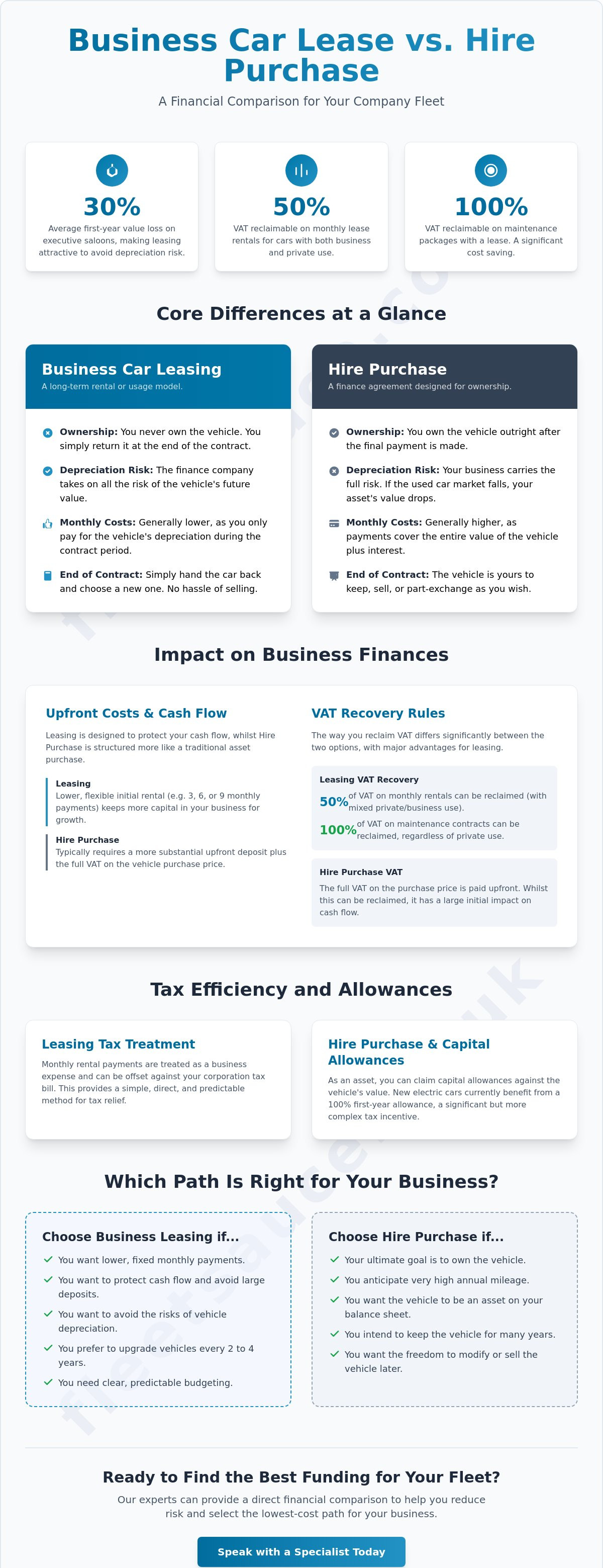
Executive saloons lose an average of 30% of their value in the first year alone, making the traditional dream of ownership feel more like a financial burden.
You've likely spent hours weighing up the business car lease vs hire purchase debate, trying to protect your cash flow whilst the 2026 ZEV mandate pushes your fleet towards electric power.
It's a complex choice that directly impacts your bottom line and your tax bill.
You deserve a clear path through the maze of VAT recovery and capital allowances. We'll show you how to identify the most cost-effective way to fund your vehicles, ensuring you don't miss out on the 4% Benefit-in-Kind rates or the 100% first-year allowances currently available for new electric cars.
Our goal is to demystify the numbers so you can decide with total confidence and precision.
We'll provide a direct financial comparison of both methods, focusing on how to reduce depreciation risk and select the lowest-risk path for your next fleet expansion in 2026.
Key Takeaways
- •
Learn how to reclaim up to 100% of VAT on maintenance whilst recovering 50% of your monthly rental costs when weighing up a business car lease vs hire purchase.
- •
Discover why the 30% first-year depreciation on executive cars makes leasing an attractive option for protecting your company cash flow.
- •
Understand the 2026 tax landscape, including the 4% Benefit in Kind rate for electric vehicles and how it influences your funding strategy.
- •
Compare capital allowances against monthly rental deductions to find the most tax-efficient route for your specific fleet requirements.
- •
Identify whether high annual mileage or a long-term desire for vehicle ownership makes hire purchase a more suitable fit for your business goals.
Table of Contents
- 01 Understanding the core differences between business car leasing and hire purchase →
- 02 Comparing the impact on business cash flow and VAT recovery →
- 03 Ownership and usage, and deciding what happens when the contract ends →
- 04 Tax efficiencies and capital allowances for modern UK businesses →
- 05 Choosing the right vehicle finance path for your company goals →
Understanding the core differences between business car leasing and hire purchase
Choosing between a business car lease vs hire purchase often comes down to your company's long-term philosophy on assets.
Business Contract Hire (BCH) operates as a pure usage model. You pay to use the vehicle for a set period, usually 2 to 5 years, then hand it back to the provider.
It is essentially a long-term rental that removes the burden of selling a depreciated asset when you are finished with it.
This lets your business stay agile and upgrade to the latest technology more often.
In contrast, Hire Purchase is a finance agreement designed to lead to full ownership. You pay for the entire value of the car over time.
This distinction is vital for SMEs because it changes how the vehicle sits on your balance sheet.
With leasing, the finance company takes the risk on what the car will be worth in the future. They own the vehicle, whilst you simply pay for its depreciation. With ownership, that residual value risk sits squarely with your business. If the used car market dips, your asset value falls too.
The mechanics of Business Contract Hire
Monthly rentals in a new business car leasing agreement are calculated by looking at the difference between the car's initial price and its predicted residual value. Because you only pay for this "slice" of the car's life, monthly costs are typically lower than other finance methods.
You never own the vehicle. This is a strict rule of Contract Hire. Accurate mileage estimates are essential here. If you exceed your agreed limit, you will face excess mileage charges because the car's value has dropped more than the funder expected. It is a highly predictable model for budgeting.
How Hire Purchase facilitates ownership
If you want to know What is Hire Purchase?, think of it as a traditional loan secured against the vehicle. You usually pay an initial deposit followed by fixed monthly instalments that cover the total cost plus interest.
Once you make the final payment and pay a small "option to purchase" fee, the legal title transfers to your business. It is a predictable path for those who want to keep their vehicles for many years.
However, it requires a higher monthly outlay than leasing and puts the responsibility for vehicle disposal on your shoulders at the end of the term.
Comparing the impact on business cash flow and VAT recovery
Cash flow is the heartbeat of your business. When you compare a business car lease vs hire purchase, the way your money leaves the bank account looks very different. Leasing is built for predictability.
You pay a set monthly fee that covers the use of the vehicle, making it much easier to forecast your monthly outgoings. Hire Purchase requires a different approach because you are paying for the whole asset.
This often leads to higher monthly costs and a different timing for your tax obligations.
Upfront costs and initial payments
Leasing offers incredible flexibility with your initial outlay. In a business car lease, you can often choose an initial rental equivalent to three, six, or nine months of the standard payment.
This keeps capital in the business, where it can be used for growth. Hire Purchase typically requires a larger deposit at the start.
Because you are buying the car, this method can put more strain on your credit lines and immediate cash reserves.
For many SMEs, the ability to keep cash in the bank while still driving a brand-new vehicle is the deciding factor.
VAT recovery and the 50% rule
VAT recovery is where the two methods diverge sharply. For VAT-registered businesses, you can reclaim 50% of the VAT on your monthly lease rentals if you use the car for both business and personal travel.
If you use the vehicle strictly for business purposes, you can reclaim 100%. It is also a major win that you can reclaim 100% of the VAT on maintenance elements, regardless of private use.
With Hire Purchase, the VAT treatment is less fluid. You must pay the VAT on the full purchase price of the car upfront.
Whilst you can usually reclaim this on your next VAT return, it creates a temporary hole in your cash flow. If you want official guidance on capital allowances, it is clear that owning the asset changes your tax position.
Explore our latest fleet management services to see which model suits your current budget and VAT status. We can help you weigh up whether the immediate VAT hit of Hire Purchase is worth the eventual ownership of the vehicle.
Ownership and usage, and deciding what happens when the contract ends
The final stage of your vehicle's life in the fleet often defines the true cost of your finance choice. When evaluating a business car lease vs hire purchase, consider your "exit strategy" from the start.
Leasing provides a clean break. You simply return the keys and move on to a newer, more efficient model.
Ownership through hire purchase requires you to manage the eventual sale or disposal of the vehicle, which brings its own set of administrative challenges and market risks.
For many UK businesses, the administrative burden of selling used cars is a significant deterrent. You have to worry about market fluctuations, finding buyers, and ensuring the vehicle has been maintained well enough to hold its value.
With the ZEV mandate requiring 33% of new car sales to be zero-emission vehicles by 2026, the used market for traditional combustion engines may become increasingly volatile. Leasing transfers this uncertainty to the finance provider, giving you a guaranteed future value from day one.
The hand back process and fair wear and tear
Returning a leased vehicle is straightforward, governed by the BVRLA fair wear and tear guidelines.
These industry-standard rules ensure you aren't penalised for minor scuffs or stone chips that occur during normal business use.
By following a proactive maintenance schedule, you can easily avoid end-of-lease charges.
This model is particularly effective for companies using fleet solutions to manage multiple vehicles. It enables a seamless vehicle-replacement cycle without the hassle of part-exchanges or private sales.
Equity and the balloon payment in Hire Purchase
Hire Purchase often involves a final "balloon" payment if you've opted for lower monthly instalments. This payment is a large lump sum required to officially transfer ownership to your business.
If the used car market is strong, your vehicle might be worth more than this balloon payment, leaving you with equity to put towards your next deposit. However, this is a double-edged sword.
With executive saloons losing 30% of their value in the first year, negative equity is a real risk. If the car is worth less than the final payment, your business must still find the cash to settle the debt.
This risk is particularly relevant as battery technology evolves in electric car leasing, potentially making older owned models less desirable.
Tax efficiencies and capital allowances for modern UK businesses
The 2026 tax landscape heavily rewards the transition to electric power. Benefit in Kind (BiK) tax for fully electric cars is set at just 4% for the 2026/27 tax year, providing a massive incentive for employees and directors alike.
When you weigh up a business car lease vs hire purchase, the tax implications for these electric vehicles are a game changer. While both methods offer tax relief, they affect your accounts in very different ways.
One focuses on immediate revenue deductions, whilst the other relies on capital allowances for owned assets.
Understanding these nuances helps you decide which route offers the best tax breaks in 2026. For many, the choice comes down to offsetting as much cost as possible against Corporation Tax.
Choosing the wrong path could lead to restricted relief or unexpected tax bills. We'll help you navigate these rules to ensure your fleet remains a financial asset rather than a liability.
Deducting lease rentals from taxable profits
Businesses can deduct 100% of their lease rentals from pre-tax profits if the car emits 50g/km or less.
This makes electric car leasing the gold standard for tax efficiency. If you choose a vehicle with emissions above this threshold, a 15% restriction applies to the amount you can claim.
This effectively means you only receive tax relief on 85% of the rental costs. Leasing is often simpler for SME accounting because the monthly payments are treated as a straightforward revenue expense. This avoids the complexity of tracking asset value and depreciation over several years.
Capital allowances and Hire Purchase
Hire Purchase allows you to claim capital allowances on the full value of the vehicle from day one.
For new electric vehicles, this means a 100% first-year allowance, which you can deduct from your taxable profits immediately. This is a powerful tool for businesses looking to reduce their tax bill in a single financial year. However, for non-electric cars, you must use writing-down allowances.
These are typically set at 18% for cars with emissions under 50g/km and just 6% for those above. Over the life of the contract, the total tax relief is often similar to leasing, but the timing of those savings varies significantly.
Explore our bespoke fleet tax guides to see how these rules apply to your specific company structure.
Choosing the right vehicle finance path for your company goals
Deciding between a business car lease and hire purchase requires looking beyond tax breaks and monthly rentals.
You must consider how your fleet operates day to day. If your drivers cover long distances, a lease's restrictions might feel like a straitjacket. Conversely, if you want to keep your company image fresh with the latest zero-emission models, ownership could leave you stuck with yesterday's technology.
Your choice should align with your 2030 sustainability goals and your immediate cash flow requirements.
We believe that every business is unique. A one-size-fits-all approach rarely works when balancing the needs of a mobile sales team against the requirements of executive directors. By looking at your total cost of ownership rather than just the initial price tag, you can ensure your fleet remains an engine for growth rather than a drain on resources.
Assessing mileage and technological change
High mileage businesses often find the certainty of Hire Purchase more appealing. When drivers cover over 20,000 miles annually, the risk of excess mileage charges in a leasing contract can outweigh the initial savings.
Ownership lets you keep the vehicle as long as you need without watching the odometer so closely. However, with the rapid evolution of battery range and charging speeds, leasing remains the safest way to upgrade to the latest EV technology every few years.
It ensures your business isn't left holding an obsolete asset as the UK moves towards the 2030 deadline for new petrol and diesel cars.
Streamlining fleet operations with FleetHub
No matter how you fund your vehicles, managing them efficiently is key to long-term success.
We provide fleet management software for SMEs called FleetHub to help you stay in control. This platform lets you monitor costs, track maintenance schedules, and keep every vehicle compliant. It bridges the gap between different finance methods, giving you a unified view of your entire operation.
At Fleetsauce, we don't just provide the finance. We act as your expert guide to help you choose the path that best fits your company culture.
Use this final checklist to help your decision:
- •
Do you want to avoid the risk of falling used car prices? (Leasing)
- •
Is your annual mileage consistently over 20,000 per car? (Hire Purchase)
- •
Do you need to keep capital free for other business investments? (Leasing)
- •
Is long-term ownership a priority for your company balance sheet? (Hire Purchase)
- •
Are you ready to transition to a 100% electric fleet to maximise tax breaks? (Leasing/Hire Purchase)
Future-proof your fleet strategy for 2026 and beyond
You now have the financial clarity to choose the best path for your company vehicles. Whether you prioritise the 100% first-year allowances of ownership or the VAT efficiencies and depreciation protection of leasing, your decision will shape your fleet's success.
Balancing the business car lease vs hire purchase debate is ultimately about matching your funding to your actual usage patterns and mileage requirements.
We are here to help you navigate these complex tax rules and logistical hurdles. Our team provides bespoke solutions for UK SMEs and large fleets, backed by our innovative FleetHub software for total oversight.
You can access expert advice on 2026 electric vehicle tax benefits to ensure you don't miss out on vital savings whilst transitioning to a greener future.
Contact the Fleetsauce team for expert fleet advice to start your journey today.
We look forward to helping you build a smarter, more cost-effective fleet for the future.
Frequently Asked Questions
Is business car leasing cheaper than hire purchase for small businesses?
Leasing typically offers lower monthly payments because you fund only the vehicle's depreciation, not its full value.
This makes it a popular choice for small businesses that want to preserve cash flow while driving newer models. Whilst hire purchase leads to ownership, it often requires a larger upfront deposit and higher monthly instalments.
The best choice depends on whether you value low monthly outgoings over the long-term value of an owned asset.
Can I claim the VAT back on a business car lease?
VAT-registered businesses can reclaim 50% of the VAT on monthly rentals for cars used for both business and private purposes.
If you use the car exclusively for business, you can reclaim 100% of the VAT. You can also reclaim 100% of the VAT on the maintenance portion of a contract regardless of private use.
This flexibility is a key factor when comparing a business car lease vs hire purchase for tax efficiency.
What is the main difference between Business Contract Hire and Hire Purchase?
The main difference is the eventual ownership of the vehicle. Business Contract Hire is a rental agreement where you return the car at the end of the term, with no further obligation.
Hire Purchase is a finance deal designed to transfer ownership to your business once you settle the final payment and option-to-purchase fee.
One focuses on mobility services, while the other focuses on building company assets.
Who is responsible for maintenance on a leased business car?
The business is responsible for ensuring the vehicle is maintained according to the manufacturer's schedule.
To simplify this, many companies opt for maintenance packages that cover servicing, tyres, and repairs for a fixed monthly fee.
This removes the risk of unexpected garage bills and ensures the vehicle meets the fair wear and tear standards required at the end of the lease. It gives busy fleet managers total peace of mind.
Can I end a hire purchase agreement early if my business needs change?
You can settle a hire purchase agreement at any point by requesting a settlement figure from the finance provider.
This involves paying off the remaining capital balance plus any applicable interest. This flexibility helps if your business needs change or you want to sell the vehicle earlier than planned. It gives you more control over the asset than fixed terms and early termination fees often found in leasing.
Does a business car lease appear on the company balance sheet?
Yes, under modern accounting rules, leased vehicles are typically recognised on the balance sheet as right-of-use assets.
This ensures transparency in financial reporting and shows the company's commitment to future payments.
Whilst it no longer offers the off-balance-sheet benefit it once did, the cash flow advantages of leasing remain a primary driver for UK fleet managers looking to avoid large capital outlays.
Are there mileage restrictions on hire purchase agreements?
Hire purchase agreements do not come with mileage restrictions because you are buying the vehicle.
This makes it an excellent option for drivers covering more than 20,000 miles per year who want to avoid the excess mileage charges associated with rentals.
When debating a business car lease vs hire purchase, your annual mileage is often the most important practical factor in deciding which finance route is most cost-effective for your fleet.
How does electric car salary sacrifice compare to business leasing?
Salary sacrifice is a specific form of electric car leasing where an employee pays for a vehicle out of their gross salary.
This results in significant tax and National Insurance savings for both the employer and the staff member. It is currently the fastest-growing fleet segment in the UK because it makes brand-new electric vehicles much more affordable than traditional finance methods.
It offers a unique way to provide employee benefits whilst reducing the company's carbon footprint.

Guide Verified & Audited By
Director at Fleetsauce
Not Sure Whether to Lease or Buy?
Our fleet specialists will compare business contract hire and hire purchase side by side for your vehicles, mileage and VAT position, so you can choose the most cost-effective route with confidence.
Why Choose Fleetsauce?
At Fleetsauce, we specialise in helping SMEs find the right car leasing solutions — not just the cheapest leasing deal.
With access to a wide range of leasing funders and hundreds of franchised dealerships across the UK, we find the best leasing deals and vehicle availability for your business and employees.
You’ll work directly with an expert dedicated account manager who understands the needs of companies — offering expert advice with a friendly, professional approach that you can always call directly.
With a five-star rating from Trustpilot, we are proud of our reviews and is evidence that we look after our new and existing customers.
Whether you're managing one vehicle or a fleet, we make business leasing simple, flexible, and cost-effective.


What our customers say...

Great service and great price setting up a Lease deal for my new BMW X5e. Matt and Luke on the ball for the supply and delivery within days of my initial enquiry. Thanks guys
Brilliant company to work with. Great prices and super helpful and efficient. Thank you to Matt, Luke & Steve for taking care of a glitch quickly and efficiently.

The car was standard, but took over 2 months to arrive and was nearly a month later than initially advised. When it did arrive it was filthy and there was no handover explaining the cars features.