
A finance lease is generally an agreement where your business rents a van over a fixed term while carrying much of the risk and reward linked to its eventual value.
Contract hire is a rental agreement too, but you normally return the van at the end, subject to the agreed mileage, its condition and the other terms you accepted.
That one difference shapes monthly cost, flexibility, administration and the size of any bill that may arrive after the van has finished its working life with you.
Choosing the wrong structure can leave a business facing a final payment it had not planned for, or return charges on a vehicle that was always going to work hard.
We'll show you how to compare the two fairly, covering payments, end-of-term choices, mileage and condition, maintenance, VAT, tax treatment and the questions to settle before signing.
The detail varies between funders, so treat the descriptions below as the usual pattern and check them against your own written quotation.
Key Takeaways
- •
Understand how a finance lease and contract hire differ on ownership, resale risk and what happens when the term ends.
- •
Compare the total expected cost of each option, including any final payment, maintenance and likely end-of-term charges.
- •
Identify how mileage, loading, bodywork changes and working conditions can point your business towards one structure or the other.
- •
Learn which VAT, capital allowance and accounting points to raise with your accountant before agreeing to either product.
- •
Discover the questions to put to a leasing provider so that two quotations can be judged on the same basis.
Table of Contents
How the Two Agreements Work
You may be replacing two tired vans before a busy season, with one quotation showing a lower rental and another looking simpler, and little to explain the gap.
Contract hire in plain terms
With business contract hire, the funder owns the van and you pay agreed rentals for a set term and mileage before handing it back.
The funder estimates what the vehicle will be worth at the end, and any gap between that estimate and the market value is then normally its problem rather than yours.
Finance lease in plain terms
With a finance lease, the rentals are usually structured to recover the cost of the van and finance charges, sometimes leaving a larger final payment known as a balloon.
At the end, a typical agreement lets you continue renting for a further period or arrange a sale to an unconnected buyer, with an agreed share of the proceeds returned to you.
Your business does not normally become the owner, so anyone who wants to own the van outright should ask about purchase products instead, including hire purchase.
If outright ownership matters to your directors, we would raise it at the very start, because it changes which products belong on the shortlist.
Payments and End-of-Term Risk
The monthly figure is only part of the cost, because the two agreements place the uncertainty about the final value of the van in different places.
Reading the monthly figure
A finance lease with a large balloon can show a modest rental, although the balance still has to be met from sale proceeds, further rentals or your own cash.
If the van sells for less than the balloon, your business may have to cover the shortfall, whereas a strong sale can leave money coming back under the agreement.
Comparing the whole term
Add together the initial payment, every rental, any final payment, maintenance, expected return charges and a realistic sale estimate, then decide which quotation is cheaper for your use.
We prefer to test a finance lease with both a cautious and an optimistic resale figure, so that directors can see the exposure before they commit.
Our whole life cost quotes are designed to bring those items together, which helps when two rentals look close but the terms behind them are quite different.
Mileage, Condition and Maintenance
How the van will be used often settles the argument more quickly than the finance theory, particularly where loads, sites and distances are demanding.
Mileage and fair wear
Contract hire normally sets an annual mileage, then charges for excess distance and assesses the returned van against a fair wear and tear standard, so honest estimates matter from the start.
A finance lease may avoid return charges of that kind, but heavy use and damage can reduce the sale price, which means the cost can still reach your business by another route.
Read our fair wear and tear guide before choosing, and photograph each van on delivery so that later conversations start from shared evidence.

Servicing and repairs
Maintenance can often be added as a separate monthly charge, giving a planned cost for the items listed in the agreement while leaving exclusions with your business.
We always suggest checking how tyres, glass, damage, breakdown cover and replacement vehicles are treated, since a package with the same name can include different things from different providers.
Our article on the maintained van lease looks at what to compare before you add it.
VAT, Tax and Accounting Points
Tax treatment depends on your business and the wording of the agreement, so we would involve your accountant before the choice is made rather than after delivery.
VAT and capital allowances
VAT-registered businesses can generally recover VAT on van rentals to the extent of business use, subject to the normal rules, evidence and any private or exempt use.
The 50% VAT block on car leasing applies to cars. For VAT, a double cab pick-up with a payload of one tonne or more is generally not treated as a car.
Direct tax is different, because since April 2025 HMRC has treated most double cab pick-ups as cars for Benefit-in-Kind and capital allowances.
Check the classification of any double cab or converted vehicle before ordering, including options on our pick-up leasing page.
Most leases of five years or less are likely to be short leases for capital allowance purposes, meaning the funder rather than your business usually claims the allowances.
Accounts and private use
The treatment under your reporting standard can affect how assets, liabilities and expenses appear in your accounts.
Under the revised FRS 102, for accounting periods beginning on or after 01/01/2026, most leases appear on the lessee's balance sheet, with exemptions for some short-term and low-value leases.
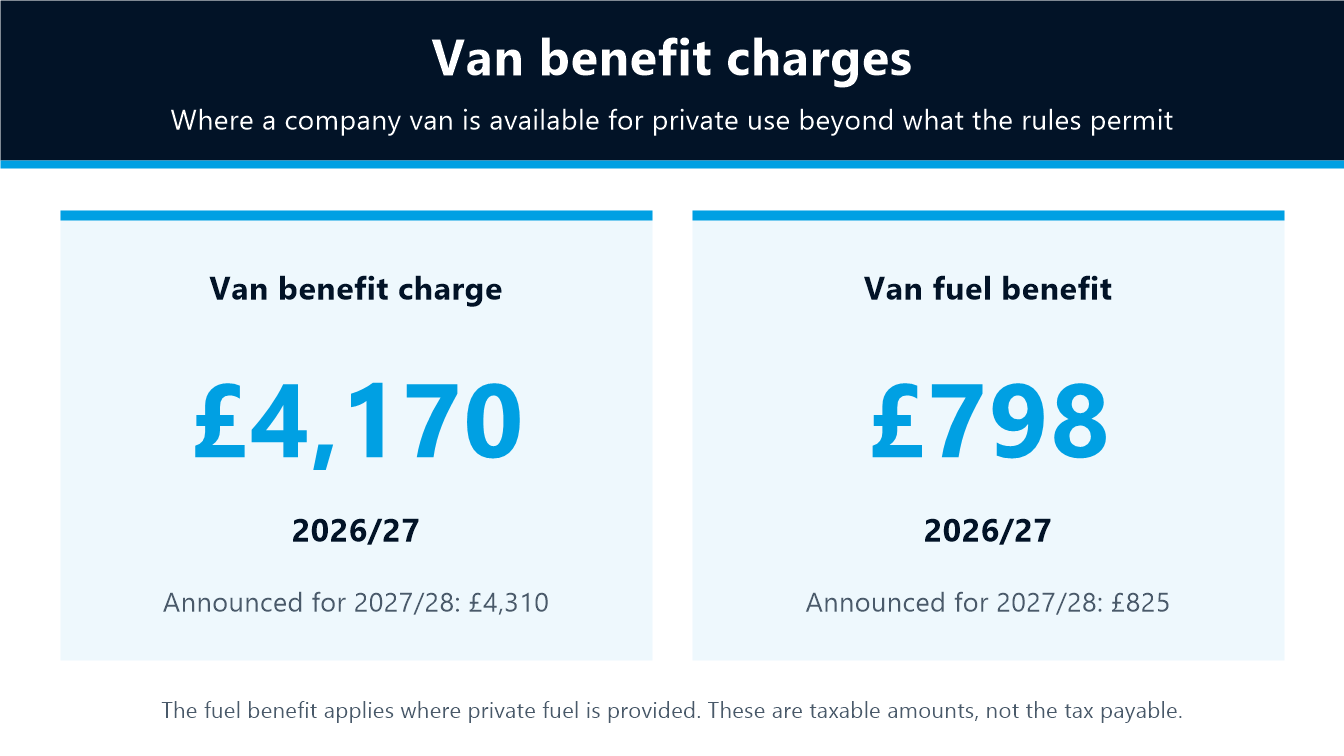
Where a company van is available for private use beyond what the rules permit, a van benefit charge of £4,170 applies for 2026/27, with £4,310 announced for 2027/28.
A separate van fuel benefit of £798 applies for 2026/27, with £825 announced for 2027/28, where private fuel is provided for such a van.
Record your private use policy and then check that drivers follow it.
Choosing for Your Van Fleet
The better option is the one that matches how long you keep vans, how hard they work and how much uncertainty your cash flow can comfortably carry.
When contract hire may suit
Contract hire tends to suit businesses that replace vans on a regular cycle, can estimate mileage reasonably well and would rather not manage disposal or carry the resale risk.
It also gives finance teams a steady rental to budget around, although excess mileage, damage and early termination can still add to the total.
If timing matters, our special offer vans are a practical place to start building a shortlist for your next contract.
When a finance lease may suit
A finance lease may suit vans with uncertain mileage, lasting alterations or unusually tough duties, provided your business understands the final payment and the possible shortfall.
Racking, specialist bodies and livery should be discussed with either funder in advance, since permission and removal terms can differ between agreements.
If you are considering electric models, our electric van leasing page is a useful place to start the range and charging conversation.
Our electric van lease guide goes further, while plug-in hybrid van leasing may suit mixed routes.
Planning Van Funding for 2026 and Beyond
Start with a written record of mileage, payload, body requirements and replacement timing, then ask for both products over the same term so that the comparison is fair.
Check who carries the resale value, what happens at the end, which costs sit outside the rental and how early termination is calculated if your contract work changes.
To see current options before your next order, browse our Ford van lease deals and Volkswagen van lease deals.
Frequently Asked Questions
What is the main difference between a finance lease and contract hire?
The main difference is who carries the resale value risk, with contract hire usually leaving it with the funder and a finance lease usually passing much of it to your business.
That affects the final payment, the choices at the end of the term and how much certainty you can build into a budget.
Do I own the van at the end of a finance lease?
Ownership does not normally pass to your business under a finance lease, although the agreement may allow further rentals or a share of the proceeds after a sale.
Ask for the end-of-term clauses in writing and read them carefully before signing.
Are there mileage charges on a finance lease?
Excess mileage charges are more closely associated with contract hire, although individual finance agreements can contain their own conditions about use and condition.
High mileage can still reduce the value achieved at sale, which may leave your business with less money back or a larger shortfall.
Can a business reclaim VAT on van lease rentals?
A VAT-registered business can generally recover it for business use under the normal rules, supported by valid invoices and records.
Private use, exempt activities and vehicle classification can change the answer, so confirm your position with an adviser.
Which option gives more predictable costs?
Contract hire usually gives a clearer picture because the resale risk sits with the funder, and a maintenance package can add further certainty for covered items.
Return charges and early termination costs remain possible, so include both of them in your planning.
Can I end either agreement early?
Early termination may be possible, but the charge depends on the agreement, the time left and the funder's calculation method.
Request an illustration before you sign, and a current figure before making any decision to hand a van back.

Guide Verified & Audited By
Director at Fleetsauce
Choosing How to Fund Your Business Vans?
Tell us how your vans work and we will help you compare business funding options over a matching term and mileage.
Why Choose Fleetsauce?
At Fleetsauce, we specialise in helping SMEs find the right car leasing solutions — not just the cheapest leasing deal.
With access to a wide range of leasing funders and hundreds of franchised dealerships across the UK, we find the best leasing deals and vehicle availability for your business and employees.
You’ll work directly with an expert dedicated account manager who understands the needs of companies — offering expert advice with a friendly, professional approach that you can always call directly.
With a five-star rating from Trustpilot, we are proud of our reviews and is evidence that we look after our new and existing customers.
Whether you're managing one vehicle or a fleet, we make business leasing simple, flexible, and cost-effective.


What our customers say...

Brilliant from start to finish, so helpful even finding a better deal than the one enquired for. Customer service so far is over and above!
Very helpful - found new Volvo V60 Ultimate on very good deal, much better than any garage I approached. Everything else from there was simple and well looked-after. Would highly recommend. Staff were very approachable ...
Excellent service, very friendly and reliable. Won't hesitate to use again.


