
Can you opt out of a salary sacrifice car scheme before the agreement has ended?
It may be possible, but your employment contract, the scheme rules and the lease behind the car decide what can happen and what it might cost.
Many drivers only ask when something at home changes, such as a new baby, a separation or a partner losing work, and by then the monthly figure matters a great deal.
Employers face the same question from the other side, because a change handled badly can create payroll errors, tax problems and a difficult conversation with a valued colleague.
We'll show you how to check your position, covering contract changes, qualifying life events, take-home pay, Benefit-in-Kind, minimum wage rules, pensions and the steps for making a request.
Everything below is general information for people with a company car through work, so confirm the detail with your payroll team or adviser before you act. Knowing the rules first should make that discussion shorter, calmer and fairer for everyone involved.
Key Takeaways
- •
Understand why leaving a salary sacrifice scheme means changing your employment contract rather than simply stopping a payroll deduction.
- •
Identify the lifestyle events that may allow a change, then check whether your own scheme rules actually include them.
- •
Compare the extra take-home pay with the loss of the car and any early exit charge before deciding.
- •
Learn how minimum wage limits, pension contributions and statutory payments can be affected by a change to your cash pay.
- •
Discover the practical steps for making a written request and agreeing an effective date that payroll can apply correctly.
Table of Contents
How the Contract Behind the Scheme Works
Salary sacrifice is an agreement to give up part of your cash pay in return for a non-cash benefit, in this case the use of a car.
A contract change in both directions
The arrangement is set up by changing the employment contract with the employee's agreement, and HMRC guidance expects the contract to be altered again with each later opt in or opt out.
The paperwork should be clear about cash and non-cash entitlements at every point, so a verbal agreement with a manager is a weak basis for changing anyone's pay.
Why timing matters
In our view, a change should be agreed before the pay it affects becomes due. HMRC expects evidence that it took effect at the right time, so do not apply it backwards.
If a sacrifice is not set up successfully, tax can be charged on the higher cash salary, which is why employers are careful about dates and signatures.
Our guide on explaining salary sacrifice to employees shows how to set those expectations before anyone signs.
When You May Be Able to Leave
Whether you can leave during the agreed term depends on the scheme your employer runs, because there is no single rule that gives every driver an exit on request.
Lifestyle events that can count
HMRC recognises that a change may be necessary where a lifestyle change significantly alters your finances, and arrangements can allow people to opt in or out for those reasons.
Examples include marriage, divorce, a partner being made redundant or a partner becoming pregnant, although your employer's own rules decide which events are written into the scheme.
Gather evidence early, so that the person reviewing your request can compare it with the rules without sending several rounds of follow-up questions.

The lease and any exit charge
The car is usually on a lease taken by the employer. Returning it early may then trigger a charge under that agreement or the scheme terms.
Some schemes include protection for events such as redundancy or long-term leave, while others pass part of the cost on, so ask for the wording rather than relying on colleagues.
Our article on end-of-lease charges covers the condition and mileage costs that can apply when any leased car goes back.
Check the fair wear and tear guide before the car is inspected, so you know what condition is expected.
What Happens to Your Pay and Tax
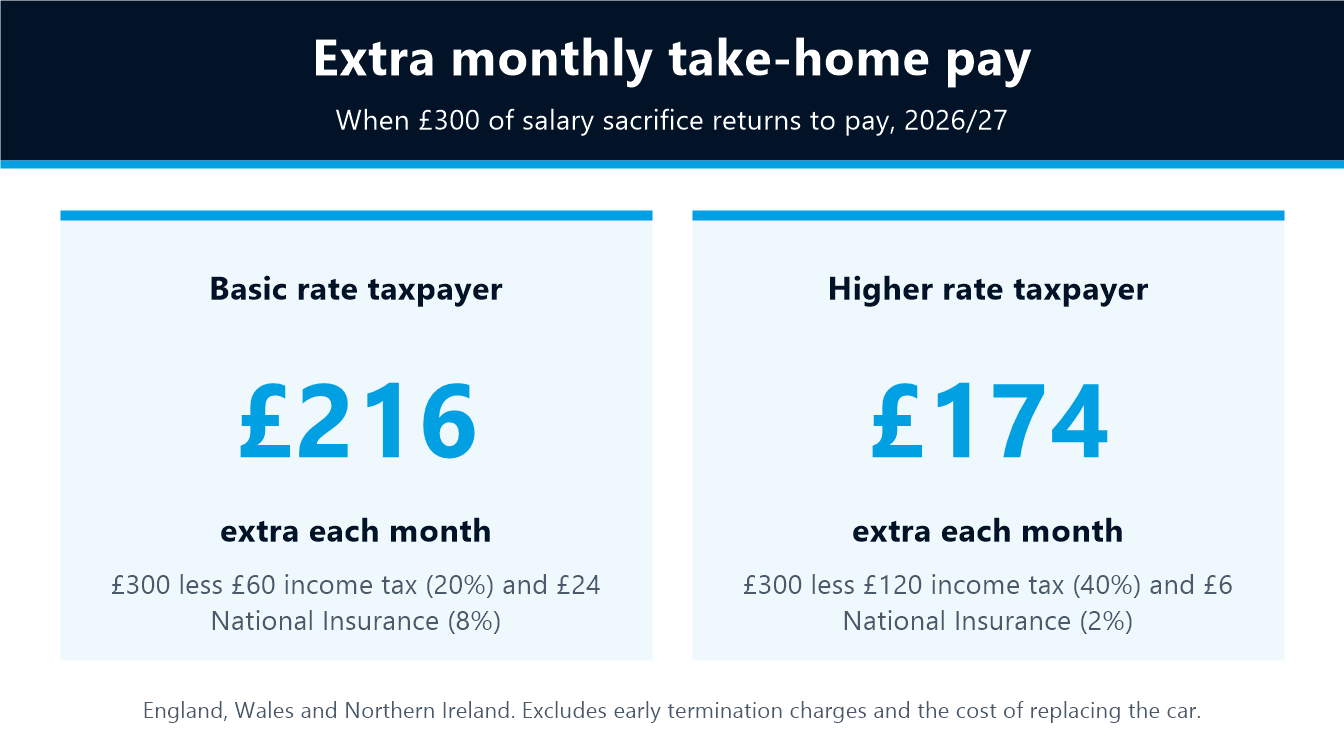
Leaving the scheme usually returns the sacrificed amount to your cash pay, which means income tax and National Insurance apply to it again.
A worked example for 2026/27
Take £300 a month returned to pay in England, assuming all of it falls within one tax band and nothing else about your earnings or deductions changes.
| Monthly figures | Basic rate | Higher rate |
|---|---|---|
| Cash pay returned | £300.00 | £300.00 |
| Income tax | £60.00 | £120.00 |
| Employee National Insurance | £24.00 | £6.00 |
| Extra take-home pay | £216.00 | £174.00 |
These figures use 20% or 40% income tax and National Insurance at 8% or 2%, while Scottish taxpayers face different income tax rates and bands and need their own calculation.
Earnings above £100,000 also reduce the personal allowance, so higher earners may see a different effect and should ask payroll for an individual illustration.
Benefit-in-Kind when the car goes back
You stop having a company car benefit for the period when the car is no longer available, which reduces the tax collected on it for that year.
For a zero-emission car with a £35,000 list price, the 4% rate for 2026/27 gives a £1,400 benefit, costing £280 a year at basic rate or £560 at higher rate.
A temporary absence is treated differently, since days of unavailability only reduce the charge when they fall within a continuous period of at least 30 days.
Our company car tax guide shows how the charge is worked out and why list price matters.
Employers can also read about the BIK and P11D changes from April 2027 when planning payroll.
Wider Effects to Check Before Deciding
Pay and the car are the obvious changes, but minimum wage compliance, pensions and statutory payments deserve a look before you settle on a date.
Minimum wage protection
A salary sacrifice must not take cash earnings below the National Minimum Wage, which from April 2026 is £12.71 an hour for workers aged 21 or over.
The rate is £10.85 for ages 18 to 20 and £8.00 for under-18s and apprentices, so a cut in hours can leave an existing sacrifice too large and require action by your employer.
Pensions and statutory pay
Salary sacrifice can affect statutory payments and some contribution-based benefits. Statutory Maternity Pay, for example, requires average weekly earnings of at least £129 in the qualifying period.
Statutory Sick Pay has had no minimum earnings test since 06/04/2026, although lower average earnings can still reduce the weekly amount.
Your employer decides how the workplace pension treats the sacrifice, often by basing contributions on the higher notional salary, so ask which figure your scheme uses.
Leaving a car scheme is separate from leaving a pension, which has its own opt-out process, a refund window of one month from joining and rules about rejoining.
Our article on salary sacrifice and pensions looks at that relationship in much more detail.
How Employers Should Handle an Opt-Out
Employers protect themselves and their staff by deciding how exits will work before the first request arrives, and by recording each decision in the same way every time.
Our salary sacrifice guidance for decision makers is a useful starting point when planning the process.
Set out the rules in advance
Name the qualifying events, the evidence required, the person who approves a change and the way any lease charge will be calculated and shared between the business and the driver.
We would put those points on a single page and give it to every applicant, so that nobody discovers an important condition for the first time after the car has arrived.
Process the change through payroll
Once a request is approved, update the contract, agree the effective date, check minimum wage compliance and record the vehicle return, then confirm the new pay figures to the employee in writing.
Plan what happens to the returned vehicle as well, since reallocating it to another eligible driver may be possible under your lease and could reduce the cost of an early exit.

Making Your Request in 2026 and Beyond
Start by reading the scheme rules and your contract variation, then write to HR with the reason, the evidence you hold and the date from which you would like the change to apply.
Ask for the exit charge, a revised pay illustration, the pension effect and the vehicle return arrangements in writing, and avoid handing back the car until the terms are agreed.
We think employers should publish this process, and name who approves exceptions, before the first driver joins, because surprises damage trust far more than firm rules do.
Companies designing a new arrangement can use our small business eligibility checklist to cover these points from the outset.
Frequently Asked Questions
Can my employer refuse to let me leave the scheme?
It may be able to where the scheme rules and contract do not provide an exit for your situation, so read both documents before assuming a right exists.
Ask for the decision and the rule behind it in writing, and consider independent advice if you believe the terms have been applied wrongly.
What counts as a lifestyle event?
HMRC examples include marriage, divorce and a partner being made redundant or becoming pregnant, where the change significantly alters your financial circumstances.
Your scheme may describe its own list and evidence requirements, and a general wish to save money might fall outside them.
Will I pay a penalty for leaving early?
A charge can apply under the lease or scheme terms, and its size depends on the agreement, the time remaining and any protection your employer has arranged.
Before committing, we would ask for the calculation and the date on which the quoted figure expires.
Does opting out affect my workplace pension?
It can change the pay figure used for contributions, depending on how your employer treats salary sacrifice, but it does not by itself remove you from the pension.
Ask payroll to show you the contribution before and after the change, so that you can compare the two figures.
Can I join again later?
Rejoining depends on your employer's rules, and a new contract change would be needed before the new sacrifice takes effect.
A fresh car order is then likely to be priced on whatever lease terms are available at that later date.
When does Benefit-in-Kind stop after the car is returned?
The charge reflects the period when the car is available to you, so payroll needs the actual return date and the end of any entitlement.
Check your tax code afterwards, because any adjustment to the amount collected may take a little time to appear on your payslip.

Guide Verified & Audited By
Director at Fleetsauce
Reviewing a Salary Sacrifice Car Scheme?
Speak to our team about scheme design, driver information and what should happen when somebody needs to leave early.
Why Choose Fleetsauce?
At Fleetsauce, we specialise in helping SMEs find the right car leasing solutions — not just the cheapest leasing deal.
With access to a wide range of leasing funders and hundreds of franchised dealerships across the UK, we find the best leasing deals and vehicle availability for your business and employees.
You’ll work directly with an expert dedicated account manager who understands the needs of companies — offering expert advice with a friendly, professional approach that you can always call directly.
With a five-star rating from Trustpilot, we are proud of our reviews and is evidence that we look after our new and existing customers.
Whether you're managing one vehicle or a fleet, we make business leasing simple, flexible, and cost-effective.





What our customers say...

Brilliant from start to finish, so helpful even finding a better deal than the one enquired for. Customer service so far is over and above!
Very helpful - found new Volvo V60 Ultimate on very good deal, much better than any garage I approached. Everything else from there was simple and well looked-after. Would highly recommend. Staff were very approachable ...
Excellent service, very friendly and reliable. Won't hesitate to use again.


